The cult Japanese independent that turns time into a mechanical sculpture
Introduction
In the hyper-saturated world of independent watchmaking, few names command the same hushed reverence as Otsuka Lotec. Founded by self-taught watchmaker Jiro Katayama, the brand has become synonymous with a singular aesthetic: retro-futuristic dials that look like they were pulled from a 1970s sci-fi film, but built with the obsessive precision of a modern artisan. The № 7.5, the latest evolution in Katayama’s numbered series, is the purest expression of that vision yet.
This is not a watch for the faint of heart. It is a statement piece that defies convention at every turn — from its unorthodox time display to its deliberately scarce production. Otsuka Lotec does not chase mass appeal; it creates objects of desire for collectors who want something no one else at the dinner table will be wearing. The № 7.5 sits at the intersection of horology, industrial design, and pure whimsy.
In this review, we break down what makes the № 7.5 tick, how it wears on the wrist, and whether the hype surrounding Otsuka Lotec is justified — or just another flash in the independent watch pan.
Manufacture History
Otsuka Lotec was founded in 2012 by Jiro Katayama, a former product designer who turned to watchmaking without formal training. Based in Tokyo, the brand produces extremely limited runs of hand-assembled watches, often using modified base movements topped with bespoke modules. Katayama's designs blend mid-century industrial aesthetics with a playful, almost steampunk approach to time display, earning a cult following among collectors who value originality over tradition.
The name "Lotec" is a nod to low technology — a deliberate contrast to the high-tech precision of mainstream Swiss watchmaking. Katayama embraces the imperfections and tactile nature of mechanical objects, creating watches that feel alive rather than sterile. Each piece is assembled by hand, and production numbers are so small that most collectors will never see one in person outside of social media.
Movement
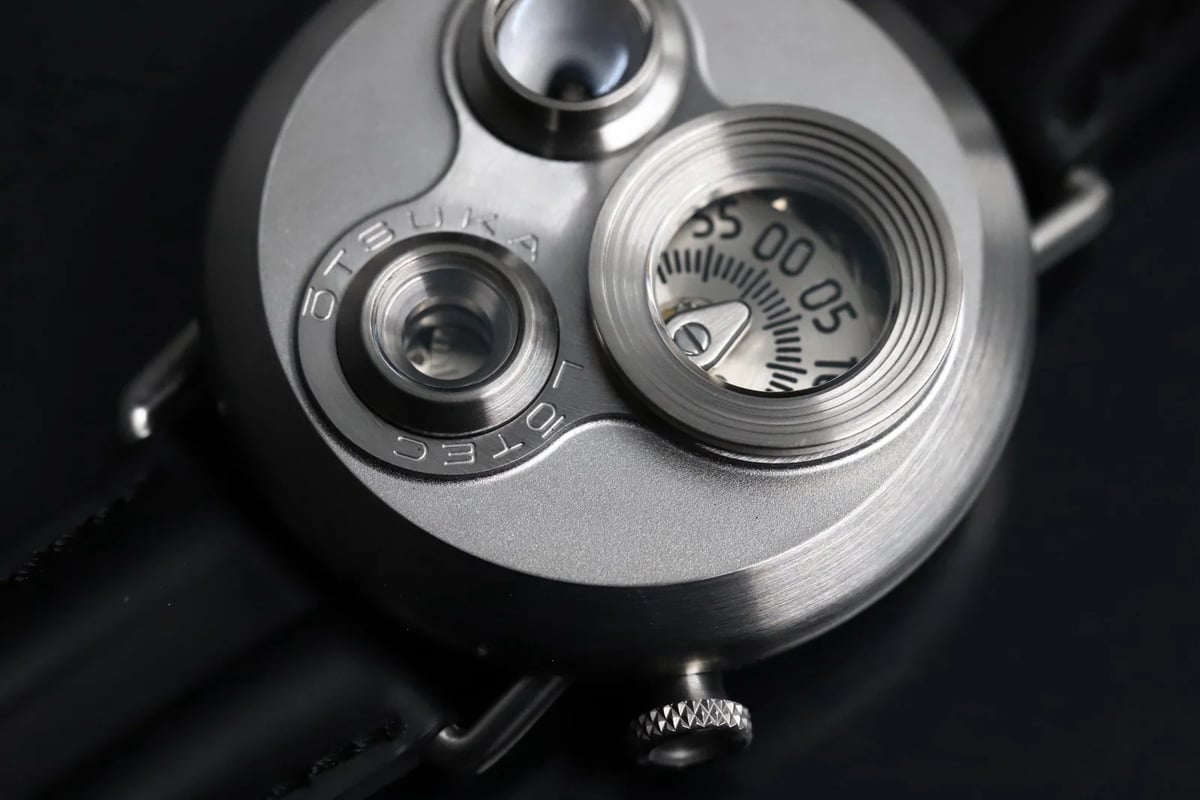
The № 7.5 uses a custom-modified automatic movement, though the base caliber remains undisclosed. Katayama starts with a reliable Japanese automatic — likely from a mainstream manufacturer — and then extensively reworks the top plate to accommodate his proprietary module. This module drives the watch's signature display: a jumping hour, retrograde minutes, and a rotating disc that together replace traditional hands.
Power reserve is approximately 40 hours, and the movement beats at a standard frequency typical of its base. Finishing is industrial rather than decorative, with an emphasis on function over flourish. The watch is not chronometer-certified, and accuracy is acceptable but unremarkable — expect ±10 to ±20 seconds per day. For Katayama, the movement is a canvas, not the art itself.
Case and Design
The case of the № 7.5 is crafted from stainless steel and topped with a sapphire crystal. Exact dimensions are not officially published, a common trait among independent makers who prefer to let the watch speak for itself. The case is compact by modern standards, with a rounded profile that sits close to the wrist. The absence of a traditional handset allows the dial to sit unusually close to the crystal, creating a flat, instrument-like appearance.
The dial is a masterpiece of layered information. At the center, a rotating disc displays the minutes in bold typography, while a separate window shows the hour. Accents in red and black add a utilitarian, almost military flavor. There is no lume, reinforcing the idea that this is a watch for daylight appreciation, not covert operations.
Wrist Feel
On the wrist, the № 7.5 is surprisingly comfortable. The compact case hugs the wrist without feeling top-heavy, and the supple leather strap keeps everything in place. Weight is moderate — substantial enough to feel premium, but not so heavy that it becomes a burden during a full day. Because the dial is so visually engaging, you may find yourself glancing at it far more often than you actually need the time.
Legibility requires a deliberate look. The unconventional layout is not instantly readable in the way a three-hand watch is, but that is part of the charm. This is a watch you wear to appreciate, not to time a sprint. For a night out or a creative workspace, it is perfect.
Accuracy
Owners report real-world accuracy in the range of ±10 to ±20 seconds per day, typical for an undecorated base automatic. The watch is not chronometer-certified and makes no pretense of being a precision instrument. Expect to reset the time every few days if you are particular about drift. Given the artistic intent, most owners accept this trade-off without complaint.
Occasions
The № 7.5 is best suited for daily wear in environments where individuality is valued — creative offices, gallery openings, or casual dinners. It can be dressed up with a formal outfit, but the lack of lume and the playful dial keep it from being a true dress watch. It is not a sports watch, so keep it away from water.
Wrist Presence
Wrist presence is a full 5 out of 5. The № 7.5 commands attention instantly. The layered discs and bold typography read as a piece of kinetic art, not a conventional timepiece. Even from across a room, it signals that the wearer has taste beyond the mainstream. If you wear this watch, be prepared to answer questions.
Reference Variants
The primary reference is the № 7.5 with a silver-white dial and black or brown leather strap. Occasional limited-run variations may alter accent colors or strap options, but these are exceedingly rare and often sell out within minutes of announcement.
Family References
The № 7.5 sits within a numbered series that includes the № 6 and № 7, each with its own distinct time display. These models share Katayama's retro-futuristic language but differ in dial layout and module design. Collectors often seek to complete the set, though doing so is a years-long endeavor.
Similar Watches
For those drawn to the № 7.5, a few other Japanese independents offer comparable originality. Kurono Tokyo's Chrono 2 shares the retro-modern aesthetic and limited production. Naoya Hida's Type 1B delivers hand-finished craftsmanship with restrained, sculptural design. At the very top, Hajime Asaoka's Project T represents ultra high-end Japanese independent watchmaking with similar scarcity-driven appeal.
Investment Value
Otsuka Lotec does not publish retail prices, and allocations are typically handled through lotteries or direct relationships. On the secondary market, pre-owned examples of the № 7.5 have sold in a range of roughly $4,000 to $9,000, depending on condition and provenance. The trend is appreciating as awareness grows, but liquidity is poor — these watches do not trade hands frequently.
For a discerning buyer, the price buys originality, hand assembly, and true rarity. It does not buy haute horlogerie finishing or brand prestige. If you buy one, plan to keep it long-term.
Service Interval
Service intervals are not officially specified, but a standard automatic movement should be serviced every 4 to 6 years. Costs vary widely depending on the watchmaker's familiarity with custom modules. Otsuka Lotec recommends service through the brand directly or a qualified independent familiar with modified movements.
Pros and Cons
Pros: Completely unique time display; hand-assembled in extremely limited numbers; strong cultural cachet among collectors; comfortable, wearable case.
Cons: Nearly impossible to buy at retail; no official specifications or service network; accuracy is mediocre by modern standards; resale liquidity is poor.
Final Verdict
The Otsuka Lotec № 7.5 is not a watch for everyone — and that is precisely the point. It is a wearable piece of design philosophy that rewards patience and curiosity. If you can find one, buy it to keep, not to flip.