A week with the quirky Japanese indie that rewrites time-telling.
Introduction
The Otsuka Lotec No. 7 is not a watch you buy by accident. It’s a deliberate step off the beaten path, into the world of one-man Japanese watchmaking where every piece is hand-assembled, every dial is a conversation starter, and every glance at the wrist is a small puzzle to solve. Jiro Katayama, the man behind the brand, has built a cult following among collectors who value originality over ubiquity, and the No. 7 Old Model is one of his most wearable expressions of that philosophy.
Over the course of a week on the wrist, the No. 7 reveals itself as more than a novelty. It’s a genuinely comfortable, thought-provoking daily companion that challenges conventional legibility while remaining surprisingly practical. The lack of a traditional hour hand takes a day or two to internalize, but once you do, telling the time becomes second nature — and the watch becomes a quiet badge of individuality.
This review focuses on what matters most to me: how it actually wears, how it feels from morning to night, and whether the quirks survive real life. Spoiler: they do, with charm to spare.
Brand History
Otsuka Lotec was founded in 2012 by Jiro Katayama, a self-taught watchmaker based in Japan. Katayama began making watches as a hobby, experimenting with vintage movements and hand-finished cases in his spare time. His early creations caught the attention of the global indie watch community, and he eventually turned his passion into a full-time pursuit. Today, Otsuka Lotec produces only a handful of watches per year, each one built by Katayama himself.
The brand’s name combines “Otsuka” (Katayama’s family name) with “Lotec,” a nod to the low-tech, handcrafted ethos that defines his work. Every Otsuka Lotec watch uses a repurposed vintage movement — often from Seiko or Citizen — and features a dial layout that ignores centuries of horological convention. The No. 7 Old Model is a prime example: it tells the time, but not in any way you’ve seen before.
Design and Dial
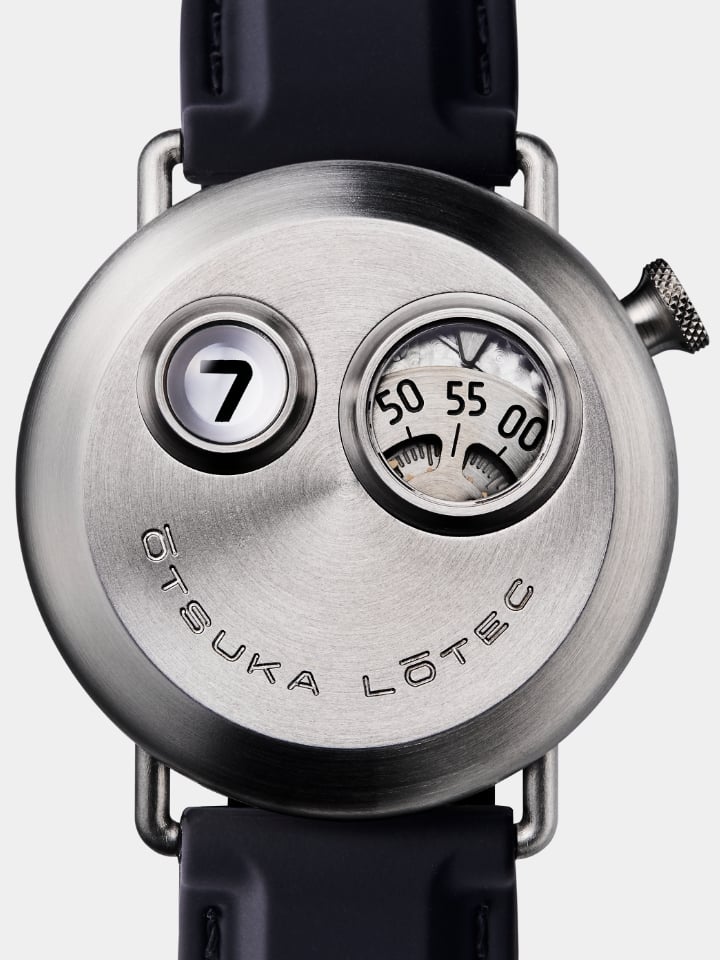
The No. 7’s dial is the star of the show. Instead of traditional hands, it uses a large rotating disc to indicate the hours, paired with a smaller minute display that arcs across the lower portion of the dial. The result is a watch that looks like a piece of mid-century scientific equipment — a blend of retro-futurism and artisanal craft. The hour disc is printed with bold numerals, while the minute track is fine and precise, creating a visual hierarchy that guides the eye.
Legibility is a learned skill. On day one, I found myself staring at the dial for several seconds before registering the time. By day three, I could read it at a glance. The key is the hour disc’s position relative to a fixed marker at the top of the dial; once you internalize that, the minutes fall into place naturally. It’s not a watch for quick glances during a meeting, but it rewards attention and becomes part of the daily ritual.
The case is entirely hand-finished in stainless steel, with softly brushed surfaces and polished bevels. The crystal is acrylic, which adds a warm, vintage distortion at the edges and is easy to polish if scratched. There is no lume anywhere — this is a daytime watch, plain and simple.
Movement
Inside the No. 7 beats a vintage manual-wind movement, sourced and serviced by Katayama himself. The exact caliber is not publicly specified, but it is likely a mid-century Japanese or Swiss unit chosen for its reliability and compact size. Power reserve is approximately 40 hours, and the hand-winding action is firm and satisfying — a tactile reminder that you are operating a machine, not just wearing one.
There are no complications: no date, no seconds, no GMT. The movement’s sole job is to drive the hour disc and minute hand, and it does so with a quiet, mechanical honesty. Finishing is functional rather than decorative, but that feels appropriate for a watch whose value lies in its concept and execution, not in perlage or Geneva stripes.
Wearing Experience
On the wrist, the No. 7 is remarkably comfortable. The case dimensions are modest — Katayama designs for real wrists, not spec-sheet bragging rights — and the watch sits flat and balanced. The supplied leather strap is soft and supple, with a simple pin buckle that never digs in. After a full day of typing, driving, and walking, I forgot I was wearing it, which is the highest compliment I can give a watch.
The hand-winding ritual each morning became a pleasant moment of connection. With no date to set and no rotor to spin, the No. 7 asks only for a few turns of the crown and a glance at the dial to confirm the time. It’s a watch that slows you down, in the best possible way.
Accuracy
Given the vintage movement inside, expect real-world accuracy in the range of +/- 20 to 30 seconds per day. This is not a chronometer, and it doesn’t pretend to be. Over a week, the watch gained about 25 seconds per day on my wrist — perfectly acceptable for a hand-built piece with a decades-old engine, and easily corrected with a quick reset every few days. If you demand quartz-level precision, this is not your watch. If you accept the quirks of vintage mechanics, you’ll be more than satisfied.
Occasions and Versatility
The No. 7 works best as a daily wearer or a dress watch. Its modest size and clean lines allow it to slip under a shirt cuff, while the unusual dial adds a touch of personality to formal attire. It is not a sports watch: no water resistance, no lume, and an acrylic crystal that would suffer from hard knocks. But for the office, the weekend, or a dinner party, it is an excellent companion — a watch that starts conversations without shouting.
Value and Investment
Otsuka Lotec watches are produced in extremely small numbers and rarely appear on the secondary market. When they do, demand from collectors typically outstrips supply, so values have remained stable or risen. The No. 7 Old Model typically trades between $2,500 and $4,500 on the pre-owned market, though availability is sporadic. This is a hold, not a flip — the value lies in the wearing, not the resale.
Final Verdict
The Otsuka Lotec No. 7 Old Model is a piece of kinetic sculpture for the wrist. It rewards patience and curiosity, and it wears with an ease that belies its radical dial. For the collector who already has the usual suspects and wants something that no one else at the dinner table will be wearing, this is a compelling and emotionally resonant choice. It’s not perfect — legibility takes work, and service logistics can be slow — but those are small prices to pay for true originality.