The Submersible that actually goes to 1,000 metres
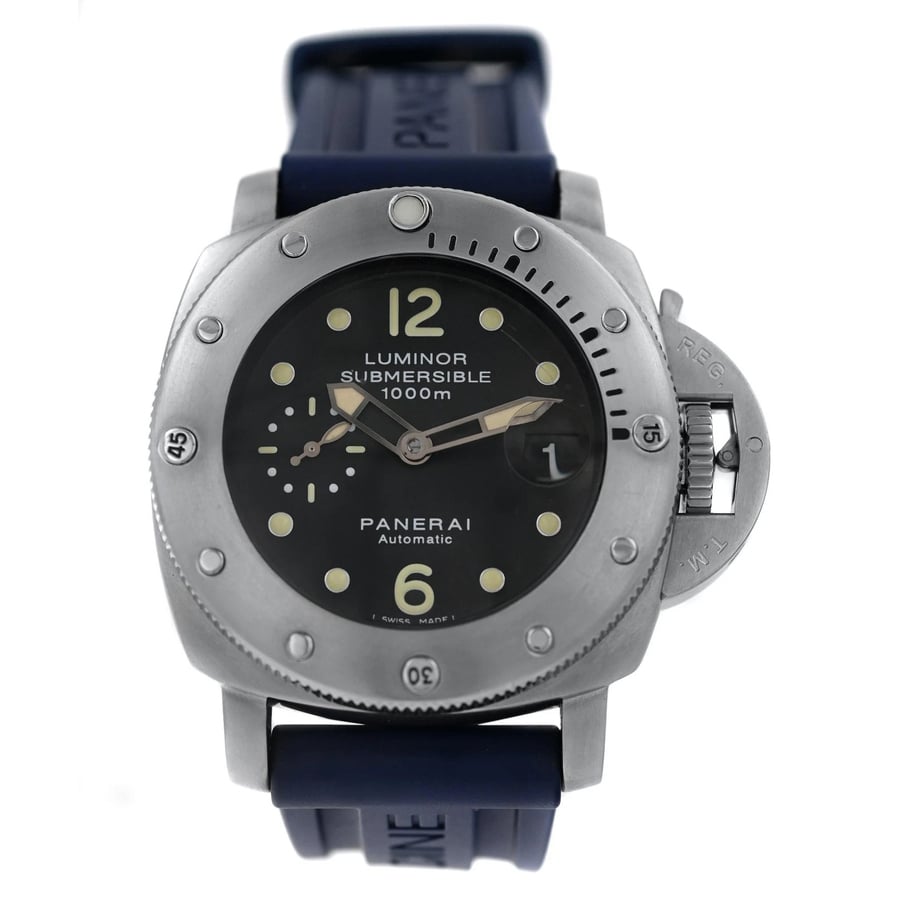
Most dive watches are rated to 300 metres, which is roughly 100 metres more than any recreational diver will ever see and about 270 metres more than they will ever need. The Panerai Luminor Submersible 1000M is not that watch. Its rating — 1,000 metres, printed plainly, no marketing asterisk — puts it in the small club of production divers built for saturation work, commercial diving, and the kind of pressure that turns a caseback into a liability.
What makes it interesting is not the number. It is that Panerai got there without abandoning the things that make a Panerai a Panerai: the cushion case, the crown-protecting bridge, the sandwich dial, the sense that you are wearing an instrument rather than an accessory. The 1000M is a Submersible first and a deep diver second, and that ordering matters.
This is the watch you buy when you have decided your dive watch should have a genuine engineering brief — and when you want it to look like it came off a bridge deck in La Spezia rather than out of a boardroom in Geneva.
Panerai, briefly: from Florence to the seabed
Giovanni Panerai opened his workshop in Florence in 1860, and the family business spent the following decades supplying precision instruments to the Italian navy. That relationship is the origin story of everything Panerai sells today. The Radiomir of 1936 — a luminous dive watch built for frogmen of the Regia Marina — and the Luminor of 1950, with the lever-locked crown bridge Panerai patented in 1956, are the two DNA strands running through the modern catalogue.
The company was acquired by the Richemont group in 1997 and spent the next two decades converting military tooling into luxury product. In 2019, Panerai spun Submersible out as its own collection, which is a corporate way of saying the dive watches now stand on their own, without the Luminor or Radiomir prefix doing the heavy lifting.
The 1000M sits at the top of that collection's depth ladder. It is the model Panerai points to when someone asks whether the Submersible line is still about diving or has become about lifestyle. The answer, at 1,000 metres, is unambiguous.
What 1,000 metres actually buys you
Depth ratings are strange things. A 300-metre rating is already absurd overkill for anyone who is not a professional, and the industry knows it — which is why so many dive watches are effectively jewellery with a bezel. A 1,000-metre rating is different in kind, not just degree. It implies a crystal thick enough not to deform under load, a caseback engineered for real compression, a crown assembly that seals reliably under the torque of a lever-locked bridge, and a case architecture with no weak points.
Panerai's crown-protecting bridge — that horseshoe-shaped guard with the locking lever — was designed for exactly this problem, and it remains one of the few genuinely functional pieces of watch design that also happens to be instantly recognisable. On the 1000M it is not decoration. It is the mechanism that lets the watch make its claim.
The movement: Panerai P.9010
Inside is Panerai's in-house P.9010, an automatic calibre developed and built at the brand's manufacture in Neuchâtel. It is the workhorse of the modern Submersible line — the same architecture that has powered the smaller Submersibles and the 47mm steel models — and it is a sensible choice here for one reason above all others: it is slim enough and robust enough to live inside a case that has to survive a kilometre of seawater.
Specification-wise you get a three-day power reserve, a balance running at 4 Hz, and a date at three o'clock paired with small seconds at nine. The two-register layout is pure Panerai: asymmetric, legible, and slightly contrary to what everyone else does with an automatic dive watch. A single mainspring barrel would have been simpler; Panerai's approach gives the calibre a longer, flatter torque curve, which is why the three-day reserve holds up rather than collapsing in the final twelve hours.
Finishing is industrial rather than decorative — brushed bridges, a signed rotor, nothing you would mistake for haute horlogerie. That is appropriate. This is a movement designed to be serviced and to keep time, not to be photographed through a display back. It is not visible anyway: the 1000M uses a solid titanium caseback, which is the correct call on a watch rated to this depth.
One thing to note: Panerai does not submit the P.9010 for COSC certification. There is no chronometer certificate in the box, and the brand makes no claims about daily rate beyond its own internal testing standards. In a category where Omega and Rolex both lean hard on certification, that is a deliberate omission — and one you should factor into what you are paying for.
Case, crystal, dial
The case is titanium, which is the right material for a watch this size. Titanium is roughly 40 percent lighter than steel for the same volume, and on an oversized dive case that difference is not academic — it is the difference between a watch you wear all day and a watch you take off after lunch. It also resists corrosion in salt water, which matters more than most owners will ever admit.
A sapphire crystal sits over a classic Panerai sandwich dial: a black base layer with cut-outs, and a luminous upper layer showing through. The lume is Super-LumiNova, applied generously to the hour markers and the broad hands. In low light it is a proper tool-dial glow — the kind you can read from across a dark room, which is exactly the point. The dial is also refreshingly uncluttered. No text blocks, no depth-rating essays, no sub-dials competing with the indices. Panerai has always understood that legibility is a design decision, not an accident.
The watch is delivered on a rubber strap with a pin buckle. That is the correct specification for the brief: rubber does not degrade in seawater, does not hold grit, and does not need to be babied. Panerai's rubber is thicker and more sculpted than most, with a pronounced taper that visually anchors the case. The trade-off is that there is no factory bracelet option, so if you want metal you are going aftermarket.
On the wrist
Let us be direct: this is a large watch. The Submersible case is a cushion, and cushions read bigger than their measurements because there is no bezel-to-lug transition to break up the mass. On a 1000M the bezel is broad, the crown guard protrudes, and the whole assembly sits high on the wrist. If you are used to a 39mm sports watch, this will feel like a different category of object — because it is.
Titanium is what saves it. Pick it up expecting steel-density heft and you will overshoot; the case all but disappears on the wrist in a way a steel version of the same watch never would. The rubber strap does most of the balance work, keeping the head from rolling. Larger wrists — call it seven inches and up — will find it sits flat and stays put. Smaller wrists will find the crown guard pressing into the back of the hand, and no strap change fixes that.
The other consideration is height. A 1,000-metre case is thick by definition, and this one is no exception. It clears a shirt cuff only if the cuff is generous, and it will catch on knitwear. This is not a watch that hides.
Presence, then, is the whole point. If you want a dive watch that reads as serious from ten feet away, the 1000M delivers. If you want something that disappears under a sleeve, look at a smaller Submersible instead.
Accuracy in the real world
Without a chronometer certificate, the honest answer is: expect a few seconds a day either side of zero, and expect that number to move with how you wear it. The P.9010's three-day reserve means the watch spends a lot of its life at partial wind if you rotate it, and rate consistency suffers at low torque. Wear it daily and it settles into a rhythm; wear it twice a week and you will be resetting it every time.
Practically, that is fine. Nobody is timing a decompression stop with a wristwatch. What matters more is positional stability — the P.9010 is a modern, well-regulated automatic, and the variance you will notice is measured in seconds per day, not minutes per week. If you want certified rate performance, this is the wrong watch; if you want a three-day automatic that keeps honest time, it is the right one.
Where it fits
Sport, obviously. Daily wear, if your daily wear tolerates a big titanium cushion case. Travel, because a three-day reserve and a date window are genuinely useful on the road, and because a rubber strap does not care about airport security or hotel pools.
Not formal. Not dress. A 1,000-metre dive watch with a rubber strap and a protruding crown guard does not belong under a dinner jacket, and Panerai makes other watches that do.
Family and variants
The 1000M's closest relatives are the rest of the Submersible line. The 300-metre steel Submersibles — the PAM01305 being the best known — are the everyday siblings: same case language, same crown bridge, less extreme depth rating, more conventional weight. The smaller Submersible references (PAM00682 and its kin) are the wearable end of the family, and the ones most people should actually buy. The Amagnetic PAM00389 and the BMG-Tech PAM00692 are the technical curiosities — titanium and bulk-metallic-glass experiments that show where Panerai's materials research has been pointed.
The 1000M is the outlier. It exists because the brand wanted to prove the line could still go deep, and because there is a specific kind of collector who will pay for that proof.
What else to consider
- Rolex Deepsea — the reference point for deep divers, with a depth rating that dwarfs the Panerai's and a resale curve that embarrasses it. It is also heavier, more conventional, and considerably more expensive on the secondary market.
- Omega Seamaster Planet Ocean 600M — a coaxial movement, a ceramic bezel, and a depth rating that is more than enough for anyone. The Omega is the more technically modern watch; the Panerai is the more characterful one.
- Blancpain Fifty Fathoms — the original modern dive watch, and the one to buy if you want the historical claim rather than the depth claim. Priced well above the Panerai.
- Tudor Pelagos — titanium, 500 metres, in-house movement, and roughly half the money. If you want the functionality without the Panerai tax, this is the honest answer.
Homages
The Panerai cushion case is one of the most copied silhouettes in watches, which means there is a healthy market of Luminor-adjacent homages. A Parnis automatic in a cushion case will give you the shape and the sandwich-dial look for around $120, and a Tandorio or similar sub-$250 automatic will get you closer on the crown-guard geometry. Neither will be rated anywhere near 1,000 metres, and neither will feel remotely like titanium. Buy them as design exercises, not as substitutes.
The market
Panerai's secondary market is not kind. The brand has produced a lot of limited editions, and collectors have learned to discount the word limited. A 1000M will hold value better than a standard-production Luminor, because the depth rating and the titanium case give it a specific reason to exist, but do not expect Rolex-style appreciation. Expect a watch that trades below its original retail and stays roughly there.
If you are buying, buy it because you want to wear it. If you are buying it as an asset, buy something else.
Service
The P.9010 is a mainstream in-house calibre with broad support through Panerai's authorised service network. Budget for a full service at the brand's recommended interval, and expect the cost to scale if the case needs pressure testing and gasket replacement — which, on a 1,000-metre watch, it will. Genuine parts flow through Panerai, so an independent watchmaker can handle the movement but may struggle with case components.
Verdict
The Luminor Submersible 1000M is a statement watch that happens to be a genuine instrument. It is too big for most wrists, too thick for most cuffs, and too specialised for most buyers — and that is precisely the point. If you want a Submersible you can wear every day, buy one of the smaller references. If you want the one that justifies the entire collection's existence, this is it.