The House That Restores First
Parmigiani Fleurier was founded in 1996 in Fleurier, Switzerland, by Michel Parmigiani, a watchmaker and restorer whose reputation was built not on new watches but on the resuscitation of old ones. His work for the Sandoz Family Foundation's collection — automata, pocket watches, complicated clocks — gave him an intimacy with historical movement architecture that few modern founders possess. The Sandoz Foundation backed the creation of the brand, and that backing allowed Parmigiani to build something rare in modern horology: a genuinely vertically integrated manufacture.
That integration matters for the Tonda 1950. Parmigiani's group includes Vaucher Manufacture Fleurier, which produces movements and ébauches; Les Artisans Boîtiers, which makes cases; Atokalpa, which produces components including balance springs; Elwin, which makes hands; and Quadrance et Habillage, which produces dials. When Parmigiani says a watch is in-house, the claim extends further than it does for most brands. The Tonda 1950 is named for Michel Parmigiani's birth year, 1950, and it functions as the brand's calling card: a watch designed to demonstrate what the manufacture can do when it prioritizes elegance over spectacle.
The Tonda case shape itself is part of that story. Where many dress watches borrow a generic round case and rely on the dial to carry the design, the Tonda family is built around a case profile with a slim bezel and lugs that taper and flow into the strap rather than sitting on top of the case as separate elements. It is a subtler form of design work than a bold bezel or an oversized crown, and it is the reason the watch reads as a single gesture rather than an assembly of parts.
The PF701: Architecture You Can See
The Tonda 1950 is powered by the Calibre PF701, a self-winding micro-rotor movement that is the technical heart of the watch. The micro-rotor is the correct solution for an ultra-thin automatic: by integrating the winding mass into the movement plane rather than stacking it on top, the calibre stays slender while retaining the convenience of automatic winding. The PF701 runs at 28,800 vibrations per hour, carries 29 jewels, and delivers a power reserve of approximately 42 hours.
Micro-rotor movements are harder to engineer than they look. The winding mass is smaller, so the winding mechanism has to be more efficient; the rotor sits within the footprint of the bridges, so the layout must be planned with far less freedom; and the whole assembly has to remain stable despite the eccentric mass spinning beside the balance. Brands that get it right — and Parmigiani, through Vaucher, is one of them — produce a movement that is both thin and reliable, with a visual signature that a conventional full rotor can never match.
The finishing is where the movement earns its keep. The bridges are decorated with Côtes de Genève, the mainplate with circular graining, and the edges are hand-bevelled and polished — operations that are increasingly rare at this price point and that reward inspection through the sapphire caseback. The micro-rotor itself is executed in gold and decorated, which is a small but meaningful flourish: the part is visible, and Parmigiani treats it as jewelry rather than ballast. The architecture is legible and classical, with the balance and escapement positioned to be admired rather than hidden.
It is worth noting what the PF701 is not. It is not a chronometer-certified movement in this application, and Parmigiani does not lean on certification as a marketing pillar for this reference. What it offers instead is a level of hand-finishing and a thinness that would cost considerably more from a brand with a more aggressive marketing machine.
Case and Dial: The Discipline of Restraint
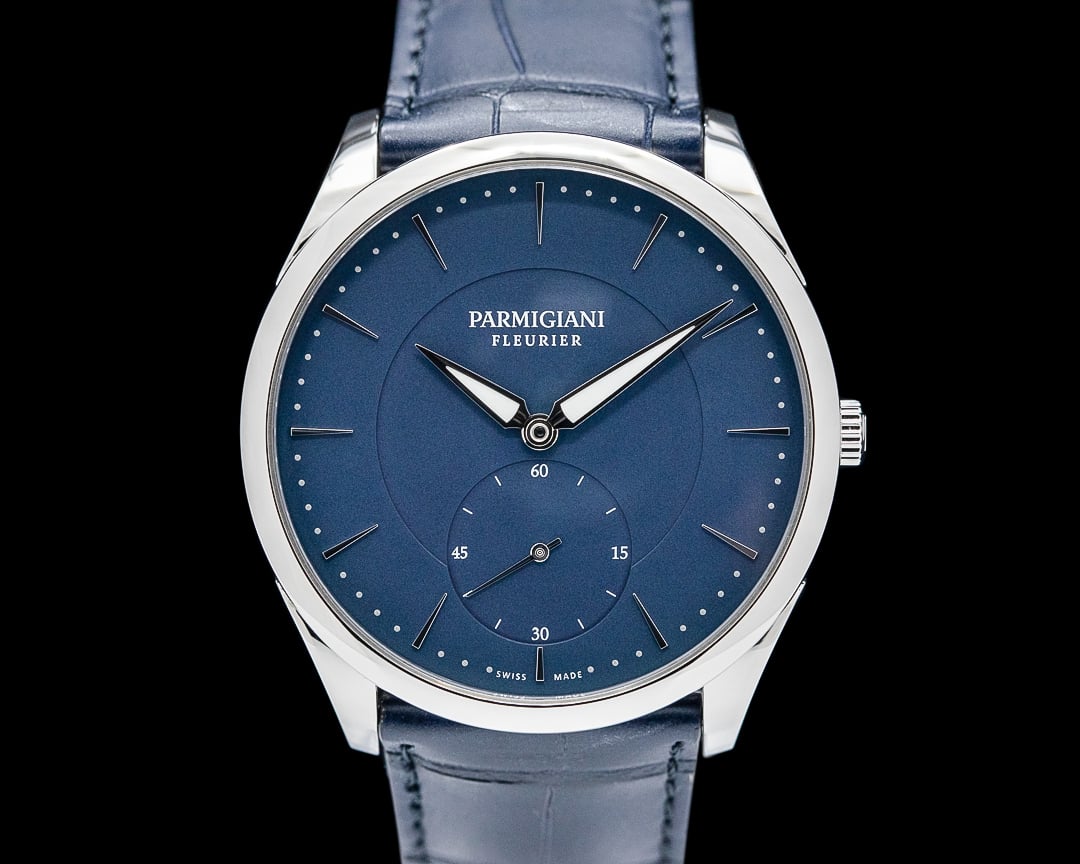
The reference PFC267-WT(OG) places the PF701 inside an 18k white-gold case with a white dial. The OG suffix corresponds to or gris — grey gold, the French designation for white gold — and the case is executed in the restrained, softly rounded Tonda form. The bezel is slim, the profile is gently curved, and the lugs taper into the strap in a way that makes the watch look smaller and more elegant than its presence on paper might suggest.
The white dial is the right choice for this case. It is clean, legible, and deliberately quiet: applied faceted indices, a fine minutes track, and a discreet date aperture that does not disrupt the symmetry of the layout. The hands are faceted and polished, catching light in a way that makes the dial feel alive without adding visual noise. There is no lume, no text beyond the essentials, and no decorative clutter. In an era when dials are frequently over-designed to justify a price, the Tonda 1950's dial is confident enough to be almost empty.
White gold also changes the character of the watch relative to steel. The tone is cooler and slightly warmer in the hand than stainless steel, and it carries a density that makes the case feel more precious without making it flashy. White gold does not announce itself the way yellow or rose gold does; it reads as silver at a glance and only reveals its nature under close inspection. For a watch designed to be worn quietly, that is exactly the right material.
The sapphire crystal is fitted front and rear, and the strap is alligator leather closed with a gold pin buckle. The overall impression is one of classical proportion rather than trend: this is a watch that would have looked correct in 1965 and will look correct in 2045.
On the Wrist
The Tonda 1950 is defined by its thinness, and thinness changes the way a watch is experienced. It sits low against the wrist, slides under a shirt cuff without complaint, and largely disappears during the day. The white-gold case gives it a surprising density for its size — white gold is heavier than steel, and the watch has a cool, substantial feel that belies its slender profile. On an alligator strap, the weight is distributed evenly, and the pin buckle keeps the closure low-profile.
The wearing experience is best described as frictionless. There is no crown dig, no case-edge pressure, and no sense that the watch is asking to be noticed. For collectors who spend their days at a desk or in meetings, this is precisely the point. The Tonda 1950 is a watch you wear rather than a watch you display, and it rewards that relationship with a comfort that thicker luxury-sports pieces cannot match. It is not a watch for the beach or the gym, and it does not pretend to be; it is a watch for the life most collectors actually live.
Keeping Time
In real-world use, PF701-based watches typically run within a handful of seconds per day — most examples settle into a range of roughly -2 to +8 seconds daily, depending on position, temperature, and state of wind. The 28,800 vph frequency gives the seconds hand a smooth, steady sweep, and the 42-hour power reserve is adequate for a dress watch that will be worn several days a week. If the watch is rotated with others, a winder or a weekly manual wind will keep it running; if it is worn daily, the automatic system will maintain it comfortably.
Collectors should treat the movement as a precision instrument rather than a chronometer. Parmigiani's regulation is competent, but this is not a reference marketed on laboratory certification, and buyers should expect normal mechanical variation rather than quartz-like consistency. The reward is a movement that is genuinely pleasant to look at through the caseback, which is more than can be said for many movements at this price.
Living With the Tonda 1950
This is a dress watch first and a daily wearer second, but it is a capable daily wearer for the right owner. It pairs naturally with tailoring, works with smart-casual, and is entirely at home on a plane or in a restaurant. It is not a sports watch: there is no lume, no screw-down crown, and no meaningful water resistance beyond what a dress watch should be asked to tolerate. Treat it accordingly — no swimming, no showering, and no exposure to the kind of knocks that a steel sports watch would shrug off.
The strap is the simplest way to change the watch's character. A black or dark brown alligator strap keeps it formal; a grained leather or suede strap softens it for everyday wear; a slim calf strap makes it more casual still. Because the case is understated, the strap does most of the styling work, and owners should feel free to experiment within the limits of good taste.
Servicing is the practical consideration. Parmigiani's service network is smaller than those of the large groups, and the PF701 should be maintained by an authorized watchmaker with access to parts. Owners should follow the maison's recommended service cadence rather than waiting for a problem to develop, and should budget for the fact that parts for a low-volume manufacture are not always cheap or quick. The upside is that the movement is robust and well-built; the downside is that ownership requires a little more planning than a Rolex does.
The Market and the Math
The Tonda 1950 in white gold sits in the middle of Parmigiani's pricing, above the steel references and below the precious-metal complications. Retail pricing for the reference lands in the low-to-mid twenties in US dollars, while pre-owned examples trade at a meaningful discount — typically in the low-to-mid teens for well-preserved white-gold pieces with box and papers. That discount is the collector's opportunity. Parmigiani's secondary market is thin and inefficient, which means patient buyers can acquire a genuinely well-finished, vertically integrated, micro-rotor dress watch for less than the price of a steel sports watch from a more famous brand.
The trade-off is liquidity. This is not a watch that will appreciate, and it is not a watch that will sell in a day. The brand's recognition is growing but remains niche, and auction results are sporadic rather than instructive. Buy it because you want to wear it, not because you want to flip it. Held for a decade and worn regularly, it will deliver more satisfaction per dollar than almost anything in its secondary price band.
Variants and Alternatives
The Tonda 1950 family extends across case metals and dial treatments. The steel references — notably PFC267-1000101 with a white dial — offer the same PF701 architecture at a lower entry point and are the value play of the line. The rose-gold reference PFC267-1263300 with its darker dial is the warmer, more traditional alternative to the white-gold watch reviewed here. Beyond the base model, the family includes the Tonda 1950 Skeleton, the Tonda 1950 Tourbillon, the Tonda 1950 Galaxy with its aventurine and meteorite dials, and a smaller 33mm variant aimed at a different wrist. The modern Tonda PF Micro-Rotor is the spiritual successor and a useful point of comparison for anyone shopping the current catalogue.
Within the wider market, the obvious alternatives are the Patek Philippe Calatrava, the A. Lange & Söhne Saxonia Thin, the Vacheron Constantin Patrimony, and the Jaeger-LeCoultre Master Ultra Thin Date. Each offers a different balance of brand equity, finishing, and price. The Parmigiani's advantage is its micro-rotor architecture and its relative obscurity; its disadvantage is resale and recognition. For the collector who values the object over the logo, that trade is favorable.
Verdict
The Parmigiani Fleurier Tonda 1950 ref. PFC267-WT(OG) is a quietly excellent watch. Its movement is architecturally interesting and properly finished, its case is elegant and comfortable, and its dial demonstrates that restraint is a design skill rather than an absence of ideas. It is not the right choice for someone who needs a watch to signal status or survive a swimming pool, but for the collector who wants a beautiful, technically credible dress watch that flies under the radar, it is one of the smartest buys in its class.