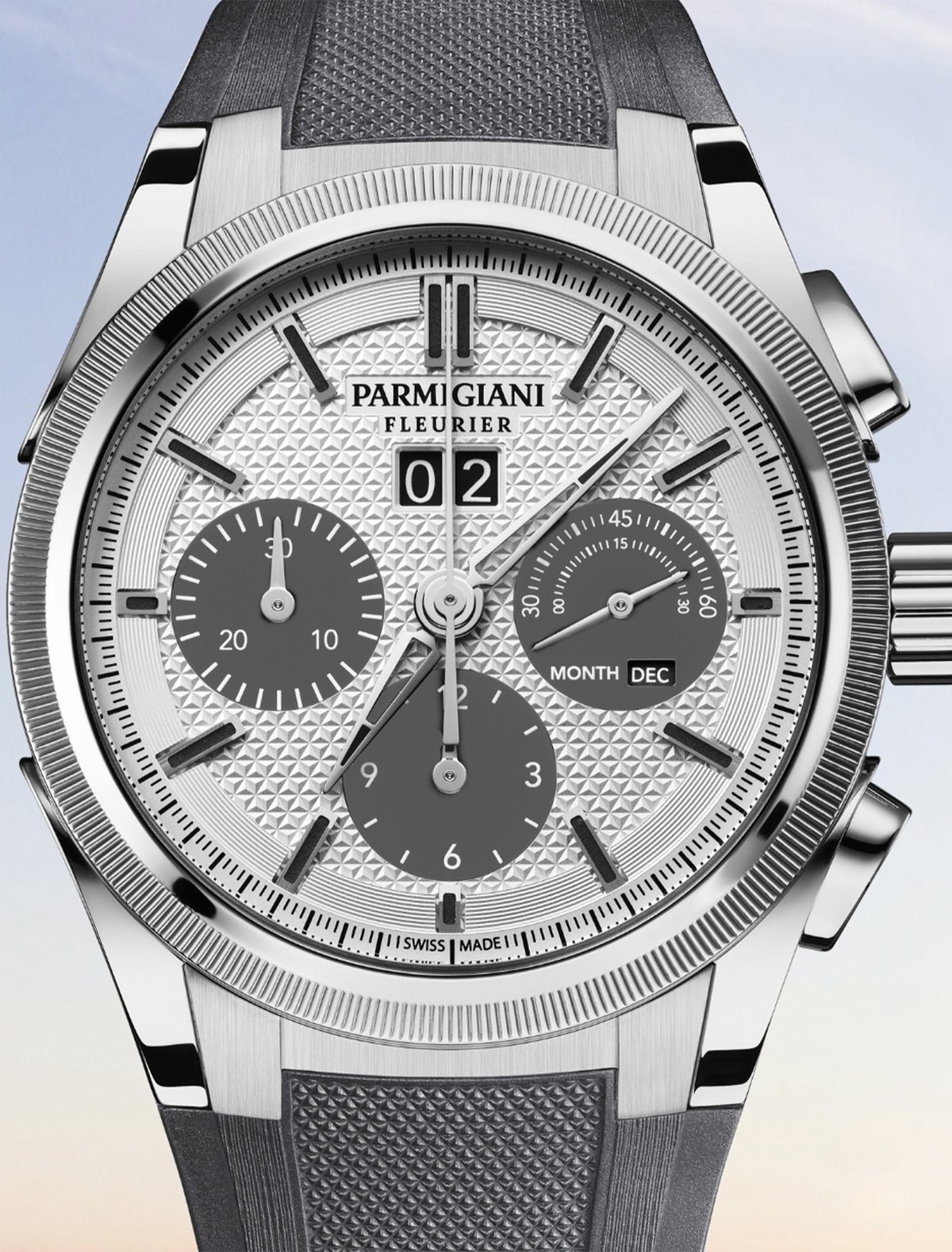
Parmigiani Fleurier Tonda GT Chronograph Review
Some watches arrive with a press release and a waiting list. The Parmigiani Fleurier Tonda GT Chronograph arrives with a more interesting question: why is this not the default answer for collectors who want an integrated steel chronograph without wearing the same three logos as everyone else?
Reference PFC910-0000210-X01482 is Parmigiani's sport-chic statement: a steel chronograph with an in-house automatic movement, a bracelet-first attitude, and the kind of finishing that rewards a loupe but does not beg for a camera flash. It is not the loudest watch in the room. It is the one the room asks about after the loud watches have gone home.
That is the Tonda GT's lane. It sits between the pure dress watch and the aggressive sports chronograph, offering a watch that can handle a day of meetings, a weekend drive, and a dinner where the sleeves are rolled up. It is luxury without the lecture.
Brand History: Restoration Roots, Modern Ambition
Parmigiani Fleurier was founded by Michel Parmigiani in 1996, building on a restoration practice that gave the brand deep respect for historical mechanics. That restoration DNA is not marketing decoration. It shapes the way Parmigiani thinks about movement architecture, finishing, and the relationship between case and dial.
The Tonda GT is the modern flex: a bridge between the workshop and the weekend. It takes the brand's high-horology instincts and puts them into a steel chronograph that can be worn hard. That is a tricky balance. Many brands can make a beautiful dress watch. Fewer can make a sports watch that still feels like it came from a place where people know what a hand-bevelled bridge looks like.
Parmigiani has always been a connoisseur's brand. It does not have the mass-market recognition of Rolex, nor the auction heat of Patek Philippe. What it has is a genuine manufacturing capability and a design language that is distinct without being difficult. The Tonda GT is one of the clearest expressions of that identity.
Design and Dial
The Tonda GT Chronograph has a 42mm stainless steel case, and it is a case that understands proportion. The lugs flow into the bracelet with an integrated-style confidence, giving the watch a continuous line from dial to clasp. It is sporty, but not aggressive. The bezel and case edges are crisp enough to catch light without turning the watch into a mirror.
The dial on this reference is a dark, low-key surface with contrasting chronograph counters. It is the kind of dial that changes character with the light: subtle in a boardroom, more dynamic outdoors. The layout is legible without being busy, and the chronograph registers are integrated into the design rather than pasted on top. The date complication is useful without dominating the face.
What stands out most is restraint. The Tonda GT does not rely on oversized numerals, carbon fibre, or a racing stripe to signal sportiness. It uses proportion, finishing, and a well-resolved bracelet. That makes it more versatile than many of its competitors. It can be worn with a tailored jacket or a T-shirt, and it never looks like it is trying too hard.
The steel bracelet is a major part of the story. It gives the watch its luxury-sports identity and makes the case feel more integrated than a simple strap swap would suggest. The folding clasp keeps the underside tidy, and the overall package feels engineered rather than assembled.
Movement: The PF071 Automatic Chronograph
Inside the Tonda GT Chronograph is the Parmigiani PF071, an in-house automatic chronograph. It runs at 28,800 vibrations per hour, carries 32 jewels, and delivers a 65-hour power reserve. Those are solid modern numbers: enough reserve to put the watch down on Friday and pick it up on Monday without resetting everything.
The PF071 is not advertised as a COSC chronometer, so there is no official chronometer claim to lean on. That is not a dealbreaker. COSC certification is a useful benchmark, but it is not the only measure of a movement's quality. What matters more is the architecture, the finishing, and the consistency of the regulation. Parmigiani is a high-horology house, and the movement reflects that with finishing that goes beyond what you would expect in a purely utilitarian steel chronograph.
The chronograph function is the headline complication, and the date adds daily practicality. This is not a monopusher or a rattrapante; it is a modern automatic chronograph built for regular use. That is exactly the right call for a watch like this. The Tonda GT is meant to be worn, not stored in a safe and admired through glass.
Specs at a Glance
- Reference: PFC910-0000210-X01482
- Case: 42mm stainless steel
- Water resistance: 100m
- Crystal: sapphire
- Dial: reference-specific dark dial
- Lume: Super-LumiNova
- Bracelet: steel bracelet with folding clasp
- Movement: automatic PF071, 65-hour power reserve, 28,800 vph, 32 jewels
- Complications: chronograph, date
On the Wrist
The Tonda GT Chronograph wears like a watch designed to stay on the wrist. The 42mm steel case has enough presence for a sports chronograph, but the bracelet and case flow together in a way that keeps the silhouette clean rather than bulky. It feels planted without feeling heavy, and the folding clasp keeps the underside tidy.
The bracelet is the key. It gives the Tonda GT its luxury-sports identity and makes the case feel more integrated than a simple strap swap would suggest. The watch has a confident wrist footprint, but it is not a slab. It reads as a precise, engineered object rather than a fashion statement.
Comfort is subjective, but the Tonda GT is the kind of watch that disappears during the day in the best way. It does not snag on cuffs, it does not demand constant adjustment, and it does not feel precious. That matters for a steel chronograph at this level. If you are going to pay high-horology money, you should be able to wear the watch without thinking about it.
Accuracy and Daily Wear
Because the PF071 is not COSC-certified, there is no official chronometer claim to lean on. In real-world use, expect modern automatic chronograph behaviour: stable timekeeping when worn regularly, some variance depending on position and temperature, and a movement that benefits from proper servicing. A new or freshly regulated example should be comfortably usable for daily wear, but this is not a watch where the marketing story is built around laboratory numbers.
That is fine. The Tonda GT is a wearer's watch, not a timegrapher trophy. The 65-hour power reserve makes it easy to rotate, and the automatic winding system keeps it ready as long as you are active. If you are the kind of collector who checks accuracy every morning, you will want to have the watch regulated to your preferences. If you are the kind of collector who wears a watch and gets on with the day, the PF071 will do what you need.
Occasions and Presence
The Tonda GT Chronograph is at its best as a daily wearer. It has enough water resistance for everyday life, enough legibility for travel, and enough polish for a smart-casual dinner. It is not a formal dress watch, but it can handle a suit if the suit is relaxed. It is not a dedicated sports watch, but it can handle a weekend of activity without anxiety.
On the wrist, the presence is a 4 out of 5. It is substantial enough for a steel chronograph, but restrained enough to disappear under a cuff and avoid the loud-luxury trap. It is the kind of watch that gets noticed by people who know watches, not by everyone in the room. That is a feature, not a bug.
Variants and Family
Reference PFC910-0000210-X01482 is the steel-bracelet expression of the Tonda GT Chronograph. That is the configuration that makes the most sense to us. The bracelet completes the design and gives the watch its luxury-sports identity. Strap variants exist in the broader Tonda GT family, but if you are buying the Tonda GT for its silhouette, the bracelet is the way to go.
The Tonda GT family also includes automatic and annual calendar chronograph versions. Those siblings share the same sport-chic philosophy but offer different complications and price points. The Tonda GT Automatic is the simpler entry point; the annual calendar chronograph is the more complicated expression. The Tonda GT Chronograph sits in the sweet spot for collectors who want a useful complication without paying for a calendar they may never set.
Comparisons
The obvious comparison is the Rolex Daytona. The Daytona is the benchmark steel chronograph, with stronger resale heat and a much longer queue. The Parmigiani is the connoisseur's alternative: more discreet, more available, and arguably more interesting to look at up close. If you want the watch that everyone recognizes, buy the Daytona. If you want the watch that rewards your own knowledge, consider the Tonda GT.
The Audemars Piguet Royal Oak Chronograph is another natural rival. It has more brand gravity and a more aggressive integrated-bracelet design. It also costs significantly more and attracts a different kind of attention. The Vacheron Constantin Overseas Chronograph is a more formal luxury-sports alternative, with interchangeable strap appeal and a slightly more traditional feel. The Zenith Chronomaster Sport is the high-frequency racing option, with a lower entry point and a more extroverted personality.
Against all of them, the Tonda GT holds its own on finishing and design. It may not win the resale contest, but it wins the quiet-confidence contest. That is a real category for collectors who have moved past the hype cycle.
Investment and Service
The Tonda GT Chronograph launched with an MSRP in the high-teens and currently retails around the high-teens to low-twenties depending on market and configuration. Pre-owned examples typically trade in the low-to-mid teens, which makes the secondary market the smarter entry point for most collectors. The trend is depreciating, not appreciating. This is not a watch to buy as a financial instrument.
That said, the value proposition is strong for a discerning buyer. You are getting an in-house automatic chronograph, high-horology finishing, and a bracelet-first design at a price that undercuts the blue-chip competition. If you buy pre-owned and hold, you are unlikely to lose sleep over the depreciation. If you buy at retail expecting a flip, you will be disappointed.
Auction history for this reference is not notable. Parmigiani chronographs rarely headline auction catalogues, and the Tonda GT is not yet a collector trophy in the saleroom sense. That could change over time as the brand's profile grows, but it is not something to bank on.
Service should be handled through Parmigiani's authorized network. Chronograph servicing and parts access are best managed by the brand or a factory-trained specialist. Do not treat this as a watch you can hand to any local watchmaker. The movement is in-house, and the finishing deserves proper care.
Pros and Cons
Pros
- In-house PF071 automatic chronograph with a useful 65-hour power reserve
- High-horology finishing at a relatively discreet price
- Bracelet-first design that feels engineered and comfortable
- A genuine alternative to the usual steel-chrono queue
- Versatile enough for daily wear, travel, and smart-casual occasions
Cons
- Resale is softer than blue-chip competitors
- Not COSC-certified
- Limited public awareness compared with Rolex and AP
- Service is best kept within the authorized network
- Not a formal dress watch, despite its polish
Final Verdict
The Parmigiani Tonda GT Chronograph is the steel chronograph for the collector who has already owned the obvious answers and wants something more personal. It pairs a legitimate in-house automatic chronograph with a beautifully resolved bracelet and a design that rewards close looking rather than logo recognition.
Buy it for the watch, not the ticker. Buy it pre-owned if you can, wear it often, and enjoy the fact that you are not wearing the same thing as everyone else at the watch meet. In a market full of loud flexes, the Tonda GT is a quiet one that speaks with more authority.