Introduction: The Quiet Perpetual
There is a particular breed of collector who, having cycled through the obvious names, arrives at Parmigiani Fleurier with the expression of someone who has just discovered a well-kept secret. The Toric Quantieme Perpetuel, reference PM020213, is precisely the sort of watch that rewards that arrival. It is a perpetual calendar — the most philosophically ambitious of all classical complications — executed with the restraint, the hand-finishing, and the architectural seriousness that Michel Parmigiani's atelier has built its reputation upon, yet wrapped in a case that refuses to shout.
The Toric is the founding collection of the maison, introduced alongside the brand in 1996, and its defining gesture is the knurled, torus-inspired bezel that gives the line its name. Where so many perpetual calendars lean on visual theatre — apertures, subdials, celestial cartography — the Toric Quantieme Perpetuel arranges its calendar information with a calm, almost architectural logic. The result is a watch that reads as a piece of classical horology first and a complication second.
This review examines the PM020213 in detail: its movement, its finishing, how it actually wears, what it costs to own, and whether it deserves a place in a considered collection. It is a watch that asks for patience and repays it.
Manufacture History: Fleurier's Vertical Vision
Parmigiani Fleurier was founded in 1996 by Michel Parmigiani, a master watchmaker and restorer whose work on historical pieces — notably for the Sandoz family foundation — gave him an unusual fluency in classical complication architecture. Based in Fleurier in the Val-de-Travers, the maison controls an unusual degree of its own production through vertically integrated facilities including Vaucher Manufacture Fleurier. The Toric, launched at founding, remains the purest expression of the brand's classical ideals.
That vertical integration matters when discussing a perpetual calendar. The complication is unforgiving: the mechanism must track the irregular length of months and the leap-year cycle across a four-year cam, and it must do so for decades without drift. Building the movement in-house allows Parmigiani to control tolerance, finishing, and the aesthetic coherence of the whole — something a maison assembling from supplier catalogues can never fully achieve. The Toric Quantieme Perpetuel is therefore not simply a brand exercise; it is a statement of manufacturing intent.
Movement: The PF 333 Perpetual Calendar
At the heart of the PM020213 beats the PF 333, a self-winding perpetual calendar movement with a module architecture that keeps the calendar indications legible rather than crowded. Bridges are decorated with circular graining and Côtes de Genève, with anglaged edges and blued screws visible through the sapphire back. Parmigiani finishes to its own standards rather than pursuing chronometer certification, prioritising aesthetic execution over paper credentials.
The perpetual mechanism itself is the classical four-year cam system familiar from the great Swiss perpetual calendars: it accounts for the 28-, 30-, and 31-day months automatically and requires no correction until 2100, a year that is not a leap year despite being divisible by four. The calendar displays — day, date, month — are arranged with restraint, and the moonphase adds a poetic counterpoint to the mechanical logic. A perpetual calendar is, in a sense, a small machine for understanding the sky, and the PF 333 renders that machine with clarity rather than clutter.
Power reserve sits at approximately 48 hours, with the balance running at 28,800 vibrations per hour. That is a thoroughly modern cadence for an automatic, offering stability and consistency in daily wear. The architecture keeps the movement relatively slim, which has direct consequences for how the watch sits on the wrist — a point to which we will return.
Case and Finishing: The Toric Gesture
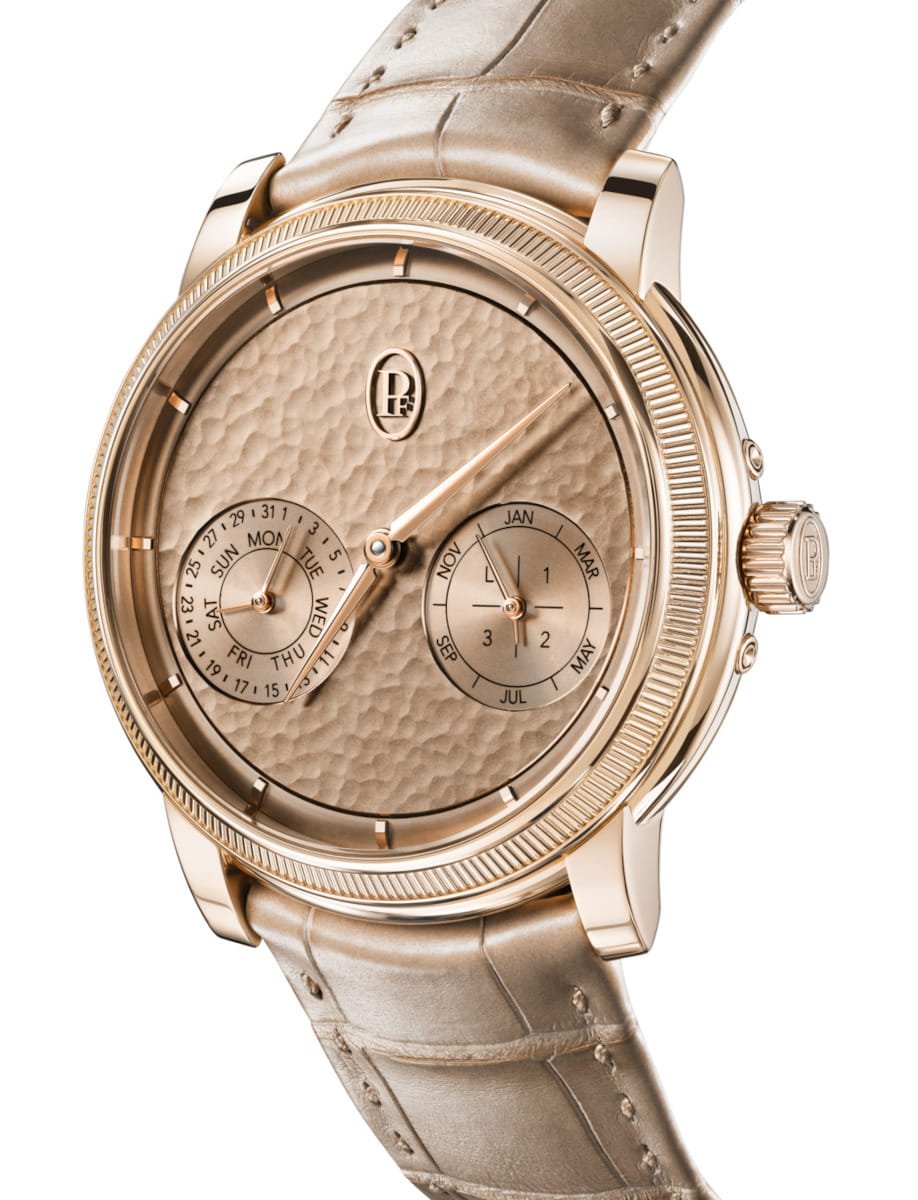
The Toric bezel is the watch's signature. Knurled and turned in gold, it echoes the torus — a shape of pure geometry — and gives the otherwise classical case a tactile, almost architectural identity. Running a fingertip across it is one of the small pleasures of ownership: the ridges are crisp, evenly spaced, and clearly hand-finished rather than stamped. It is the kind of detail that distinguishes a maison with a genuine finishing culture from one merely assembling a product.
The case itself is executed in gold with the polished-and-brushed alternation that classical watchmaking demands, and the lugs are shaped to flow rather than to intrude. The sapphire crystal is domed subtly, preserving the vintage-inflected proportions that the Toric has always carried. There is no lume here, and no pretence of sportiness — this is a dress watch and it knows it. Water resistance is modest, as befits a perpetual calendar with a push-piece-corrected calendar; this is not a watch for the pool, and Parmigiani has never pretended otherwise.
The Dial: Calendar Architecture
Where the dial of a perpetual calendar can easily become a diagram, the Toric Quantieme Perpetuel arranges its information with grace. The silvered opaline surface gives the indications a soft, luminous ground against which the applied indices and hands read crisply. Day, date, and month are presented without theatre, and the moonphase — always the emotional centre of a perpetual calendar — receives a treatment that is decorative without becoming kitsch.
The real achievement is legibility. A perpetual calendar that requires a loupe to read is a failure of design, no matter how clever its mechanism. The Toric gets this right: each indication occupies its own space, the hierarchy is clear, and the dial reads at a glance. That is harder to achieve than it sounds, and it is a large part of why the watch works so well in daily wear.
On the Wrist: How It Wears
The Toric Quantieme Perpetuel wears as a classical dress watch should: the case sits close to the wrist, the knurled bezel catches light without demanding attention, and the leather strap drapes rather than stands. The gold case carries genuine heft, but the mass is distributed evenly, so the watch never feels top-heavy or prone to rotating on the wrist. It is the sort of watch you forget you are wearing until you glance down and are quietly rewarded.
Because the perpetual calendar information is laid out with restraint rather than spectacle, the dial remains legible at a glance, which matters enormously in daily wear. There is no clutter of overlapping subdials fighting for space; each indication has room to breathe. On a smaller wrist the proportions read as elegant and classical rather than precious, and the watch tucks neatly under a shirt cuff — a consideration that many complicated watches ignore entirely.
The strap, as with all Toric pieces, is a Parmigiani-made leather with a pin buckle. It is supple and well-finished, and the pin buckle suits the classical temperament of the watch better than a deployant would. Owners typically rotate through a small collection of straps — the watch is forgiving of colour, and both black and dark brown leathers suit the silvered dial.
Accuracy and Ownership
As with any perpetual calendar, the priority is calendar accuracy rather than rate precision: a correctly set perpetual mechanism will not need adjustment until the year 2100, and that is the kind of accuracy that matters here. In day-to-day running, Parmigiani's automatics are well-regulated and dependable; owners should expect a few seconds per day of variance, entirely normal for a complicated automatic. The movement is not COSC-certified, and Parmigiani does not market it as such — the maison's standards are its own. Real-world ownership is about setting the calendar correctly once and then trusting it for decades.
Servicing, however, is the practical consideration. A perpetual calendar requires specialist attention, and Parmigiani's authorised network is the right route. Expect a service interval of roughly five years and a cost that reflects the complexity of the calendar mechanism. This is not a watch to hand to a generalist; it is a watch to entrust to someone who understands what a four-year cam does. For collectors considering a pre-owned example, service history is the single most important question to ask.
Value and the Secondary Market
At retail the Toric Quantieme Perpetuel is a serious proposition, but on the secondary market it is one of the most underrated perpetual calendars available. Parmigiani's resale values do not hold like those of Patek Philippe or A. Lange & Söhne, and that is precisely why the pre-owned market is compelling: the price buys genuine hand-finishing and architectural integrity that badge-driven buyers overlook. A discerning collector can acquire a perpetual calendar of real quality for a fraction of what the more famous names command.
The trade-off is honest: buy a Toric to wear, not to flip. The depreciation curve is real, and the brand recognition lags behind its horological peers. But for the collector who has moved past logos and cares about the object itself, that gap is the opportunity. The reward is the watch, not the balance sheet.
Verdict: The Collector's Perpetual
The Parmigiani Fleurier Toric Quantieme Perpetuel is the perpetual calendar for the collector who has moved past logos. Its PF 333 movement, its knurled Toric bezel, and its calm, legible dial arrangement represent classical horology executed with real conviction. It will not hold value like a Patek, and it will not turn heads across a room — but worn daily, it rewards in the only currency that ultimately matters: the quiet satisfaction of a beautifully made thing on the wrist.
In a market that increasingly rewards noise, the Toric remains a whisper. For the sophisticated young collector building a collection with intention rather than imitation, that whisper is worth listening to.