The Strategic Pivot: Why 'Destro' Matters
In the world of luxury asset management, rarity is the primary driver of value. When Patek Philippe announced the discontinuation of the 5372P and its replacement with the 5373P, the market was initially confused. Why would a brand known for its adherence to classical norms release a 'left-handed' watch as its flagship split-seconds perpetual calendar? The answer lies in the 'Application Piece' model. By creating a watch that is functionally niche, Patek ensures that the production numbers remain low and that only their most loyal—and perhaps most eclectic—collectors gain access. For Edward Sterling and the analysts at Vivir, this is a clear 'Buy' signal for those with the capital, as unique configurations historically outperform standard models at auction.
Technical Mastery: The CHR 27-525 PS Q
At the heart of the 5373P is the Caliber CHR 27-525 PS Q. This movement is a marvel of miniaturization. To fit a split-seconds chronograph (one of the three most difficult complications to build) and a full perpetual calendar into a height of just 7.3mm is an achievement that few other manufactures can claim. The movement architecture is visible through the sapphire caseback, revealing the intricate dance of the two column wheels and the hand-beveled bridges. The finishing is, as expected, superlative. Every sink is polished, every wheel is circular-grained, and the Geneva stripes are applied with a depth that mimics the rolling waves of Lake Geneva.
The Aesthetic Shift: Redefining the Grand Complication
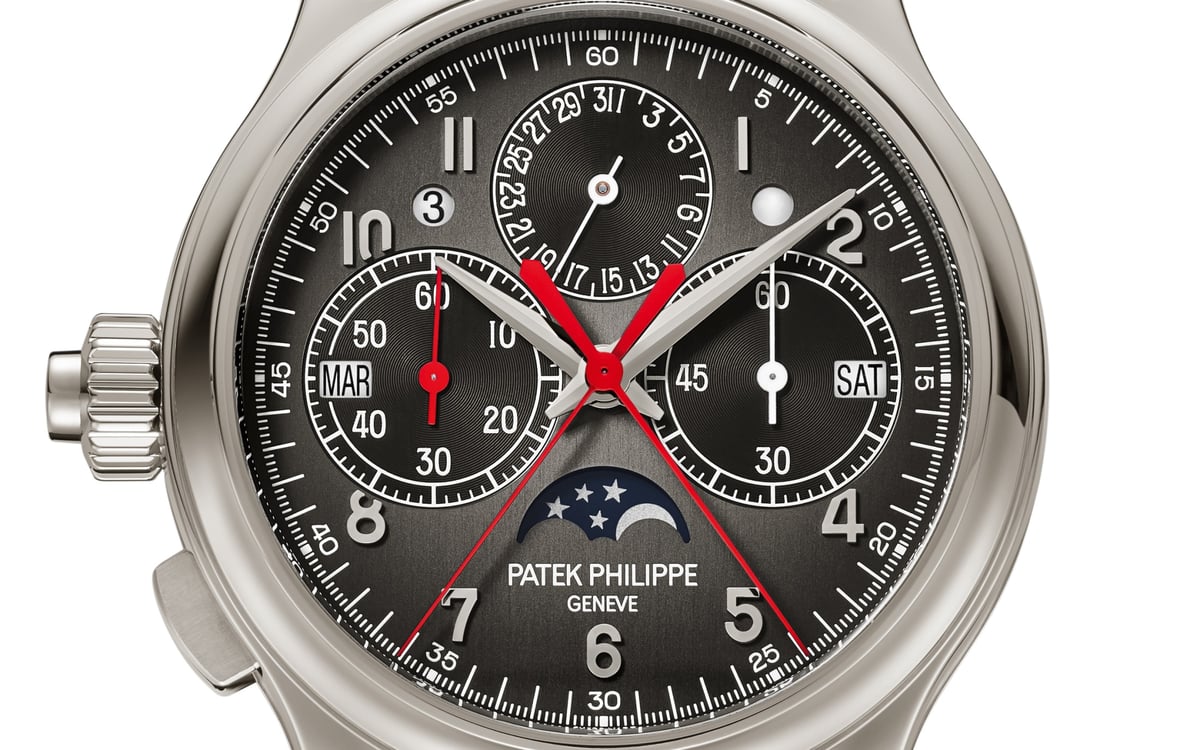
Traditionally, a Patek Grand Complication was a staid, conservative affair—usually paired with a white or blue dial and a classic alligator strap. The 5373P breaks this mold. The charcoal-gray dial features a vertical satin finish that catches the light in a way that feels industrial yet refined. The addition of red varnish on the chronograph hands provides a 'racing' feel, further emphasized by the calfskin strap with its embossed textile pattern and red stitching. This is a watch designed for the collector who drives a modern Ferrari rather than a vintage Rolls-Royce. It is a sportier take on the high-complication genre, and it reflects a broader market trend toward 'wearable' luxury that doesn't feel out of place in a casual setting.
Investment Analysis: Hold vs. Sell
From a resale data perspective, the 5373P is currently in a 'Hold' phase. Because it is an 'Application Piece,' the initial owners are vetted by the Stern family themselves. Flipping such a piece immediately would result in being blacklisted from future allocations, which keeps the secondary market supply extremely tight. We anticipate that as the 5373P nears the end of its production cycle, its value will see a significant spike. The 'destro' layout makes it an outlier in Patek's history, and outliers—like the stainless steel 1518—are often the pieces that command the highest premiums decades down the line. If you are fortunate enough to be offered this reference at retail, the $600,000 MSRP is a justified entry point for a piece that will likely appreciate as it enters the vintage market.
Final Thoughts on the 5373P
The Patek Philippe 5373P is not a watch for everyone, and that is precisely why it is successful. It challenges the wearer, it disrupts the traditional dial layout, and it provides a level of mechanical sophistication that is unmatched in its thinness. For the sophisticated young collector, it represents the pinnacle of modern horology—a bridge between the heritage of the past and the bold, design-forward future of the brand. It is a masterpiece of engineering that happens to sit on the 'wrong' side of the wrist, making it all the more right for a serious portfolio.