Why the 5990/1A matters
The Nautilus has always been a shape-first watch. Gerald Genta's 1976 design turned a porthole into a status symbol, and the steel bracelet became as important as the dial. The 5990/1A respects that formula but pushes it into grand-complication territory. It is not a dress watch with a sporty bracelet. It is a full travel-time chronograph disguised as a luxury steel sports watch.
That dual identity is why the 5990/1A resonates with younger collectors. It works with a hoodie, a suit and an airport lounge. It has the Nautilus silhouette that reads instantly across a room, but it also has enough dial architecture to reward a closer look. The chronograph pushers, the second time zone and the date make it a watch you can use, not just admire.
The 5990/1A also sits in a sweet spot between purity and complexity. The 5711 is cleaner, the 5980 is more chronograph-focused, and the 5740 is more formal. The 5990/1A is the one that does the most without losing the Nautilus character. That balance is the whole argument.
Brand history and Nautilus context
Patek Philippe was founded in Geneva in 1839 and remains one of the last independent, family-owned watch manufacturers in Switzerland. The maison built its reputation on pocket watches, complications and understated dress watches before the Nautilus changed its public image. The Nautilus was launched in 1976 with a design by Gerald Genta, and it took the idea of a luxury steel sports watch seriously at a time when gold dress watches still dominated the category.
The 5990/1A extends that lineage into travel-time chronograph territory. It is not a limited edition, but it is allocation-driven, and that has shaped its market life. The reference has become a collector's alternative to the 5711 for people who want more mechanics in the same silhouette. It is also a reminder that Patek's steel sports watches are not just exercises in minimalism; the maison can pack a lot of function into a Nautilus when it wants to.
Movement and complications
The 5990/1A runs on the CH 28-520 C FUS, an automatic integrated chronograph with a column wheel and vertical clutch, topped with a travel-time module. The base architecture is well known in Patek's lineup: a flyback chronograph with a central chronograph seconds hand, a 30-minute counter and a date, plus a second time zone with day/night indication. The FUS suffix signals the travel-time function, and the result is a movement that feels more integrated than a modular afterthought.
The chronograph action is crisp and controlled. The pushers have a firm, mechanical feel without being harsh, and the flyback function makes quick timing resets feel natural. The travel-time system is equally practical: you can track a second zone without losing the main time, and the day/night indicators help when you are crossing time zones or coordinating with someone in another city.
Finishing is pure Patek. The sapphire caseback reveals Geneva stripes, circular graining and polished bevels, and the automatic rotor is finished to the standard you expect at this price. The movement is not COSC-certified because Patek uses its own Patek Philippe Seal, which governs rate, finishing and overall quality. The power reserve is in the 45-55 hour range, so it rewards regular wear but is not a long-weekend king. This is a movement that wants to be worn, not stored.
Case, dial and bracelet
The 5990/1A uses the classic Nautilus case language: a rounded octagonal bezel, horizontal satin finishing, polished bevels and the integrated bracelet that flows into the case. The 40.5mm diameter is right in the modern sweet spot, and the 12.53mm thickness gives the watch a substantial feel without turning it into a slab. Water resistance is rated to 120 meters, which is more than enough for daily life and the occasional swim.
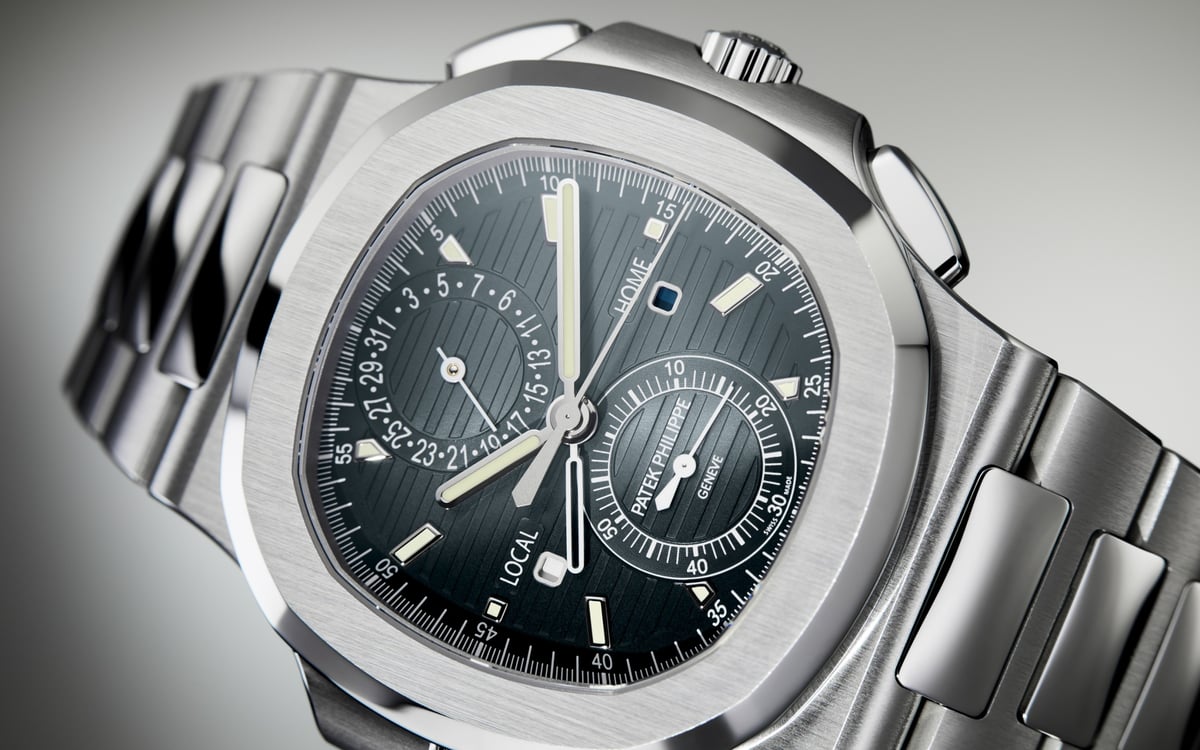
The dial is where the 5990/1A divides people. It is busy. The horizontal Nautilus embossing is still there, but it has to share space with chronograph registers, a date window at 6 o'clock, local and home time indications, and two day/night indicators. The blue dial variant is the more classic choice, while the black dial variant reads sharper and more modern. Neither is minimalist, and that is the point. The 5990/1A is a watch for people who like their complications visible.
The steel bracelet is the other half of the Nautilus formula. It is brushed and polished, tapers cleanly and closes with a deployant clasp. The bracelet is comfortable enough for full-day wear, and it gives the watch the jewelry-like presence that made the Nautilus a cultural object in the first place. This is not a strap watch. The 5990/1A wants to be worn on steel.
On the wrist
The 5990/1A wears like a Nautilus first and a complication watch second. The 40.5mm steel case and integrated bracelet wrap the wrist cleanly, and the 12.53mm thickness is noticeable but not punishing. It sits flatter than many chronographs with this much going on, and the bracelet tapers enough to keep the watch from feeling top-heavy.
The deployant clasp is secure and low-profile, and the steel bracelet is comfortable enough for full-day wear. This is not a delicate dress watch, but it is also not a brick. The 5990/1A feels engineered for people who actually move through their day in one watch. It has enough wrist presence to be noticed, but it does not announce itself the way a gold Royal Oak or a gem-set Nautilus might.
The dial is legible once you learn its hierarchy. The main time is easy to read, the chronograph registers are clear, and the date window is positioned where it does not fight the rest of the layout. The travel-time indicators take a moment to internalize, but that is part of the ownership experience. This is a watch that rewards familiarity.
Accuracy and ownership
The 5990/1A is governed by the Patek Philippe Seal, not COSC. Expect modern Patek chronometer-level performance in real wear, broadly within a few seconds per day, with the caveat that any complicated watch can vary with position, temperature and chronograph use. The travel-time and chronograph functions do not change the fundamental ownership experience: this is a high-precision mechanical object that rewards regular wear.
Ownership is not just about rate. The 5990/1A is an allocation watch, which means the buying experience can be as much about relationships as it is about money. On the secondary market, condition and completeness matter enormously. A full set with box and papers, a clean bracelet and a documented service history will always be easier to move than a loose watch. The Patek Philippe Seal also means service should go through authorized channels; complicated Nautilus references are not the place to experiment with a generalist watchmaker.
Variants, family and alternatives
The core steel references are the 5990/1A-001 with a blue dial and the 5990/1A-011 with a black dial. The blue dial is the more classic Nautilus look, while the black dial gives the watch a sharper, more technical feel. The 5990/1R-001 shifts the formula into rose gold with a blue dial and rose-gold bracelet; it is warmer, heavier and more formal, but it loses some of the stealth wealth appeal of steel.
Within the Nautilus family, the 5711/1A is the purity play, the 5980/1A is the chronograph-focused predecessor, the 5726/1A adds an annual calendar, and the 5740/1G is the perpetual calendar flagship. The 5990/1A sits between them as the travel-time chronograph. It is more usable than the 5740 and more complicated than the 5711, which is exactly why it has a dedicated following.
If you are shopping alternatives, the Audemars Piguet Royal Oak Chronograph 26331ST is the obvious integrated-steel chrono rival. The Vacheron Constantin Overseas Chronograph 5500V offers a softer luxury-sport posture and an interchangeable-strap system. The Rolex Daytona 116500LN is the default steel chrono flex, but it is more tool watch than travel watch. The Girard-Perregaux Laureato Chronograph offers a similar silhouette at a lower entry point.
Investment and service
The 5990/1A has held value well above retail, but it is not the most speculative steel Nautilus. The 5711 became a cultural phenomenon; the 5990/1A is more of a collector's watch. Pre-owned examples typically trade in the low-to-mid six figures, depending on dial variant, condition and completeness. The trend is best described as stable rather than explosive. Buy it because you want the complication and the Nautilus silhouette, not because you expect a quick flip.
Auction history does not define this reference the way it defines the 5711. Most 5990/1A examples change hands privately or through dealers, and full-set steel examples have traded in the low-to-mid six figures. Provenance and service history do the heavy lifting. If you are buying, prioritize condition and completeness over saving a few thousand dollars on a loose watch.
Service should be handled through Patek Philippe authorized service centers. Complicated Nautilus models benefit from factory-trained watchmakers, and the travel-time chronograph module is not the place for shortcuts. The exact service interval and cost depend on use and condition, so treat any generic number with suspicion. The important thing is to budget for proper care and to keep the paperwork.
Final verdict
The 5990/1A is the Nautilus for collectors who want their steel sports watch to do more than tell time. It is complicated, wearable and culturally locked into the modern luxury-sport conversation. The dial is busy, the case is not thin, and the price is not for everyone, but the watch earns its keep through real utility and unmistakable Patek finishing.
If you can get one at a sane price, it is a long-term keeper. If you are chasing a quick flip, the market has already moved on. The 5990/1A is best understood as a travel watch with a chronograph, a chronograph with a second time zone, and a Nautilus with a brain. That is a rare combination, and it is why this reference continues to matter.