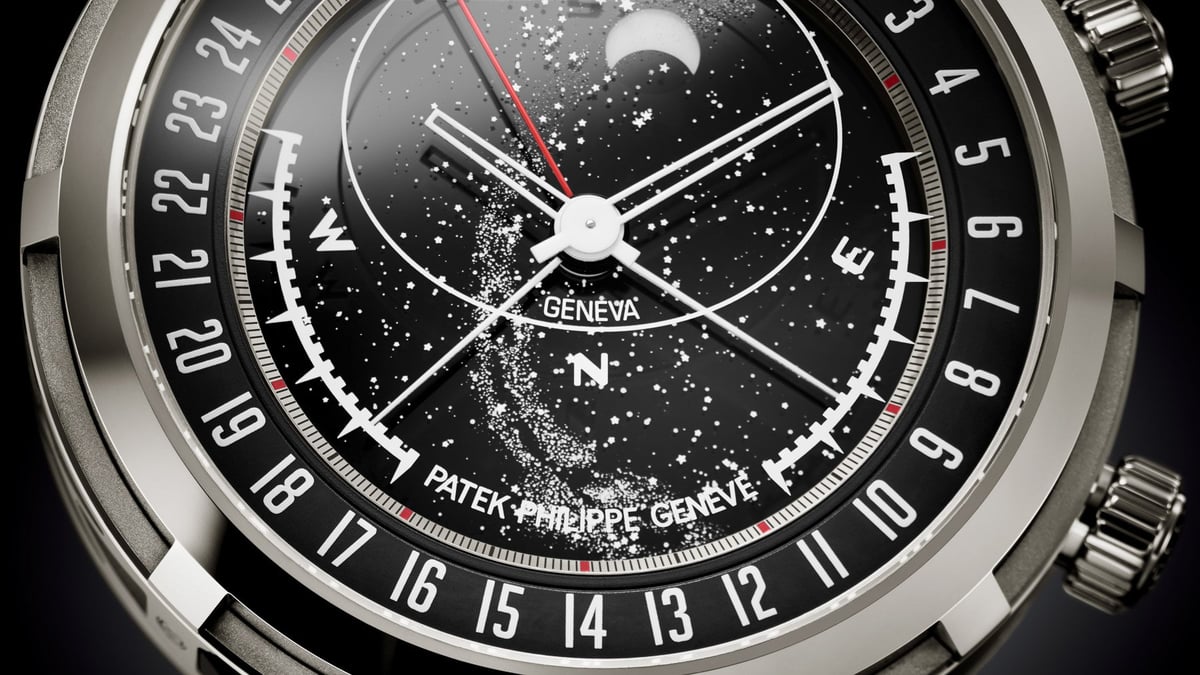
Patek Philippe Celestial Ref. 6105G: The Sky at a Quarter Million
Every few years Patek Philippe reminds the market that it can still attempt something no other maison will build at production scale: a wristwatch that maps the night sky. The Celestial Ref. 6105G is that reminder. In 18K white gold, with a rotating celestial chart, a Milky Way rendered in gold, and a moon phase, it is less a timekeeper than a planetarium you can wear to dinner.
It is also the opposite of everything the last five years of watch hype taught young collectors to chase. There is no waitlist theatre, no grey-market premium, no flip economy, no queue at the boutique that never calls. The 6105G is the other kind of Patek money — the kind that sits in a safe, comes out six times a year, and is bought by people who already own the Nautilus and are quietly bored of it.
So let us treat it like what it is: a six-figure acquisition with a thin secondary market, real service costs, and a very specific buyer. Here is the full picture, from the movement up.
The House: Geneva, Since 1839
Patek Philippe has been in continuous operation in Geneva since 1839, when Antoine Norbert de Patek and François Czapek hung a shingle; Adrien Philippe joined in 1845 and gave the firm the winding-and-setting mechanism that eventually carried his name. Astronomy has been part of the DNA almost from the start — the astronomical pocket watches of the 1920s, the Henry Graves Supercomplication of 1933 with its celestial chart, the Star Caliber 2000, and the Sky Moon Tourbillon all lead directly to the Celestial line.
The Ref. 6105G is the modern production heir to that thread. It replaced the Ref. 5102, which carried the Celestial banner for well over a decade, and it is the reference Patek currently builds when a client asks for the sky on the wrist rather than another tourbillon or minute repeater.
The Movement: Caliber 240 LU CL C
Under the dial sits Patek's Caliber 240 LU CL C, an automatic movement built on the legendary 240 base — the same architecture that has powered everything from the Ellipse to the Nautilus, here carrying an astronomical module. It is a micro-rotor design: an off-center 22K gold mini-rotor is recessed into the movement, which is why a complication this elaborate does not balloon the case the way a full-rotor perpetual calendar would. Patek quotes a 48-hour power reserve and a frequency of 21,600 vibrations per hour.
Finishing is Genevan in the traditional sense — Côtes de Genève on the bridges, circular graining on the mainplate, polished bevels, a Gyromax balance — and the whole assembly carries the Patek Philippe Seal rather than COSC certification. That seal is Patek's own standard and it is stricter on rate than COSC is, which matters more here than on a sports watch: astronomical displays are unforgiving of sloppy regulation. Wind it, wear it, and the sky stays where it should be.
The complication set is deliberately narrow: a rotating celestial chart, a moon phase, and the time. Nothing else competes for attention, and that restraint is the point. A sky chart does not need a chronograph bolted to it.
The Dial: A Sky Chart That Actually Moves
The dial is the whole argument. Beneath the hands sits a rotating disc printed with the night sky — the constellations of the northern hemisphere, the stars picked out in gold, and the Milky Way rendered as a band of gold across the field. The chart completes one full rotation in a sidereal day, roughly 23 hours and 56 minutes, which is the actual period of the Earth's rotation relative to the stars rather than the sun. That means the display is not decorative. Set correctly, it shows the sky above you at that moment.
The moon phase sits within the same composition, tracking the lunar cycle across the chart. Setting the whole thing correctly — date, moon phase, and the chart's orientation — is a small ceremony, and Patek's instructions deserve to be read twice. Get it right and the dial becomes a party trick nobody at the table has seen before. Get it wrong and you are wearing a very expensive approximation of the sky.
Case and Finishing
The case is 18K white gold, fully polished, with the kind of hand-finishing that only reveals itself under a loupe: crisp bevels, a mirror-polished bezel, and lugs that taper into the strap without a hard edge anywhere. Sapphire covers both sides, which means the movement and the astronomical module are on display from the back as well. The crown is small and unobtrusive, which is the correct choice on a watch whose dial is doing all the talking.
White gold is the right metal here. Yellow gold would make the sky chart look like a casino; platinum would push the price and the weight past the point of comfort; steel would be a contradiction in terms. The 6105G is a dress complication with a very generous dial, and white gold keeps it cool and slightly austere.
On the Wrist
This is a substantial white gold case and it wears like one. The Celestial is not a shrinking violet; it is a statement piece with real mass, and the heft is part of the experience. White gold is denser than steel, and on a leather strap the weight sits forward on the wrist rather than distributing itself the way a bracelet does. If you are used to a Nautilus, the first ten minutes will feel like strapping on a paperweight.
After that it settles. The micro-rotor keeps the profile manageable for a movement this complicated, the lugs curve down cleanly, and the alligator strap with its white gold fold-over clasp keeps the whole thing anchored. The absence of lume is not a problem — nobody is checking the time on this at 3 a.m. from a tent. What you notice instead is the dial: from across a table it reads as a deep blue field with gold glinting through it, and people will ask.
Accuracy and Daily Life
Patek does not submit this reference to COSC, so you will not find a chronometer certificate in the box. What you get instead is the Patek Philippe Seal, an internal standard that is stricter on rate than COSC certification, and in practice a healthy 6105G will run within a few seconds a day. Grand complications with astronomical modules are rarely the most precise watches in a collection — there is more going on, more friction, more to regulate — so do not expect quartz, and do not expect a Nautilus either.
What you should expect is a service conversation. The celestial module needs to be checked and recalibrated periodically, and this is not a water watch. Treat it the way you would treat any six-figure dress complication: rain is survivable, swimming is not, and the pool is never the right answer.
The Family Tree
The 6105G sits in a small lineage. Its direct predecessor is the Ref. 5102 Celestial, which held the line for well over a decade and remains the more accessible entry into Patek astronomy on the secondary market. Above it sits the Ref. 6002G Sky Moon Tourbillon, which adds a tourbillon, a minute repeater, and an entire second dial of complications — and roughly triples the price of admission.
Around the brand, the Celestial lives alongside the perpetual calendars such as the Ref. 5320G, the classic Calatrava Ref. 5227, and, of course, the Nautilus and Aquanaut. But it shares almost nothing with them. The Nautilus is a liquidity event. The Celestial is a legacy object.
Alternatives Worth Cross-Shopping
If the idea of a mechanical sky appeals more than the Patek name, the field is small but real. Vacheron Constantin's Métiers d'Art Copernicus puts a heliocentric sky on the dial with the same obsessive craft and a much smaller production run. Van Cleef & Arpels' Midnight Planétarium is a genuine mechanical planetarium, with the planets orbiting in real time — more jewellery than horology, but the same effect at the table. Jaeger-LeCoultre's Master Grande Tradition Grande Complication brings a celestial dial and a flying tourbillon for a fraction of the money. And Christiaan van der Klaauw builds planetarium watches for collectors who want the astronomy without the Patek premium.
At the other end of the market, the gesture is available for the price of a nice dinner. Sugess's MoonPhase Master and the Orient Sun and Moon both deliver a rotating astronomical display for a few hundred dollars. They are not the same object and no one will confuse them — but if what you actually want is the look of a moving sky, they will tell you whether the itch is real before you spend six figures on it.
Hype Cycle Reality Check
If you arrived at this review from the sports-watch side of the internet, recalibrate. The 6105G has no waitlist, no allocation drama, no secondary premium, and no meaningful presence in the flip economy. It is not on the radar of the people queueing for steel chronographs, and that is precisely why it is interesting. The watches that appreciate are the ones with the widest possible demand; the Celestial has the narrowest. Its value proposition is not financial — it is that you get to own something almost nobody else has, at a price set by craft rather than by scarcity marketing.
The Money: Retail, Resale, and Whether to Hold
Patek lists the 6105G in the mid-$200,000s in the United States, and the number has crept upward with every price increase. On the secondary market, examples trade in the low-to-mid $200,000s, which makes this one of the rare corners of the Patek catalogue where the pre-owned buyer is not punished. There is no grey premium here, no queue, no allocation politics. You can walk into a salon, or you can buy a two-year-old example and save the difference.
The trend is stable rather than appreciating. Grand complications of this type are not hype assets: the buyer pool is small, the objects are illiquid, and the spread between what a dealer pays and what a dealer charges is wide enough to swallow a year of gains. If your plan is to flip, this is the wrong reference — and honestly, the wrong category. Celestials are bought by people who intend to own them for a decade or more, often passing them to the next generation.
The rational play, if you are a young collector with the capital, is to buy pre-owned from a specialist dealer with full documentation, budget for a service, and then forget about the market for five years. The 6105G is not going to make you money in a bull run. It is going to be the watch in the collection that people remember.
Servicing
Patek does not publish a fixed service interval, and grand complications are not the place to improvise. Plan on a full service every several years through an authorized service center — this is not a watch any independent should open, given the celestial module and the parts situation. Budget accordingly: servicing a complication of this complexity runs into the thousands, and the celestial display should be recalibrated as part of the work.
Verdict
The Patek Philippe Celestial Ref. 6105G is the most romantic object in the modern Patek catalogue and one of the least cynical purchases you can make at this price. It is not a trade, it is not a status symbol in the way a Nautilus is, and it will never be the watch that gets you into the right group chat. What it is: a functioning map of the night sky, in white gold, made by the only house that still does this at scale.
Buy it if you want to own something that will still be interesting in thirty years. Skip it if you want a return.