Patek Philippe, briefly
Patek Philippe was founded in Geneva in 1839 by Antoni Patek and Franciszek Czapek. The modern house took shape in 1845 when Adrien Philippe arrived with his keyless winding system, and the Stern family has owned it since 1932. In the decades since, the brand has built the deepest complication catalog in watchmaking — perpetual calendars, minute repeaters, split-seconds chronographs — and has guarded its positioning with a discipline that rivals any luxury house in the world.
The Nautilus landed in 1976 as reference 3700/1A: a 42mm steel sports watch with a monobloc case, an integrated bracelet, and a price above most gold dress watches of the day. Genta's design was slow to become the object it is now, but the last fifteen years settled the argument. The 7118 is the modern 35.2mm interpretation of that design, launched in 2016 and now one of the most requested steel references in the collection.
Movement: Caliber 324 S C
The 7118/1A-011 runs Patek's Caliber 324 S C, a self-winding movement with center seconds and a date at 3 o'clock. It is the same family of movement that has powered the Nautilus line for years, and it is a known quantity: 45 hours of power reserve, 28,800 vibrations per hour (4 Hz), 29 jewels, a Gyromax balance, and a Spiromax balance spring. Winding is handled by a 21K gold rotor, visible through the sapphire caseback.
Finishing is where Patek separates itself. Bridges wear Geneva stripes, the mainplate is circular-grained, edges are beveled and polished, and the whole assembly is certified under the Patek Philippe Seal, which specifies a rate tolerance of -3 to +2 seconds per day — tighter than COSC and, unlike COSC, applied to the finished, cased watch. There is no chronograph, no GMT, no moonphase. Just the date. That restraint is the point: this is a three-hand watch built to the same standard as the brand's complications.
Specs that matter
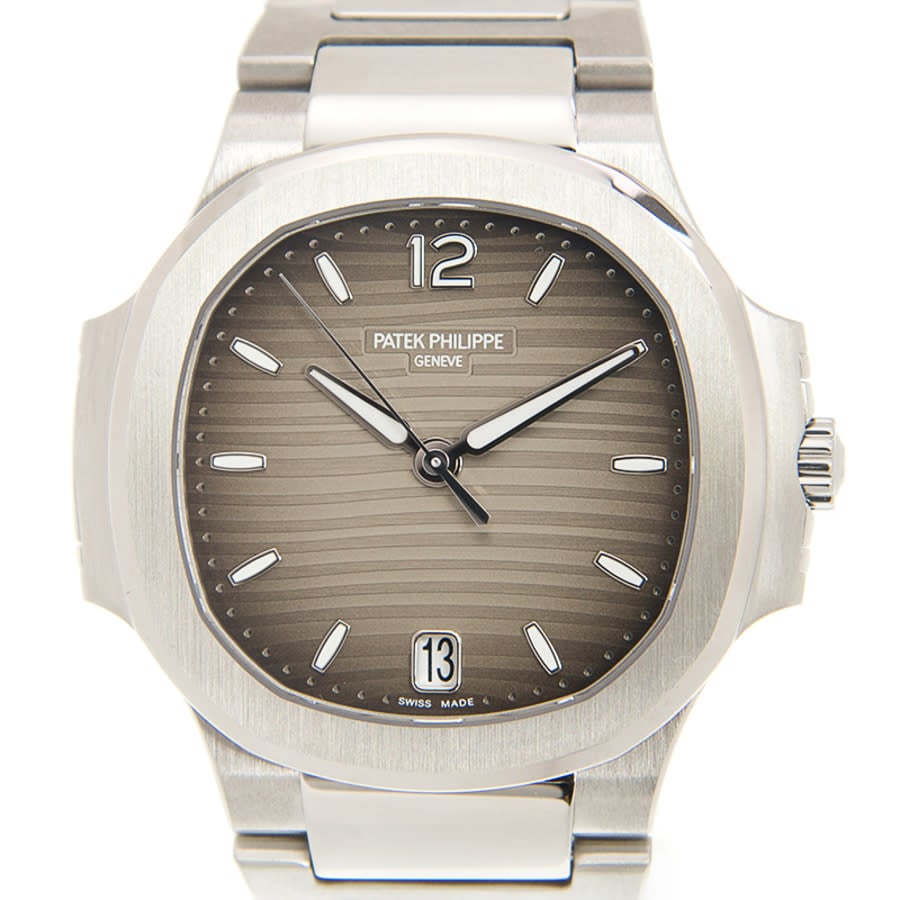
- Case: stainless steel, 35.2mm diameter, cushion-shaped with the Nautilus's rounded octagonal bezel and lateral hinge ears.
- Crystal: sapphire, front and caseback.
- Water resistance: 60 meters.
- Dial: blue with a black gradient toward the rim, horizontal embossed wave pattern, applied gold numerals and hands with luminescent coating.
- Bracelet: integrated stainless steel with a fold-over clasp.
- Movement: Caliber 324 S C, automatic, 45-hour power reserve, 28,800 vph, 29 jewels.
What is not on that list matters too. No oversized lume plots, no 300-meter rating, no thick case that fights a shirt cuff. The 7118 is a jewelry-grade sports watch in the original sense — slim enough to disappear under a sleeve, robust enough to swim in.
How it wears
The 35.2mm cushion case reads bigger than the number suggests. The wide, flat bezel and the bracelet that continues the case line give the 7118 more visual mass than a 35mm round dress watch, so on a 6.5-inch wrist it covers the top of the wrist cleanly without overhang, and on a 7-inch wrist it reads as a slim, dress-adjacent sports watch rather than a small one. The case sits low and flat, and because the profile is thin and the bracelet tapers quickly, the whole thing disappears under a cuff in a way a 40mm Nautilus never quite does.
The bracelet is the real story. Integrated, articulated, and finished to Patek's standard, it hugs the wrist instead of rattling around it, and the fold-over clasp with safety lock keeps the profile clean. Steel means real weight, but not so much that you notice it after an hour. The one catch: the bracelet is sized with removable links rather than a micro-adjust, so getting the fit exactly right is a boutique job, not a kitchen-table job.
Accuracy in the real world
The Patek Philippe Seal's -3/+2 seconds per day tolerance is stricter than COSC and, unlike COSC, it is applied to the finished, cased watch rather than the bare movement. In practice, 324 S C-based Patek watches typically run within a couple of seconds a day, and many settle closer to +1 or +2, with positional variance modest enough to ignore. The 45-hour power reserve means it will still be running if you take it off Friday night and put it back on Sunday morning, but only just — rotate a lot of watches and you will be resetting the date most Mondays.
Where it works
This is one of the few genuinely dual-purpose watches in its bracket. It is formal enough for a wedding, a closing dinner, or a board meeting, because the dial is restrained and the case is slim. It is casual enough for a t-shirt and denim, because the bracelet is steel and the shape is sport. It travels well: 60 meters of water resistance covers swimming, the sapphire crystal shrugs off a week in a bag, and the date is the only thing you have to think about across time zones.
What it is not: a gym watch, a dive watch, or a watch you throw in a drawer without thinking. This is a piece you wear with intent, and the blue gradient dial is the reason — it shifts from mid-blue in daylight to something close to navy in low light, which keeps it from reading as a one-note blue watch.
The 7118 family and the competition
Within the 7118 line, the /1A-011 sits at the top of the steel, non-diamond hierarchy. The 7118/1A-001 is the silvery opaline version; the 7118/1A-010 is the earlier blue-dial steel reference; the 7118/1200A-001 and 7118/1200A-010 add a diamond-set bezel and diamond hour markers. Rose gold variants like the 7118/1R-010 deliver the same proportions in warm metal for buyers who do not want steel.
Against the wider market, the obvious rival is the Audemars Piguet Royal Oak Selfwinding 34mm — the other Genta-designed steel icon in a size that suits the same wrist. Vacheron Constantin's Overseas 34.5mm offers a more technical feel and a quick-change strap system. Chopard's Alpine Eagle 36 undercuts both on price with real finishing. And Cartier's Santos de Cartier Medium does the same job in a different shape. None of them carry the Nautilus's specific gravity, and none of them are as hard to get.
Market, value, and the auction question
Retail on the 7118/1A-011 sits in the high-$30,000s at US boutiques, up from roughly $36,000 when the reference was introduced. The secondary market has it modestly above that — call it the low-$40,000s to high-$50,000s depending on condition, completeness, and how motivated the seller is. That is a premium, but it is a far cry from the 2021-22 peak, when steel Nautilus demand went vertical and even 35.2mm pieces traded at numbers that now look like a fever dream.
Two things are true at once. First, the 7118/1A-011 holds value better than almost any other watch at its price point — steel Patek sports watches have a structural supply problem that is not going away. Second, it is not the 5711. Liquidity is thinner, the buyer pool is smaller, and if you need to sell in a hurry you will feel the difference. The auction world has not made this reference a headline act; the landmark Nautilus result remains the 5711/1A-018 Tiffany Blue at $6,503,500 in December 2021, and that is a story about one reference, not the whole family.
The practical read: buy at retail if you can get allocation, buy on the secondary market only if you plan to keep it, and do not treat this as a store of value with a liquidity guarantee.
Service and ownership
Patek's guidance points to a service roughly every five years, and the work should go through an authorized service center — independent watchmakers can service a 324 S C, but you give up the Patek Philippe Seal paperwork and complicate resale. Pricing is quoted per watch rather than published, so ask before you commit. Keep the box, the papers, and the original invoice; on a steel Nautilus, completeness is worth real money at resale.
Pros and cons
Pros: a 35.2mm cushion case that wears larger than its size and suits wrists a 40mm Nautilus overwhelms; the proven, beautifully finished Caliber 324 S C with a -3/+2 seconds per day seal standard; the most interesting dial in the steel 7118 range; genuine one-watch versatility; strong value retention.
Cons: no micro-adjust on the bracelet; a 45-hour power reserve that is merely average in 2025; a date-only movement at a price where rivals offer more complication; secondary prices above retail; and the allocation politics that come with any steel Nautilus.
The verdict
The 7118/1A-011 is the steel Nautilus most people can actually wear — 35.2mm, thin, beautifully finished, and paired with the best dial in the steel 7118 lineup. It is not the 5711 and it does not pretend to be. It is a daily-wear Patek with a real movement, real water resistance, and a bracelet that makes the case look like it was carved from a single piece of metal. If you want the shape without the dinner-plate proportions, this is the reference to chase — and if a boutique offers you one at retail, say yes before you finish the sentence.