The Kinetic Architecture of the Perrelet Turbine Diver
In the world of high horology, the term 'animation' is often reserved for the whimsical or the prohibitively expensive. However, Perrelet has carved out a distinct niche by making mechanical animation the very core of their design language. The Turbine Diver, reference A1067/2, is perhaps the most robust application of this philosophy. By merging the brand's signature turbine dial with the stringent requirements of a professional diver, Perrelet has created a timepiece that is as much a feat of engineering as it is a work of visual art.
Historical Context: The Legacy of the Double Rotor
To understand the Turbine Diver, one must first understand the Double Rotor. In 1777, Abraham-Louis Perrelet invented the self-winding mechanism, a foundational moment in watchmaking history. In 1995, the brand honored this legacy by patenting the Double Rotor—a system where a second rotor on the dial side is synchronized with the winding rotor on the movement side. This was not just for show; it improved the winding efficiency of the movement while providing a unique aesthetic signature.
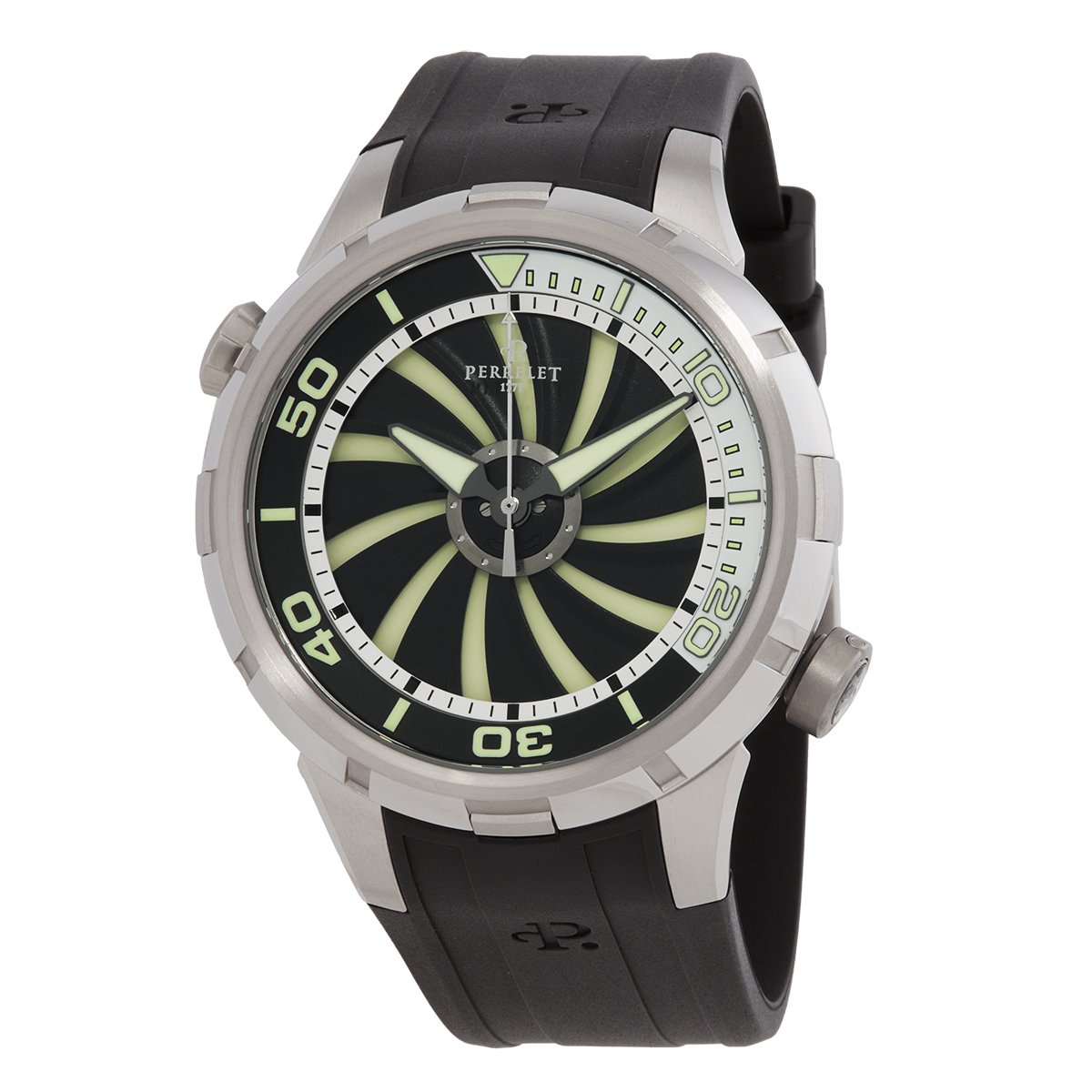
The Turbine collection, launched in 2009, took this concept to its logical extreme. By decoupling the dial-side rotor from the winding system and allowing it to spin freely at high speeds, Perrelet transformed the watch face into a shimmering, kinetic sculpture. The A1067/2 applies this to the maritime world, substituting the standard dial for a blue-and-white motif that reveals itself only when the eleven black anodized aluminum blades are in motion.
Case Construction and Ergonomics
The case of the A1067/2 is a formidable piece of stainless steel architecture. Measuring 47.5mm in diameter, it is undeniably a large watch. However, the technical precision of the case finishing prevents it from feeling unwieldy. The mid-case features the signature Perrelet 'fluting' or vertical grooves, which provide a tactile grip and visual break to the polished surfaces. This fluting is a nod to classical columns, yet in the context of a diver, it feels industrial and purposeful.
One of the most critical elements of a dive watch is the bezel. Unlike traditional divers with external rotating rings, the Turbine Diver utilizes an internal rotating bezel. This is controlled by the crown at the 10 o'clock position. This configuration protects the bezel from accidental knocks during a dive and maintains the clean, circular silhouette of the case. The crown at 4 o'clock handles time-setting and winding, creating a balanced, dual-crown aesthetic that recalls the 'Super Compressor' cases of the 1960s.
The Turbine Mechanism: Physics Meets Aesthetics
The star of the show is the turbine itself. Composed of 11 blades made from lightweight aluminum, the turbine is perfectly balanced to ensure that even the slightest movement of the wearer's wrist sends it into a rapid spin. Underneath the blades lies a sub-dial with a blue and white pattern. When the turbine spins, the blades become a blur, and the sub-dial pattern 'emerges' through the gaps, creating a shimmering effect reminiscent of a propeller underwater.
From a technical standpoint, the challenge for Perrelet was ensuring that the mass of the turbine did not interfere with the hand stack or the overall thickness of the watch. The tolerances are incredibly tight; the blades must clear the hands and the crystal while remaining close enough to the sub-dial to maintain the visual illusion. The use of aluminum is critical here—it provides the necessary rigidity without adding the centrifugal mass that might damage the pivots during a sudden shock.
Movement Analysis: Caliber P-331
Powering the A1067/2 is the Caliber P-331. This movement is a product of the Festina Group’s vertical integration, specifically manufactured by Soprod. The P-331 is a refined version of the Soprod A10, a movement designed to compete with the ETA 2892. It beats at 28,800 vibrations per hour (4Hz) and offers a power reserve of 42 hours.
The finishing on the P-331 is exemplary for this price bracket. Through the sapphire crystal case back, one can observe the circular graining on the plates and the bridges, as well as the custom open-worked rotor. The rotor itself is finished in a dark grey, providing a modern contrast to the rhodium-plated components below. While it lacks the hand-applied anglage of a Patek or Vacheron, the machine-finishing is crisp, clean, and entirely appropriate for a technical tool watch. The movement’s architecture is thin enough to accommodate the turbine module on the front without pushing the total case height into the realm of the unwearable.
Diving Utility and Legibility
Purists often argue that a 'busy' dial is the enemy of a dive watch. Perrelet counters this by focusing on high-contrast hands and markers. The hour and minute hands are oversized and heavily coated in Super-LumiNova, ensuring they remain visible even when the turbine is at full tilt. The internal bezel features a clear 60-minute scale with a prominent luminescent triangle at the zero marker.
The water resistance is rated at 300 meters (1,000 feet), making this a legitimate professional instrument. The crowns are screw-down, and the gaskets are oversized to handle the pressures of deep-sea exploration. During my time with the watch, I found the internal bezel crown at 10 o'clock to be remarkably smooth, with enough resistance to prevent accidental adjustments while still being easy to operate with wet fingers.
Final Thoughts: The Sophisticated Collector's Choice
The Perrelet Turbine Diver A1067/2 is not a watch for the faint of heart. It is a bold statement of mechanical ingenuity and a refusal to follow the path of least resistance. In an industry currently obsessed with 'vintage-inspired' 38mm divers, Perrelet’s commitment to avant-garde, large-scale horology is refreshing.
For the young collector at Vivir, this watch represents an opportunity to own a piece of genuine Swiss heritage (the Perrelet name) combined with modern manufacturing prowess. It is a watch that rewards curiosity—every flick of the wrist provides a new visual experience. While it may not be the only watch in your collection, it will undoubtedly be the one that people ask about most. It is a testament to the fact that even in the serious world of professional diving, there is always room for a bit of technical theater.