The Genesis of a Modern Classic
In the world of luxury horology, the term 'independent' is often thrown around loosely. However, Gaël Petermann and Florian Bedat embody the true spirit of the word. Trained in the rigorous workshops of Renens and having spent time under the tutelage of industry legends like Dominique Renaud, the duo launched Petermann Bedat with a clear vision: to create watches that honor traditional craftsmanship while pushing the boundaries of mechanical ingenuity. The 1826, their first major release, is the physical manifestation of that vision.
The reference 1826 is centered around the deadbeat seconds complication—a mechanism where the seconds hand ticks once per second, similar to a quartz watch, but driven entirely by a mechanical movement. Historically used in marine chronometers for precise timing, the deadbeat seconds is notoriously difficult to execute properly without siphoning too much energy from the escapement. Petermann Bedat solved this through the development of the Calibre 171.
Technical Excellence: The Calibre 171
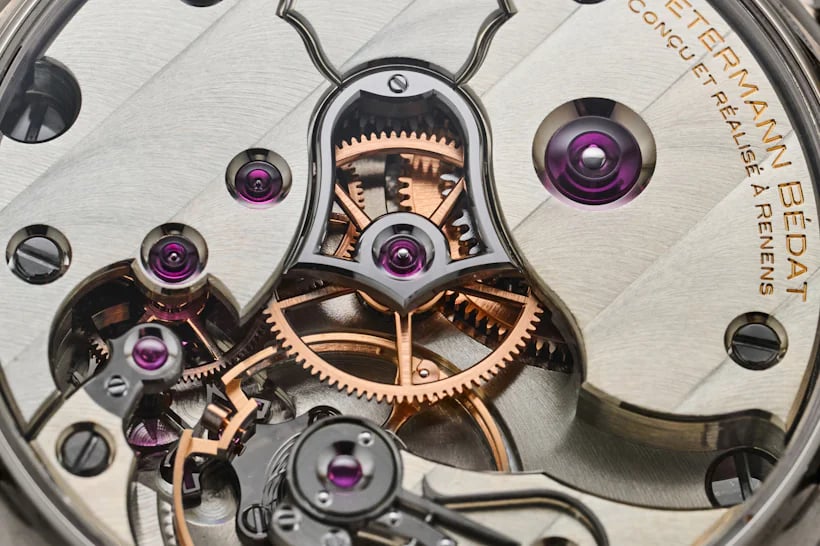
The heart of the 1826 is the Calibre 171, a manual-wind movement that is as much a work of art as it is a feat of engineering. Operating at a traditional 18,000 vibrations per hour, the movement allows the viewer to appreciate the deliberate, rhythmic motion of the balance wheel. The deadbeat seconds mechanism utilizes a four-armed star wheel mounted on the escape wheel arbor. This star wheel interacts with a dedicated lever and spring, which releases the seconds hand at precise one-second intervals.
Beyond the complication, the finishing is where Petermann Bedat truly separates itself from the competition. The bridges are made of German silver, which develops a warm patina over time. Every edge is hand-beveled (anglage) to a mirror shine, and the screw heads are black-polished to perfection. The level of inward angles—a hallmark of true hand-finishing—is staggering for a brand of this age. This is finishing that competes directly with the likes of Philippe Dufour or Rexhep Rexhepi.
Design and Aesthetics
The 1826 features a 39mm case that is quintessentially elegant. The dial is a multi-part construction that offers a glimpse into the mechanical soul of the watch. A semi-open architecture reveals parts of the deadbeat mechanism, providing a sense of depth and technical intrigue without sacrificing legibility. The use of frosted finishes on the dial plates contrasts beautifully with the polished hands and markers.
The choice of a 39mm diameter is a nod to the 'golden ratio' of dress watches. It is large enough to be noticed but small enough to remain sophisticated. The sapphire crystal is slightly domed, adding a vintage touch that complements the traditional movement architecture. The overall aesthetic is one of restrained power—it doesn't shout for attention, but it commands it through the sheer quality of its execution.
The Market Perspective: Investment and Resale
From an investment standpoint, the Petermann Bedat 1826 is currently one of the most sought-after watches in the independent sector. With production limited to just a handful of pieces per year, the supply-demand imbalance is extreme. Retail prices, which were originally around CHF 60,000, have been eclipsed by secondary market results that frequently double or triple that figure.
As an analyst at Vivir, my judgment is that the 1826 is a 'Strong Hold.' The brand is still in its infancy, yet it has already secured a GPHG win and a loyal following among the world's most influential collectors. In the current market cycle, where collectors are increasingly prioritizing 'human-scale' watchmaking over corporate luxury, Petermann Bedat is positioned for long-term growth. The auction history at houses like Phillips and Christie's confirms that the 1826 is not a temporary trend but a foundational piece for any serious independent collection.
The Verdict
The Petermann Bedat 1826 is a rare achievement. It manages to be technically innovative while remaining deeply rooted in the history of Swiss watchmaking. For the collector who demands the highest level of hand-finishing and a complication that is both intellectually stimulating and visually engaging, the 1826 is peerless. While the barrier to entry is high—both in terms of price and availability—the reward is a timepiece that represents the very best of contemporary horology.