Petermann Bédat Ref. 1825: The Collector's Deadbeat
The Petermann Bédat Ref. 1825 is not a watch for the collector who needs a daily liquidity quote before lunch. It is a low-volume independent with a deadbeat-seconds display, a watchmaker-led movement, and a market that rewards patience far more than speed. For young collectors, that is exactly the point. The Ref. 1825 sits in the narrow lane between classical dress watch and modern independent horology, where the buyer is paying for architecture, finishing, and scarcity rather than a logo on a bezel.
In the current market, independents with genuine in-house mechanics and GPHG attention have moved from curiosity to allocation. Petermann Bédat is one of the names that collectors now track, even if the secondary market remains thin and opaque. The Ref. 1825 should be judged as a collector's object first and a resale trade second. It is a hold for the right owner, not a flip for the impatient.
Manufacture history and brand trajectory
Petermann Bédat was founded in Switzerland in 2018 by Gaël Petermann and Florian Bédat. It is a watchmaker-led independent, not a marketing-led start-up, and that matters when you are buying a watch at this level. The brand's first major statement was the Réf. 2941, a split-seconds chronograph that won GPHG's Horological Revelation prize and put the two watchmakers on the collector map.
That prize history has a real market effect. Independent collectors follow GPHG cycles because they create a shortlist of names with peer recognition. It does not create instant liquidity, but it does create demand among buyers who want to be early on a brand before it becomes impossible to allocate. The Ref. 1825 builds on that trajectory with a deadbeat-seconds chronometer rather than another chronograph. It is a narrower, more intellectual proposition, and that is precisely why it appeals to the collector who already has the obvious pieces.
The brand's production is low, its distribution is selective, and its public specification sheets are not as exhaustive as those from large groups. That opacity is frustrating for spreadsheet collectors, but it is also part of the independent-watch reality. The buyer needs to work through the brand or a trusted dealer, confirm the exact current specification, and treat the purchase as a relationship rather than a transaction.
Movement and the deadbeat-seconds story
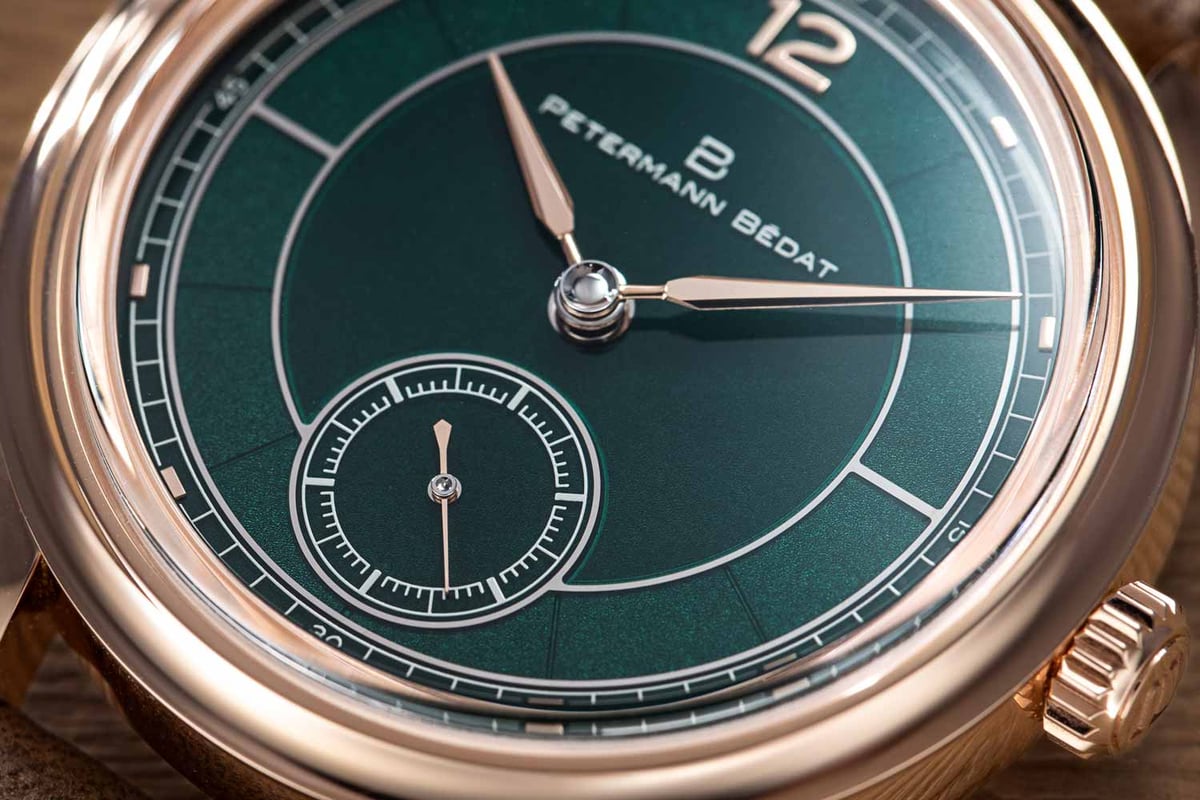
The Ref. 1825 is a manual-wind, in-house watch with a deadbeat-seconds mechanism. That is the headline. A deadbeat seconds, or seconde morte, makes the seconds hand tick once per second rather than sweep. In a mass-market quartz watch it is ordinary; in a mechanical independent it is a piece of horological theatre that requires additional mechanism and careful regulation.
Petermann Bédat does not publish every conventional movement figure in the materials reviewed for this reference. We are not going to invent a power reserve, frequency, or jewel count to fill a table. What matters is the architecture: this is a watchmaker's movement, finished for visual and mechanical pleasure, and it should be judged on execution rather than on a spec-sheet checklist. The deadbeat seconds is not a rate guarantee, either. It is a display complication. The chronometry positioning of the watch is separate from the visual tick.
For collectors, the movement is the reason to pay the independent premium. The case and dial are restrained; the mechanism is where the brand earns its keep. Ask for detailed movement photography, service history if pre-owned, and a timing sheet. On an independent watch, paperwork and transparency are part of the asset.
Specifications and what is actually published
The public specification picture for the Ref. 1825 is intentionally lean. Case diameter, case thickness, lug-to-lug, water resistance, and jewel count are not published in the materials reviewed, so we leave those fields blank rather than substituting typical independent-watch numbers. That is not a knock on the watch; it is a warning to the buyer. If you need a dimension before you commit, request it directly from Petermann Bédat or an authorized retailer.
What we can say is that the watch is configured as a dress-oriented piece with a sapphire crystal, a leather strap, and a pin buckle. Lume is not part of the brief. This is not a desk-diver or a travel watch. It is a mechanical object for the collector who wants a formal watch with an independent heartbeat.
The absence of published water resistance is worth noting for daily wear. Do not assume sports-watch protection. Treat the Ref. 1825 like a dress watch, keep it away from water, and confirm the brand's official guidance before you wear it in anything more than incidental exposure. The same logic applies to case material: if the exact alloy matters to you, get it in writing on the current order form.
Wrist feel and presence
On the wrist, the Ref. 1825 reads as a dress-adjacent independent. The round case and restrained lugs keep it close to the cuff, while the leather strap gives it a formal, old-school character. Because verified case dimensions are not published in the sources reviewed, fit should be confirmed in person or through the brand. Collectors with smaller wrists should not assume a universal fit, and collectors with larger wrists should not assume it will feel substantial.
The deadbeat seconds changes the experience. A conventional dress watch has a smooth sweep that almost disappears. The Ref. 1825 gives you a visible pulse, a one-per-second beat that makes the watch feel alive in a different way. It is not loud or aggressive; it is a quiet mechanical signal for the owner rather than for the room. That is exactly the kind of detail that keeps a collector engaged after the honeymoon phase.
Wrist presence is a 4/5. It is not a statement piece in the way a gold sports watch is. It is discreet at a dinner, but immediately legible to someone who knows the independent scene. The pleasure is in the recognition, not in the attention.
Accuracy and daily expectations
No COSC certification is claimed for this reference in the public materials reviewed. The deadbeat seconds is not a rate guarantee, and collectors should not confuse chronometry positioning with a modern METAS-style certification. Expect independent-watch variance. A well-regulated example should be comfortably wearable, but the buyer should ask for a timing sheet and a service history if buying pre-owned.
Daily use is realistic if you treat the watch properly. It is a manual-wind piece, so routine winding becomes part of the ownership ritual. The lack of lume and the dress-watch brief mean it is not the watch for a beach holiday or a gym session. It is the watch for a desk, a dinner, and a collection where the owner enjoys the act of winding and checking the beat.
Occasions and versatility
The Ref. 1825 is at its best with formal and dress attire. It works with a suit, a jacket, or a dark knit, and it has enough independent-watch character to avoid looking generic. It can be a daily watch for someone who works in a dressier environment or rotates several watches, but it is not a sports watch and should not be pushed into that role.
For travel, the lack of published water resistance and the dress-watch construction make it a secondary choice. If you want one watch for a week of meetings and dinners, it works. If you want one watch for a week of airports and pools, it does not.
Variants and family references
The Ref. 1825 is a single reference in the current Petermann Bédat family, with dial and strap combinations varying by order or allocation. Collectors should confirm the exact dial color and strap configuration on the order form, because independent brands often keep small variations outside the public catalog. The key family reference is the Réf. 2941, the split-seconds chronograph that established the brand's reputation. The 1825 is the quieter, more classical sibling: less theatrical, more intellectual, and just as focused on movement execution.
Similar watches and affordable alternatives
In the independent space, the F.P. Journe Chronomètre Souverain is the obvious comparison: a dress-chronometer with a strong collector base and much better secondary-market liquidity. The Philippe Dufour Simplicity is the hand-finish benchmark, but it operates at a completely different price level. The Voutilainen Vingt-8 and Grönefeld 1941 Remontoire are also collector-grade independents with visible mechanical character. None of them are direct substitutes, but they occupy the same consideration set for a buyer who wants low-volume watchmaking rather than a group-brand dress watch.
For affordable alternatives, the Seiko Presage Cocktail Time and Orient Bambino deliver a classical dress-watch look at a fraction of the price. The Tissot Le Locle is another formal option. None of these offer a deadbeat-seconds mechanism or independent finishing, so they are stylistic homages rather than mechanical equivalents. That is fine. The point of an homage is to scratch the visual itch while you save for the real thing.
Investment value and resale outlook
The Ref. 1825 is not a liquid asset. There is no broad public resale index for it, and auction history is limited. MSRP and current retail are not publicly listed in the materials reviewed, so we are not going to invent a number. The pre-owned market is price-on-request and relationship-driven. That means the buyer should focus on provenance, completeness, and service history rather than on a short-term spread.
The trend is stable rather than appreciating in a straight line. Petermann Bédat has real collector credibility, and the brand's GPHG-winning trajectory supports demand. But thin liquidity cuts both ways: it supports scarcity and it makes exits slow. If you buy at retail, hold, and enjoy the watch, the risk is manageable. If you buy as a flip, you are taking a liquidity risk that the watch does not deserve.
The hold recommendation is straightforward. Hold if you are allocated at retail or buy from a trusted collector at a sensible level. Do not chase the watch at a premium without a clear exit plan. The Ref. 1825 is a collector's object, and the best returns are often measured in ownership pleasure rather than in a quick resale multiple.
Service and ownership
Service intervals and costs are not publicly specified for this reference. The brand is small, so authorized-only service is the prudent route. Confirm lead times, parts support, and shipping logistics before purchase, especially if you are buying pre-owned. An independent watch without clear service access is a different proposition from one with a documented path back to the maker.
Ownership is about more than the watch. It is about the relationship with the brand, the ability to get parts, and the confidence that the movement can be maintained. Ask questions. Get answers in writing. That is how serious collectors buy independents.
Pros and cons
The pros are clear: an in-house manual-wind movement, a deadbeat-seconds complication with chronometry focus, a GPHG-winning brand trajectory, and low-volume collector appeal. The cons are equally clear: opaque public specifications and pricing, a limited service network, thin secondary-market liquidity, and no COSC certification. The buyer who wants a frictionless luxury product should look elsewhere. The buyer who wants a watchmaker's watch will understand the trade.
Final verdict
The Petermann Bédat Ref. 1825 is a collector's watch first and a daily driver second. It rewards buyers who value independent watchmaking, deadbeat seconds, and scarcity over resale speed. Hold if allocated; buy pre-owned only with provenance and a service plan. In a market full of safe choices, it is a watch for the collector who wants a mechanical pulse and a story.