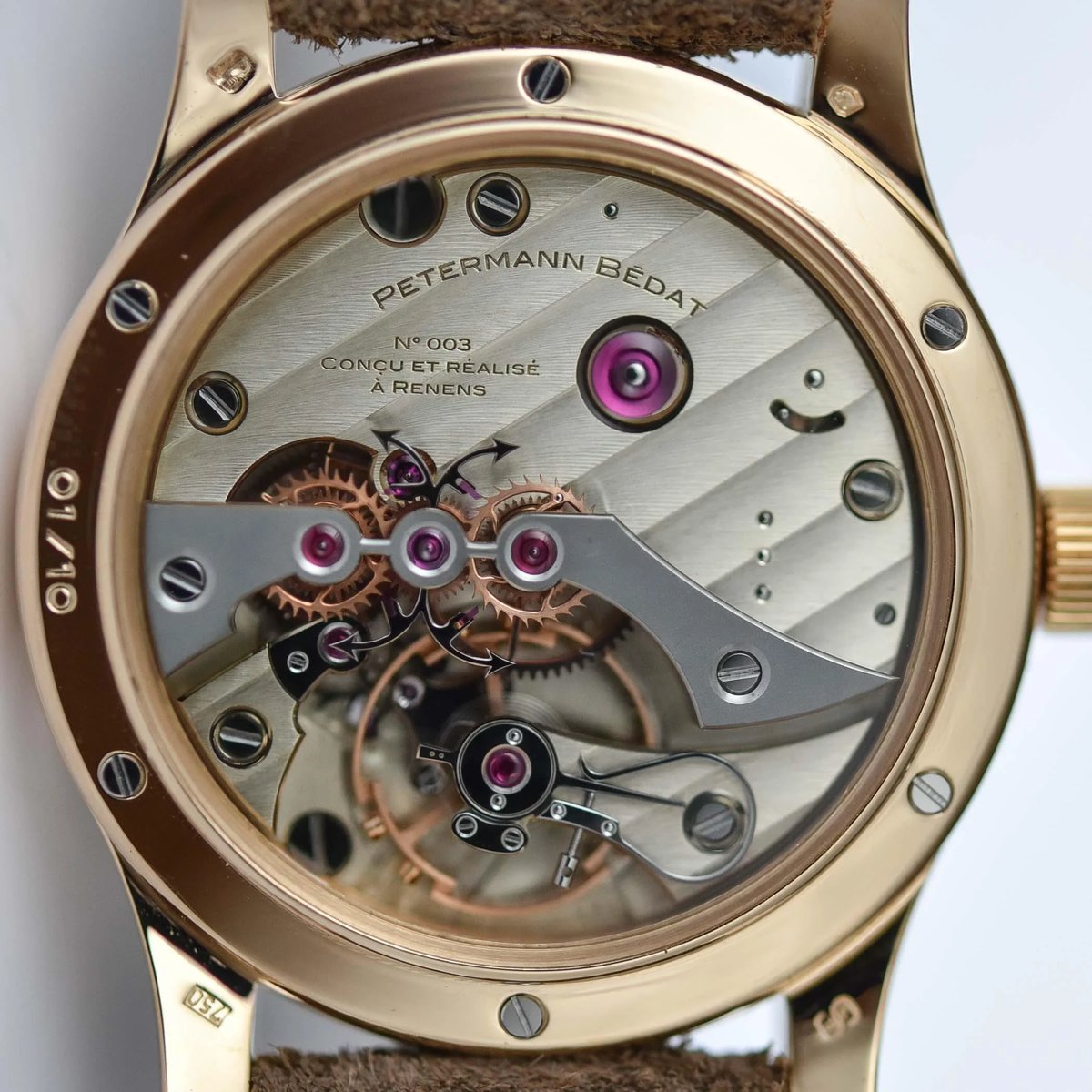
Every independent maison gets one chance to make a first impression, and Petermann Bédat spent theirs on a deadbeat seconds. The Référence 2941, revealed in 2019 and awarded the Horological Revelation prize at the 2020 Grand Prix d'Horlogerie de Genève, was a study in restraint: no tourbillon, no astronomical theatre, just a seconds hand that ticked once per second with the deliberateness of a regulator clock. It announced two watchmakers more interested in the discipline of horology than in its performance.
The second act is harder. The Référence 2914 is a split-seconds chronograph — the rattrapante, the most demanding of the classical complications, and the one that most exposes a finisher's hand. Two chronograph hands run in perfect synchrony until the wearer stops one to read an intermediate time, then releases it to snap back and rejoin the other in flight. That snap is the whole game: it demands a clamp, an isolator, and a level of adjustment that no amount of industrial tooling can shortcut.
What Petermann Bédat has built is not a maximalist showpiece. It is a quiet, hand-finished answer to a question the classical chronograph has been asking for a century — and it is made in numbers so small that most collectors will never see one in the metal.
The maison behind the reference
Gaël Petermann and Florian Bédat founded their maison in Geneva in 2018, after formative years spent inside established Swiss houses learning how the large makers actually finish, assemble and regulate. That apprenticeship shows. There is nothing naive about the 2914: the architecture is orthodox where orthodoxy serves reliability, and idiosyncratic only where the maker has a better idea.
The house model is not the one the industry usually pursues. There is no boutique network, no ambassador programme, no annual novelty calendar. Production is counted in single digits per year, watches are finished to order, and the small team does the regulating itself. The 2941 proved the maison could execute a difficult escapement concept with composure; the 2914 proves it can do the same with the most fragile mechanism in the classical repertoire, where a single poorly adjusted clamp will produce a stutter the wearer will feel through the crown.
Case and dial: restraint as a design position
The case is platinum, round, and unapologetically classical. There are no crown guards, no integrated lugs, no bezel architecture competing with the dial for attention. What separates it from the ordinary is proportion and finish: the caseband is slim, the lugs are shaped to drop away from the wrist rather than flare outward, and the polishing is broken by satin flanks in the manner of mid-century chronographs rather than in the manner of modern luxury goods. Platinum here is not a marketing decision. It gives the watch a density and a coolness that changes how it feels in the hand, and it patinates slowly into a soft grey lustre rather than scratching into brightness like steel.
The dial is where the maison's vintage instincts are most legible. Two registers balance the composition — running seconds and a chronograph minutes counter — with the central chronograph seconds and the split-seconds hand stacked coaxially above it. That stack is the only visual flourish the watch permits itself, and it is a functional one: you can see, at a glance, that there are two hands where most watches have one.
Typography and layout are austere. No tachymeter, no telemeter, no date aperture, no lume. The 2914 refuses the entire vocabulary of the modern sports chronograph and instead aligns itself with the dress chronographs of the 1940s and 1950s, watches built to time a train connection rather than a lap. The result is a dial that reads instantly and rewards close inspection, particularly around the registers where the finishing of the hands and the crispness of the printing do the work that a busier design would disguise.
The movement: a rattrapante with nothing to hide
Petermann Bédat builds its own movements, and the calibre inside the 2914 is a hand-wound split-seconds architecture rather than a base movement carrying a chronograph module. This distinction matters more than any specification sheet can convey. A module bolts a complication onto an existing gear train; an integrated calibre is designed around the complication, with the going train, the switching mechanism and the split-seconds assembly resolved as a single problem.
The chronograph is actuated by a single pusher, with the split function given its own discreet control — a layout that keeps the caseband clean and forces the wearer into a deliberate sequence rather than a fumbled one. Start, stop, reset, split, release: each actuation has a defined beginning and end, and the maker has tuned the feel so that the pusher travel is short and the engagement is crisp without being abrupt.
How the split-seconds stays honest
A rattrapante is essentially two chronographs sharing one gear train. The second hand is driven by a heart-shaped cam and held by a clamp; when the wearer splits, the clamp closes on the moving hand and arrests it, while the primary chronograph hand continues. Release the splitter and the clamp opens, and the split hand's heart cam allows it to catch up instantly. In a badly executed mechanism, that catch-up is a lurch — the hand overshoots, vibrates, or hesitates before rejoining.
The harder engineering problem is amplitude. Arresting a hand mid-flight loads the gear train, and on a less sophisticated design the balance visibly loses amplitude the moment the split is engaged. Petermann Bédat's calibre incorporates an isolation system that decouples the split-seconds assembly from the going train when it is not needed, so the movement's rate is protected during normal running and only momentarily disturbed during an actual split. It is the kind of solution a watchmaker develops after watching a timing machine rather than a mood board.
Finishing
The finishing is where the maison's training shows most clearly, and it is deliberately visible through a sapphire caseback. Bridges are frosted rather than striped, giving the movement a soft, granular surface that scatters light differently from the usual Côtes de Genève. Edges are anglaged and polished by hand — including, crucially, the internal angles where a bridge meets a recess, the detail that separates a hand-finished movement from an industrially finished one that merely imitates it.
The steel work is black-polished. This is the most punishing finish in watchmaking: a steel lever is drawn across a rotating tin lap charged with diamond paste until its surface becomes a mirror so flawless that any residual scratch is visible at arm's length. It cannot be corrected once it fails; it can only be re-polished from scratch. A rattrapante has more of these components than an ordinary watch — the clamp, the isolator, the levers of the switching mechanism — and finishing them all to that standard is why this reference exists in such small numbers.
Wheels are circular-grained, screws are thermally blued, and the chronograph mechanism is left on display rather than concealed beneath a plate. Nothing in this movement is finished to be photographed; it is finished because the maker would know if it were not.
On the wrist
This is a dress chronograph in the old sense of the phrase. It sits close, wears flat, and asks nothing of a cuff. The platinum case gives it a settled gravity that steel cannot replicate — you notice the weight when you pick it up, and you forget it once it is on. The lugs are shaped to drop rather than flare, so the watch centres cleanly and reads smaller than its footprint suggests, which is precisely what you want from a piece that will spend most of its life under a sleeve.
The strap is hand-stitched leather, soft from the first wear, and the pin buckle keeps the whole assembly low-profile. There is no crown guard, no screw-down hardware, no lume interrupting the dial. Nothing on this watch is there to solve a problem the owner does not have. The result is a piece that disappears in the office and then rewards every time the sleeve comes up — and because the split-seconds hand sits visibly stacked over the chronograph seconds, the watch communicates its rarity only to the person who knows what they are looking at.
Rate and reliability
There is no chronometer certification here, and the maison does not court it. The priority is the behaviour of the chronograph, not a certificate. In practice, a well-regulated example should hold within a few seconds a day, with the usual caveat that a low-beat balance and a hand-wound mainspring reward consistent wearing habits. Expect the rate to tighten slightly after a service once the movement has settled, and to drift marginally as the reserve runs down.
The more interesting question is what happens under load. Engaged chronographs, and above all a split-seconds mechanism, impose genuine torque on the going train. The isolation system exists precisely so that the balance does not sag when the wearer splits the hands. In daily use that means the watch should not visibly lose rate while the chronograph is running — the mark of a properly resolved rattrapante rather than merely a working one.
Owning one: service, scarcity and value
Ownership of a watch like this is a relationship rather than a transaction. Service returns to the manufacture, where the movement is stripped, the rattrapante clamp and isolator are re-adjusted by hand against a timing machine, and the case is refinished to the maker's specification. Independent watchmakers will not have access to parts or to the adjustment specifications for the split mechanism, so the practical alternative to a factory service does not exist. The upside is that the maker knows every example it has built, and the small team that assembles the watch is the same team that maintains it.
Pricing for the 2914 is negotiated rather than posted. Expect a six-figure figure and expect the real constraint to be allocation rather than budget: production is measured in single digits per year and existing clients absorb most of it. On the secondary market, examples almost never appear at public auction, and the private market between collectors reflects that scarcity — values have moved upward since launch rather than settling, which is unusual for a complication that costs real money to maintain.
The value argument is straightforward. A mainstream split-seconds chronograph from a large maison buys you a hallmarked name and a service network. The 2914 buys you a hand-finished in-house rattrapante from a two-person maison operating at the limit of what small-scale production allows, in a platinum case, with a complication whose adjustment costs are baked into the price. That is a different kind of asset, and it has historically held better.
Alternatives worth considering
The obvious comparison is F.P. Journe's monopoussoir rattrapante, the benchmark modern split-seconds from a Geneva independent, which shares the 2914's insistence on visible mechanism but operates at a very different scale of production and price. A. Lange & Söhne's 1815 Rattrapante offers a German interpretation of the same complication, more architectural in its finishing and vastly more available. Vacheron Constantin's Traditionnelle Split-Seconds represents the establishment Geneva view, and Patek Philippe's 5372P demonstrates what happens when the same complication is mated to a perpetual calendar and priced accordingly.
What none of them offer is the specific proposition of the 2914: a classical, unlumed, two-register dress chronograph with an integrated in-house rattrapante, built by the people who will also service it, in numbers that guarantee you will not see another one at dinner.
Verdict
The Référence 2914 is the rare second act that improves on a celebrated debut. It is a split-seconds chronograph built with the patience of a restoration rather than the ambition of a launch, and it asks the wearer to value adjustment over spectacle. For the collector who already owns the obvious things, this is one of the most quietly consequential watches being made in Geneva today — and the fact that so few will ever own one is not a marketing position but an honest consequence of how it is made.