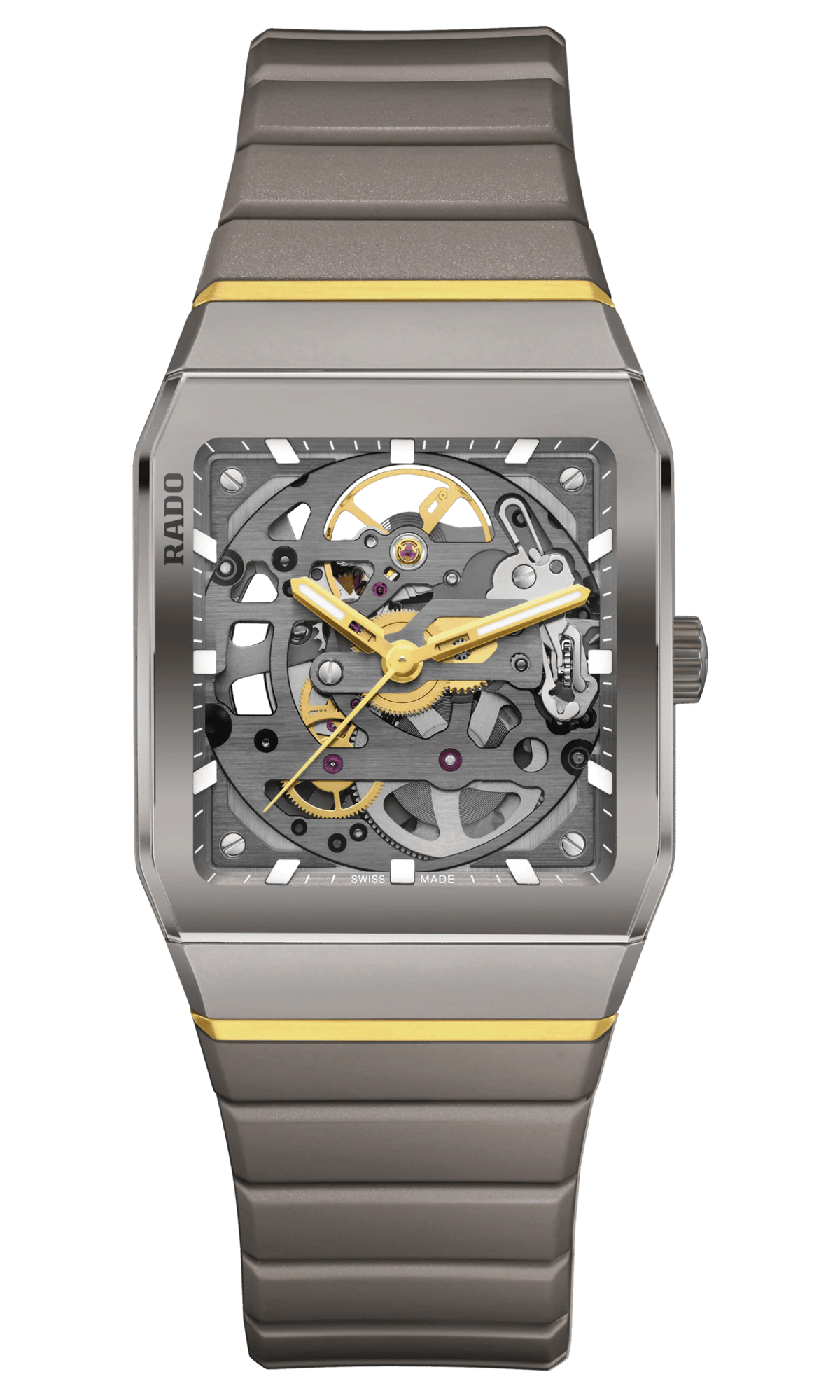
Rado Anatom Automatic Skeleton: the quiet flex of ceramic and openwork
Rado is not the brand collectors whisper about at auction, and that is exactly why the Anatom Automatic Skeleton works. It arrives without the usual hype tax: no waiting list, no grey-market premium, no mythology built on a decade of scarcity. What it offers instead is more interesting for a certain kind of young collector: a high-tech ceramic case, an integrated bracelet, and a skeletonized automatic movement with an 80-hour reserve. It is the watch you wear when you want something architectural and a little weird, but you do not want to spend the evening explaining why your watch costs more than a car.
The Anatom name is the hook. Rado first used it in the 1980s for an ergonomically shaped watch, long before every brand with a CNC machine discovered the tonneau case. The new Anatom Automatic Skeleton revives that silhouette and pushes it into open-dial territory. This is not a heritage reissue with a vintage dial and a patina story. It is a modern Rado: ceramic, lightweight, scratch-resistant, and unapologetically design-led. The skeleton version adds a layer of mechanical theatre that the standard Anatom does not have, and that changes who the watch is for.
Is it a serious collector piece? Not in the investment sense. Is it a serious daily wearer with a point of view? Yes. The Anatom Skeleton occupies the same mental space as an integrated-bracelet sports watch, but it refuses the usual steel-and-black-dial formula. That alone makes it worth a look.
Rado history and the Anatom lineage
Rado was founded in 1917 in Lengnau, Switzerland, and built its modern identity on materials that other watchmakers treated as industrial curiosities. The brand made its name with scratch-resistant cases, sapphire crystals, and high-tech ceramic at a time when ceramic was more commonly associated with kitchen knives than luxury watches. The DiaStar, the Integral, and the Captain Cook all sit in that story, but the Anatom is the model that best captures Rado's ergonomic streak.
The original Anatom arrived in the 1980s as a watch shaped around the wrist rather than a circle screwed onto a strap. It was not a conventional dress watch, and it was not a tool watch in the military sense. It was a design object with a practical argument: a curved case and integrated bracelet can wear better than a round case with lugs. The new Anatom Automatic Skeleton picks up that argument and adds an openworked movement. Rado is currently known for the Captain Cook and the True Square, but the Anatom is the sleeper in the catalogue. It has the brand's material story, a distinctive case, and now a movement you can see through.
Movement: Rado Calibre R808
The engine is Rado Calibre R808, an automatic movement with an 80-hour power reserve, 25 jewels, and a frequency of 21,600 vibrations per hour. It is a Rado-branded calibre from the Swatch Group ecosystem rather than a fully in-house haute-horlogerie movement. That matters for context, not for daily life. The R808 is a modern workhorse with a generous mainspring, and Rado has skeletonized it with open bridges and an openworked rotor so the watch reads as mechanical jewellery rather than a closed case with a dial.
The 80-hour reserve is the practical headline. Put the watch down on Friday night and it will still be running on Monday morning. That is the difference between a skeleton watch you wear occasionally and one you can actually live with. The 21,600 vph frequency is on the lower side compared with 28,800 vph movements, which generally means a slightly slower sweep and a different feel through the winding action, but the R808 is not a high-beat showpiece. It is tuned for reserve and reliability.
Finishing is industrial-modern rather than Geneva-standard. You will see anglage-like bevels, openworked bridges, and a rotor that lets the mainplate show through, but this is not a watch where the movement alone justifies the price. The value is in the combination: ceramic case, integrated bracelet, skeleton dial, and an 80-hour automatic. If you want hand-finished bridges and a name that belongs in a safe, this is the wrong watch. If you want a tactile, legible-enough skeleton for daily wear, the R808 makes sense.
Case and bracelet: ceramic as a design language
The Anatom Automatic Skeleton uses high-tech ceramic as its primary case material, and the bracelet continues that material story. Rado is one of the few brands that can make ceramic feel native rather than like a novelty. The case has the Anatom's tonneau-inspired shape, with a curved profile that flows into the bracelet. The skeleton dial is framed by warm gold-tone accents on the black ceramic reference, which gives the watch a dressier edge than a full-black tactical look.
I am intentionally not quoting case diameter, thickness, lug-to-lug, or water resistance here. Rado's reference sheets vary by market and variant, and a review that invents a number is worse than one that tells you to verify the exact reference before buying. What I can say is that the Anatom is designed as an integrated watch. The bracelet is not an afterthought; it is part of the silhouette. The folding clasp is secure, and the ceramic links give the watch a smooth, dense feel that steel cannot replicate. Ceramic is scratch-resistant, but it is not impact-proof. Treat it like a ceramic watch, not a hammer.
The bracelet's ceramic links are the reason the watch feels more expensive than its price point. They catch light in a way that brushed steel does not, and they stay looking new for longer. The trade-off is that ceramic can chip or crack under a hard knock, and resizing usually requires the right links or a trip to an authorized dealer. If you are rough on your watches, a steel sports watch is the safer choice. If you like the idea of a daily watch that still looks sharp after a year of desk duty, ceramic is the argument.
Wrist feel and presence
The Anatom is a tonneau-shaped integrated-bracelet watch, so the first sensation is continuity: the case flows into the bracelet and the whole thing reads as one ceramic object. On wrist, it feels lighter than a steel sports watch of similar visual mass, and the high-tech ceramic has that dense, glassy smoothness Rado has built its reputation on. The short, curved profile is the key. It keeps the watch close to the wrist rather than letting it perch, and the bracelet carries the visual weight instead of a thick caseback.
I would not call it a featherweight, but the balance is better than most skeletonized integrated bracelets because the case is not trying to be a chunky diver. The folding clasp is secure, and the ceramic links resist scratches in daily wear. For smaller wrists, the tonneau shape and integrated lugs do more work than a raw diameter number. For larger wrists, it still has enough presence because the bracelet is wide and the open dial catches light. On the wrist, it reads as modern, slightly retro, and more expensive than the badge suggests. That is a rare combination.
Wrist presence is a 4 out of 5. It is not a statement piece in the way a gold Daytona or a Royal Oak Offshore is, but it has a distinct silhouette that people notice. The skeleton dial gives it movement and depth, and the ceramic bracelet makes it look intentional. It is the kind of watch that gets a question at dinner from someone who knows watches, not from the whole table.
Accuracy and daily ownership
The R808 is an 80-hour automatic, so the practical ownership story is generous: put it down Friday and pick it up Monday without resetting. It is not COSC-certified, so expect normal mechanical variation. A few seconds a day, depending on position and power reserve, is the realistic expectation. Skeletonized movements can be a little more sensitive to positional variation, but the R808 is a modern workhorse architecture, not a fragile showpiece. In daily wear, judge it by consistency rather than chronometer papers: wind it regularly, let it settle, and check it against a phone once a week.
If you need quartz certainty, this is not that watch. If you want an automatic with weekend-proof reserve and enough visual drama to justify the service, it delivers. The open dial does not hurt accuracy, but it does make you more aware of the movement. You will notice the rotor, the bridges, and the mainspring barrel. That is part of the appeal. It is also a reminder that this is a mechanical object, not a sealed appliance. Keep it away from strong magnets, avoid dropping it on tile, and it will behave like a modern automatic should.
Occasions: where it works
The Anatom Skeleton is more versatile than its skeleton dial suggests. It works as a daily watch because the ceramic case and bracelet are robust in the scratch-resistance sense, and the 80-hour reserve makes it easy to rotate. It works as a dress watch because the tonneau shape and gold-tone accents give it a jewellery quality that a steel dive watch does not have. It works for formal occasions if you keep the rest of the outfit sharp. It works for sport in the sense of a casual weekend watch, but I would not take it to the gym or the beach. Ceramic is not the material for contact sports.
Travel is fine as long as you do not need a GMT or a world timer. The skeleton dial is not the most legible in low light, and there is no lume. That is not a flaw for this watch; it is a design choice. If you want a watch that glows in a cinema, look elsewhere. If you want a watch that looks like a piece of architecture on your wrist, the Anatom Skeleton is the point.
Variants, family, and alternatives
The reference I used for this review is R10201152, the black ceramic skeleton with warm gold-tone accents. The reference variants list in the data above should be checked against the exact market you are buying in, because Rado rotates dial accents and bracelet finishes. The core recipe stays the same: ceramic case, integrated bracelet, R808 automatic, open dial. If you see a variant with a different accent colour, assume the movement and case architecture are the same unless the dealer tells you otherwise.
The Anatom family includes the original 1980s Anatom, the modern Anatom Automatic, and this Anatom Automatic Skeleton. The standard Anatom Automatic is the quieter, more legible alternative. The Skeleton is for buyers who want the movement to be the dial. Within Rado, the Captain Cook is the dive watch, the True Square Skeleton is the square ceramic alternative, the DiaStar is the retro-futurist icon, and the HyperChrome is the sportier ceramic option. The Anatom sits between dress and sport, which is why it feels different from the rest of the catalogue.
Similar watches from other brands include the Tissot PRX Powermatic 80 Skeleton, which offers an integrated bracelet and an open dial at a lower price. The Bell & Ross BR 05 Skeleton is the architectural alternative with a square case and a more industrial feel. The Zenith Defy Skyline Skeleton is the high-end version of the same idea, with a more elaborate movement and a much higher price. If you want the Rado's ceramic case and tonneau shape, none of these are direct substitutes. If you want the look of an integrated skeleton, they are worth trying on.
Homage territory is murkier. Budget brands have produced skeletonized integrated-bracelet watches that borrow the general idea, but they do not match Rado's ceramic case or movement reserve. A generic Pagani Design skeleton integrated-bracelet model might cost around $180 and give you the silhouette, but it will not give you the material feel or the R808. Buy a homage if you want to test the style. Buy the Rado if you want the real thing.
Investment value and service
The Anatom Automatic Skeleton is not an investment watch. Rado does not have the auction gravity of Rolex, Patek Philippe, or Audemars Piguet, and skeletonized ceramic watches are not the first category collectors chase when money gets tight. The MSRP is around $3,200, and pre-owned examples typically trade below that. The trend is depreciating, which is normal for a modern Rado. Buy it because you like the design, not because you expect it to appreciate.
That said, the value proposition is strong for a discerning buyer. At the street price, you are getting a high-tech ceramic case, an integrated ceramic bracelet, an 80-hour automatic, and a skeleton dial that looks like nothing else in the price range. The hold recommendation is simple: if you want one, buy pre-owned or negotiate retail. Do not stretch for it as an asset. Wear it, enjoy it, and accept that it will lose some value like most watches in this tier.
There is no major auction history for this reference. Service should go through Rado authorized centers because of the ceramic case and skeletonized movement. I have left the service interval and approximate cost blank in the data because those figures vary by region and condition. The safe assumption is that a full service will be more involved than a standard steel automatic, and you should factor that into the ownership cost. Authorized-only is the right approach for ceramic parts and movement work.
Pros and cons
Pros: the high-tech ceramic case and bracelet are scratch-resistant and visually distinctive. The R808 automatic offers an 80-hour power reserve, which makes it a genuinely usable daily watch. The skeleton dial is more interesting than the standard Anatom, and the tonneau shape gives it a silhouette you do not see on every wrist. The price is reasonable for a ceramic integrated bracelet with an openworked movement.
Cons: the skeleton dial can be busy, and legibility is not its strong point. Ceramic is scratch-resistant but not impact-proof, so it is not a beater. Rado does not hold value like the usual steel sports suspects. Service is authorized-only and potentially costly. If you want a simple, legible, go-anywhere watch, the standard Anatom Automatic is the smarter buy.
Final verdict
The Rado Anatom Automatic Skeleton is a smart, culture-forward alternative to the endless steel integrated-bracelet watches that dominate the conversation. It has a real design argument, a usable 80-hour movement, and a ceramic case that feels unlike anything else at its price. It is not an investment, and it is not for buyers who need lume and 300 metres of water resistance. It is for the collector who wants a watch with a point of view and does not need the market to validate it.
If you are drawn to the Anatom shape, the Skeleton is the version to get. It turns a quiet Rado into a conversation piece without turning it into a hype object. That is a rare balance, and it is why the Anatom Automatic Skeleton deserves a place on the shortlist for young collectors who care more about design than resale.