The shape that refuses to age
Rado has spent more than sixty years insisting that a watch should survive its owner. The DiaStar arrived in 1962 with a claim nobody else was making: the first scratch-resistant watch, protected by a Hardmetal bezel of tungsten carbide so hard that keys, doorframes and desk edges simply bounce off it. The shape that carried that claim — a wide, faceted, almost shield-like oval that sits somewhere between a cushion case and a pebble — became one of the most recognisable silhouettes in Swiss watchmaking and, quietly, one of the most imitated. It is also, for a great many collectors under forty, a watch they have seen in photographs and never seriously considered strapping on.
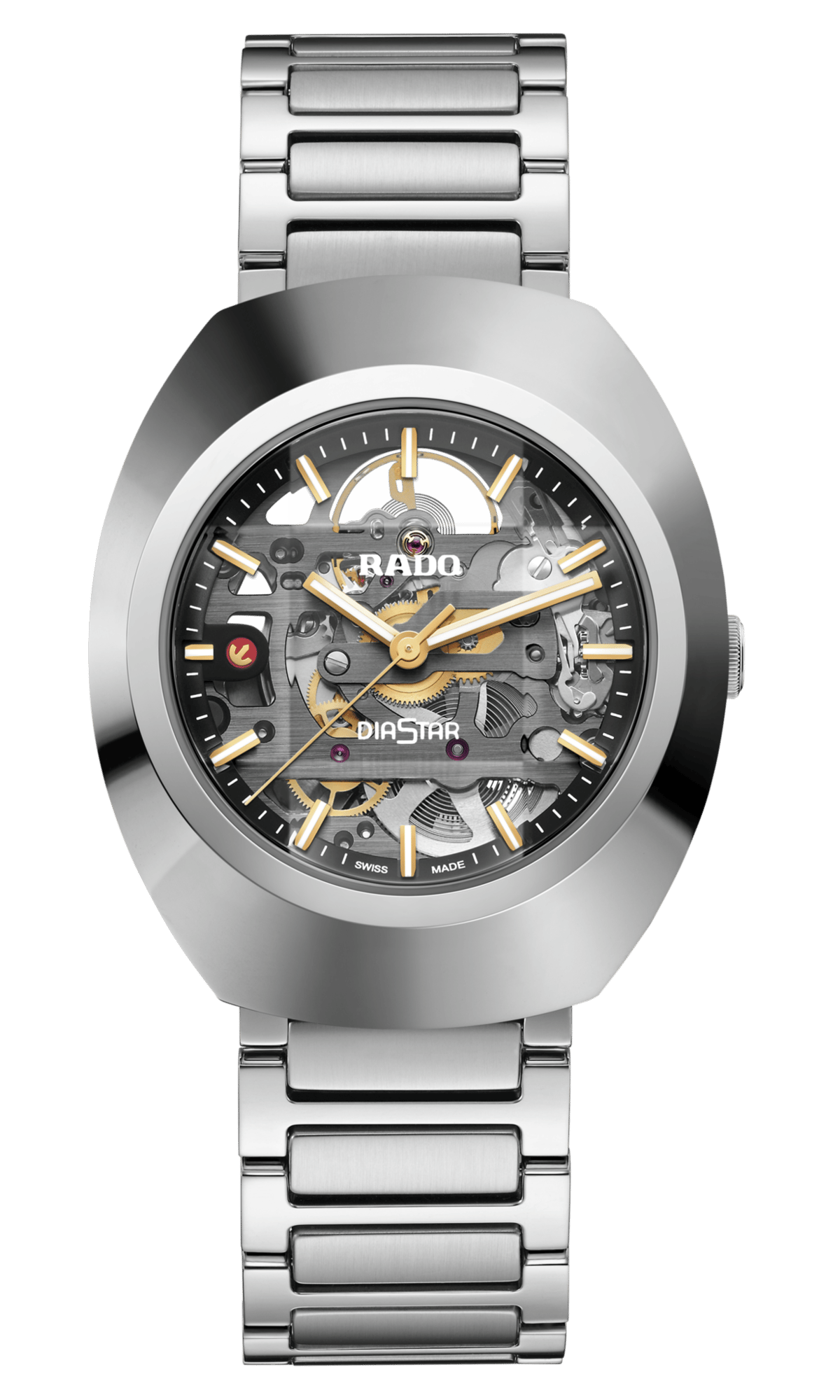
The DiaStar Original Skeleton is Rado's attempt to fix that. Keep the archival case, keep the Hardmetal bezel, and cut the dial away until the R808 automatic underneath becomes the entire point. Sapphire on both sides. A bracelet option that finally looks like it belongs in this decade rather than 1974. It is a strange, confident, faintly retro-futurist object — and, this is the part that surprised me, it is genuinely comfortable for a full week of real wear.
This is not a watch you buy for a spec sheet. It is a watch you buy because the proportions work on small and medium wrists, because the bezel means you can stop flinching every time you reach for a door handle, and because the view through the crystal is worth the money. The caveats are real too, and I will get to them.
A short history of an odd idea
Rado began in 1917 in Lengnau, Switzerland, as a movement-supply house founded by the Schlup brothers, and only took the Rado name in the 1950s. It joined what would become the Swatch Group in 1983. Across all those decades the brand has been consistently, almost stubbornly, interested in materials rather than complications: ceramic, sapphire, Hardmetal, high-tech diamond-like coatings. Where other houses chase chronometer certificates, Rado chases hardness and lightness.
The DiaStar is the purest expression of that. It was never a watch for people who wanted a movement to admire; it was a watch for people who did not want to think about their watch at all. That is precisely why the Skeleton is such a curious object: it takes a design founded on the idea of a protected, sealed, indifferent case and turns it inside out, exposing the very thing the original was built to hide behind a solid dial.
Somehow it works. The DiaStar's bezel was always the star of the show, and openworking the dial does not diminish it — it gives the eye somewhere to travel after the initial hit of that faceted ring of grey alloy.
The movement: an 80-hour workhorse, undressed
Inside is Rado's Calibre R808, an automatic drawn from the Swatch Group's 80-hour family and fitted with a Nivachron hairspring for magnetic resistance. It runs at 21,600 vibrations per hour — 3 Hz, the practical choice for a long mainspring — and it is skeletonised, with openworked bridges and plates finished in muted anthracite and grey tones rather than the gilded frippery you often see at this price.
That restraint is the right call. A gold-plated skeleton in a Hardmetal case would feel like a costume. The grey, industrial finish reads as engineered rather than decorative, and it plays well against the darker bezel. You get sapphire on the front and sapphire on the back, which matters more than usual here: the reverse side shows the skeletonised oscillating weight doing its slow orbit, and with an 80-hour reserve you will see it move a great deal over a weekend off the wrist.
Practically, 80 hours is the single most useful thing about this watch. Take it off on Friday evening and it is still running and still roughly correct on Monday morning. For anyone who rotates two or three watches, that removes the entire ritual of resetting and rewinding — a small thing that becomes a large thing by the third week of ownership. The Nivachron hairspring is a quiet bonus in a world of laptops, tablets and magnetic clasp bags.
It is not an in-house calibre, and Rado does not submit it for chronometer certification. That is worth saying plainly, because the watch's price puts it in conversation with pieces that do make those claims. What you are buying here is a well-proven architecture with a long service tail, not a manufacture flex.
On the wrist: the part that actually decides it
The first thing you notice is the bezel, not the case size. The Hardmetal ring is broad, faceted and gently domed, sloping away from the crystal like the shoulder of a 1970s television set. On the wrist that geometry does something genuinely useful: it spreads the mass across the top of the wrist rather than driving a narrow caseback into the skin. The watch sits flat, stays centred, and does not rotate on the forearm even when the bracelet is adjusted on the loose side.
Balance is the real achievement. Skeletonised watches frequently feel hollow or top-heavy because so much metal has vanished from the dial side. Here the openworking is confined to the movement and dial, while the Hardmetal bezel preserves a reassuring density at the perimeter. The result is a watch that feels solid without feeling heavy — the sort of object you forget you are wearing by mid-afternoon, which is the highest compliment a daily wearer can receive.
The bracelet deserves its own paragraph. It articulates well, the edges are chamfered enough that arm hair survives the week, and the clasp sits slim enough under a cuff that you stop noticing it. Micro-adjustment is limited, so spend ten minutes getting the fit right on day one; this is a watch that rewards a proper fit and becomes mildly irritating with a sloppy one. Switch to the rubber or leather strap and the whole character shifts — lighter, more casual, more obviously a design piece rather than a tool.
Two fit notes for the fussy. Those with very flat wrists may find the caseback sits a touch high, because the case is shallow and wide rather than deep and narrow. And the crown is small: hand-winding takes two fingers and a little patience, which is fine given the automatic rotor does the work but worth knowing if you like to top up manually on Monday mornings.
Legibility, and the honest cost of the view
Here is where the Skeleton asks you to make a deal. The openworked dial is beautiful in daylight: the balance and escapement are visible through the apertures, the bridges throw shadows as your wrist turns, and the hands — polished, faceted, unfilled — catch light from most angles. In a bright room or under an office ceiling it is entirely readable at a glance.
Then the light drops. There is no luminous material anywhere on this watch, and an openworked dial behind polished hands is the least contrast-friendly combination in horology. In a dim restaurant or a cinema the hands can vanish into the movement behind them, and you will find yourself tilting your wrist towards a candle. If you check the time in the dark more than occasionally, this is a genuine disqualifier rather than a quirk.
There is no date either, which I count as a plus — a date window cut into that openworked landscape would have been an act of vandalism. The seconds hand sweeps at 3 Hz without stutter, and the whole dial side reads as an object rather than an instrument. That is the trade: you get a face unlike anything else at the price, and you give up the two things every tool watch promises, night legibility and instant legibility. Know which you are.
A week of real use
Rado does not publish a tolerance for the R808 and does not submit it for chronometer certification, so judge it as a modern 3 Hz automatic with a long mainspring. Expect somewhere in the region of -5 to +12 seconds a day in mixed wear, tightening as the movement beds in. Mine settled around +7 seconds a day across seven days of normal use, which is exactly what this architecture should deliver. Positional variation is modest: resting it crown-up overnight clawed back a couple of seconds a day.
The rest of the week was uneventful in the best way. It survived a laptop bag, a hotel key card in the same pocket, two flights, a school pickup and an afternoon of moving furniture. The Hardmetal bezel came out of all of it unmarked — that is the entire DiaStar proposition and it still holds. What the watch does not want is a pool. Rado does not position the Skeleton as a water-sports piece; treat it as a desk-to-dinner watch, keep it out of the shower and the sea, and it will look after you.
Occasions? It handles daily wear and travel without complaint, dresses up better than expected on the leather strap, and looks perfectly at home with a jacket. It is not a formal watch in the strict sense — that bezel is too architectural — but it is far more versatile than the skeletonised-dial tag suggests. It is definitely not a sports watch, whatever the rubber-strap variant implies.
Choosing a variant
The family splits three ways: steel bracelet, black rubber strap and leather strap, all sharing the same openworked grey movement finishing. The bracelet version is the one to buy if this will be your only watch or your most-worn one — it is the most versatile and the clasp is genuinely good. The rubber strap drops noticeable weight and pushes the watch towards short sleeves and weekends. The leather strap is the sleeper: it tames the Hardmetal shine and makes the case look smaller and more formal than it has any right to.
If you are shopping second-hand, ask specifically which strap or bracelet the watch was originally delivered on, because the bracelet is the expensive component to add later and the one that transforms the wearing experience.
The competition
Hamilton's Jazzmaster Skeleton Auto runs the same openworked-automatic brief for less money, but it does so in a conventional round case — you lose the entire reason to want a DiaStar. Maurice Lacroix's Aikon Automatic Skeleton is the closest rival for wrist presence: integrated bracelet, openworked dial, similarly industrial finishing, and a case that makes a statement in the same register. Step up considerably in budget and Zenith's Defy Skyline Skeleton offers genuine high-frequency horology with the same openworked theatre.
None of them, however, offers tungsten carbide. That is the DiaStar's moat. Plenty of brands will sell you a skeleton dial; almost nobody sells you one you can wear against a brick wall without thinking about it. The homage market has noticed — inexpensive openworked automatics from Pagani Design and Cadisen get you a similar look for a tenth of the money — but they also demonstrate the point: the design is easy to copy, the alloy and the finishing are not.
Value and ownership
At retail, the DiaStar Original Skeleton sits around the low two-thousands in US dollars, and the secondary market has been softer, with clean examples trading meaningfully below that. Rado is a volume brand with a design-led catalogue, and skeletonised dials are a taste, which together mean you should not expect this to appreciate. Buy it because the shape delights you and because a scratch-proof bezel is a genuine luxury in a life full of doorframes.
Servicing is straightforward: the underlying Swatch Group architecture is well understood, and any competent watchmaker can handle it, though a Rado-authorised centre is the safer route if you want the skeletonised components kept original. Keep the box and papers — not to chase a profit, but because it puts you at the top of the realistic secondary range if you ever move it on.
Verdict
The DiaStar Original Skeleton is the rare heritage piece that improves its ancestor's premise rather than merely repeating it. The scratch-proof bezel still does its job, the case still sits flat and comfortable through a fourteen-hour day, and the hollowed-out R808 finally gives you a reason to look down at your wrist that is not simply checking the time. It is not a lume watch, not a swim watch and not an investment. It is a well-proportioned, genuinely comfortable daily wearer with a face unlike anything else at the price — and if the shape speaks to you, buy the bracelet version and wear it hard.