Most watches announce themselves. The Rado Golden Sabre does the opposite. Slip it under a shirt cuff and it vanishes — no glare, no heft, no wrist presence to speak of — until someone across the table notices the warmth of the case and asks what it is. That is the particular trick of Rado's postwar gold dress watches: they were made to be worn, not displayed.
What the Golden Sabre actually is
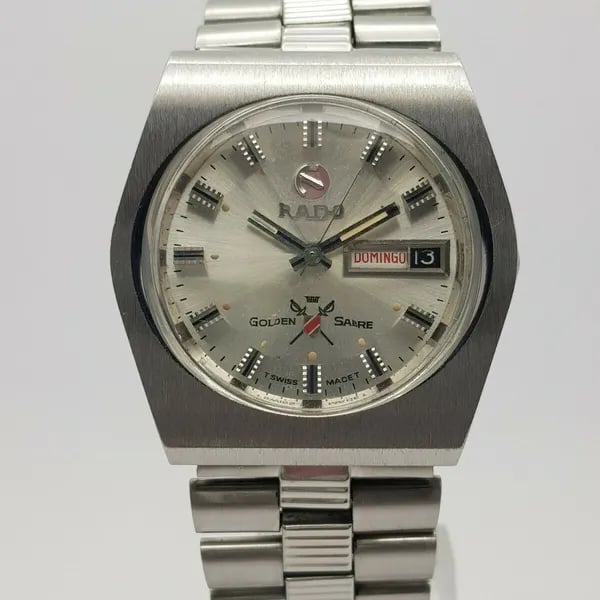
Reference 625.3082.2 is a small, gold-finished, mid-century automatic with an acrylic crystal, applied indices and Rado's signature free-swinging anchor on the dial — the little detail that separates a Rado from every other gold dress watch of its era. There is no lume, no clutter on the dial of the example I wore, and nothing remotely sporty about it. You put it on with a suit. You forget about it. You look down three hours later and enjoy it all over again.
It arrived in the middle of the last century's love affair with thin gold watches, when every serious Swiss house offered something similar: Omega had the Seamaster De Ville, Longines had the Flagship, Tissot had the Visodate. What Rado brought to that crowded table was a marketing instinct for durability and a handful of visual signatures that made its watches instantly identifiable across a room. The Golden Sabre inherited both.
Rado's golden decade
Rado started in 1917 in Lengnau as Schlup & Co., a supplier of movements and components to other brands. The Rado name only became the company's public face from the 1950s, and the brand spent that decade positioning itself around robustness rather than haute horlogerie. The Golden Horse arrived in 1957 with an automatic movement and a promise of reliability. Five years later came the DiaStar, the first scratch-resistant watch, and the Captain Cook, a genuinely capable dive watch. Rado was not chasing the drawing rooms of Geneva; it was selling watches to people who wanted them to keep working.
The Golden Sabre belongs to the dressier branch of that family tree, in the same stable as the Golden Horse and the Green Horse. These were watches sold on the strength of their finish and their value — gold-cased automatics that looked far more expensive than they were. That legacy cuts both ways today. On one hand, the Golden Sabre is one of the few genuinely affordable routes into a Swiss automatic with real mid-century design. On the other, Rado's vintage records are patchy, and many of these watches left the factory in configurations that were never properly catalogued. Buy the example in front of you, not the number on a website.
On the wrist: the long wear report
The first thing you notice is how little there is to notice. A gold-finished case from this era carries almost no mass compared with a modern steel sports watch, and the whole thing perches on the wrist rather than pressing down on it. It slides under a double cuff without a fight, which is the entire point of a watch like this. The curved lugs mean it sits close to the arm rather than standing proud on a flat wrist.
The trade-off is that it disappears a little too completely. On a smaller wrist the proportions feel correct and balanced; on a larger wrist it can read as slightly precious, almost like jewellery borrowed from another decade. If you are used to a diver, the first hour with a Golden Sabre feels like you have forgotten to put a watch on.
The crown is small and undeniably fiddly to wind and set, as crowns of this vintage always are. The acrylic crystal picks up hairline scratches with the enthusiasm of a child at a birthday party, though a dab of polyWatch in front of the television deals with most of them. Fit it to a slim, unlined leather strap in brown or black and the balance is close to ideal. Fit it to anything chunky and the whole thing collapses — a dress watch this restrained needs a strap that respects it.
One practical warning I give every first-time vintage buyer: keep it away from water. There is no meaningful water resistance here by modern standards, the gaskets are decades old, and a splash of the sink is enough to ruin a dial. Wash your hands carefully. Take it off before you do anything more ambitious than that.
Dial and legibility
The dial is where the Golden Sabre earns its keep. Applied gold-tone indices catch light from every angle, and the slender hands are elegant rather than utilitarian. It reads beautifully in daylight and photographs far better than it costs — which is why these watches have become a quiet favourite among people who want to look like they inherited something.
Legibility is the honest weak point. There is no lume at all, so after dark the Golden Sabre becomes a small gold disc and nothing more. Even in low indoor light, the low-contrast hands against a warm champagne dial demand a second glance. If you are looking for a watch to read while driving at night, this is not it. If you are looking for a watch to glance at while signing a lease, it is perfect.
Then there is the anchor. Rado's little free-swinging anchor rotor appears on many automatic dials of this era, turning gently with the movement of your wrist. It is a piece of theatre, and on a watch this otherwise restrained it is the only concession to amusement. Watching it spin during a dull meeting is one of the genuine pleasures of ownership.
Do check the dial carefully before you buy. Sunburst finishes and applied markers are frequently refinished, redials are common in this price bracket, and a heavily polished case will have lost the crisp edges that give the Golden Sabre its shape. Originality matters far more than the condition of the strap.
The movement
Inside sits a Rado-signed Swiss automatic from the period, and here the honest answer is that documentation is inconsistent. Rado sourced ébauches from suppliers rather than building movements in-house, as most watchmakers of its size did, and the exact calibre behind a given Golden Sabre can differ from one example to another. There is no reliable published jewel count, frequency or power reserve specific to this reference that I am prepared to state as fact.
What is consistent is the behaviour. These movements were built to a price and regulated by hand at the factory. They wind with a slightly grainy feel, they are not especially quiet, and they will vary positionally depending on whether you are at a desk or in a car. That is not a fault; it is the era. It also means servicing requires care. A competent independent watchmaker can handle a period Rado automatic without drama, but parts availability depends entirely on which ebauche you have, so have the movement identified before you commit to a purchase. Authorised factory service is rarely the right route for a watch of this age and value.
Accuracy in the real world
A well-serviced example will typically hold to within a minute a day, and often rather better when worn consistently and kept away from temperature swings. Over a week of ordinary desk-bound wear, mine drifted enough that I reset it once. For a sixty-year-old dress watch, that is entirely acceptable — and honestly, setting a watch once a week is part of the ritual.
What matters more is consistency. If it gains the same few seconds a day, the watch is healthy. If the rate swings wildly between wearing and resting, or if it stops overnight, budget for a service before you budget for anything else. Use that as your negotiating tool on any example you are considering.
When you would actually wear it
This is a suit watch first and foremost. Weddings, interviews, launches, dinners that go past ten, a quiet afternoon in a gallery. It works with a navy suit and a white shirt and it works with a tweed jacket and a roll neck. It does not work with shorts and it does not work at the gym.
It is more versatile than its reputation suggests, though. On a slim brown strap it is perfectly happy with a knitted polo and tailored trousers, and in an office where nobody else wears a watch it never looks like you are showing off. It is the sort of watch that gets noticed by exactly the right people and ignored by everyone else.
Value and the vintage market
Gold-plated and gold-capped examples sit in the low hundreds; solid gold pieces trade considerably higher and largely track the metal price rather than any collector premium. That spread is the important thing to understand. At the bottom of the market you are getting an enormous amount of period charm for very little money. At the top you are paying for condition, originality and case metal — and you should only do that if a specialist has confirmed what you are actually buying.
This is not an appreciating asset and there is no meaningful auction record for Rado's vintage dress watches. Do not buy it as an investment. Buy it because a small, warm, gold-cased automatic from the middle of the last century is a genuinely lovely thing to own, and because at current prices you can afford to actually wear it rather than keeping it in a drawer. Rado's reissues of the Golden Horse have done a little to raise awareness of the name, but nobody is fighting over Golden Sabres at auction, and that is precisely what makes them good value for a young collector.
Living with it
Seven days in, the Golden Sabre had done what a good dress watch is supposed to do: it made the ritual of getting dressed feel slightly more deliberate. It never got in the way, it never needed winding at an inconvenient moment, and it never drew the wrong kind of attention. I would not want it as my only watch — no lume, no water resistance and an acrylic crystal make it a poor daily companion for anyone with an active life.
As a second watch, though, it earns its place easily. Pair it with a modern sports watch and you have both halves of a complete collection for less than the price of one mid-range Swiss diver. That is a genuinely sensible argument for a young collector, and it is the argument I would make.
The verdict
The Rado Golden Sabre 625.3082.2 is not a watch you buy because it will appreciate, and it is certainly not one you buy for spec-sheet bragging rights. It is a watch you buy because a small, warm, gold-cased automatic that slips under a cuff and asks nothing of you is a lovely thing to own. It reads beautifully in daylight, it wears with genuine comfort, and its swinging anchor is a small daily pleasure that no modern watch will give you.
Buy a well-preserved example, budget for a service, treat it like the sixty-year-old object it is — and it will quietly become the watch you reach for whenever the occasion calls for a suit.