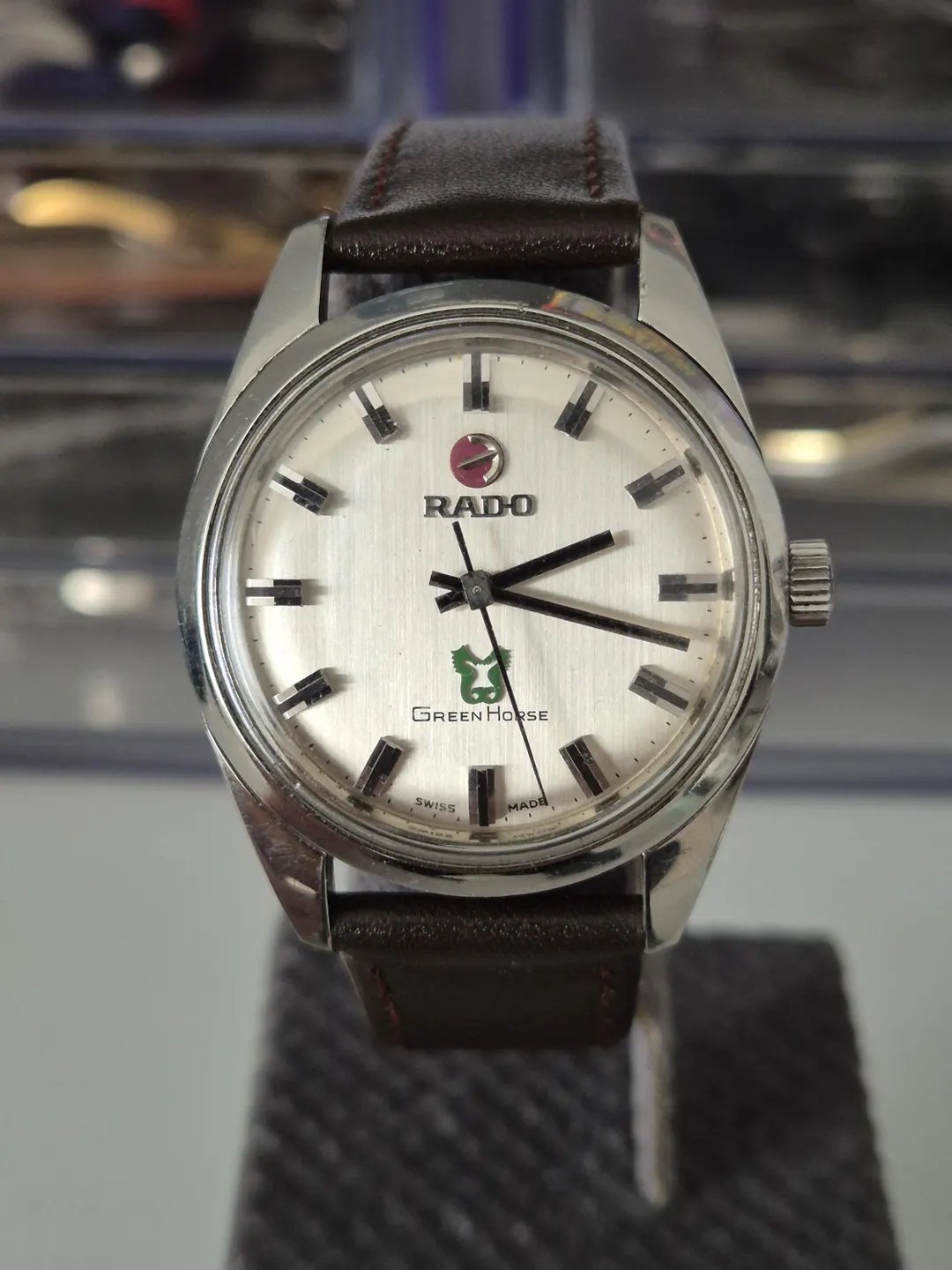
Rado Green Horse Ref. 11657: A Vintage Automatic Reviewed
The Rado Green Horse ref. 11657 is not a watch that arrives with a modern press kit. It is a mid-century Swiss automatic from a brand that built its reputation on practical robustness, unusual materials, and a certain quiet stubbornness. That makes it more interesting, not less. The Green Horse belongs to the moment when Rado was translating post-war utility into everyday watches: compact cases, legible dials, automatic movements, and enough charm to survive decades of changing taste.
I approach this reference as a vintage object first and a catalog entry second. Rado’s archival trail for the Green Horse is thin, and many examples have lived several lives. Original dials, replaced crowns, polished cases, and service movements are part of the territory. The review below separates what can be said with confidence from what should be verified on the specific watch in hand.
What emerges is a watch with a clear brief: reliable automatic timekeeping in a restrained, wearable package. It is not a safe queen, and it is not a modern daily driver in the way a current Rado is. It is a piece of mid-century industrial design with a movement that rewards sensible ownership.
Rado’s mid-century context
Rado was founded in Lengnau, Switzerland, in 1917 and rose to prominence in the post-war decades with robust automatic watches and pioneering use of scratch-resistant materials. The Green Horse sits within that mid-century automatic tradition, a sibling to the better-known Golden Horse line and a reminder that Rado’s reputation was built on everyday endurance rather than haute horlogerie spectacle.
The Green Horse name suggests a certain romanticism, but the watch itself is pragmatic. Rado was not chasing the precious-metal crowd with this model. It was making a watch for people who wanted an automatic movement, a legible dial, and a case that could handle ordinary life. That brief is exactly why the reference remains appealing today.
Movement and architecture
The movement is automatic, Swiss, and period-correct. I am not going to invent a caliber number or a jewel count for ref. 11657; the public record is not reliable enough for that, and vintage Rado production can vary. What can be said is that this is a conventional Swiss lever automatic of the era, built around robustness and serviceability rather than exhibition finishing. The architecture is familiar to any watchmaker who works on mid-century movements: a compact automatic winding system, a center-seconds train, and a simple date mechanism where present.
Finishing is industrial in the honest sense. You will not find the hand-bevelled bridges or black-polished steel of a haute horlogerie movement, and you should not expect them. What you want is clean, uncorroded metal, a free-running rotor, and a movement that has been serviced by someone who understands period tolerances. The Green Horse is not a display-back watch. Its movement is there to do a job, and the best examples do that job quietly.
The reference is generally encountered as a simple automatic with a date aperture. Confirm the specific dial and function set on the individual watch, because vintage assembly and later repair can blur the line between original specification and period service replacement. That is not a reason to avoid the model; it is a reason to buy with eyes open.
Case, dial, and presence
The case is stainless steel, and the crystal is acrylic, both appropriate to the period. I am deliberately not quoting case diameter, thickness, lug-to-lug length, or water resistance. Those figures are not reliably documented for this exact reference in public sources, and guessing them would turn a review into a spec sheet fantasy. What matters more is the design intent: a compact, restrained case that sits close to the wrist and lets the dial do the talking.
The dial is where the Green Horse earns its keep. Period Rado dials tend to be legible and slightly formal without feeling dressy. Applied markers, simple hands, and a clean outer track are common themes. Patina is part of the story now, but originality matters. A beautifully aged dial with even wear is more desirable than a shiny refinish that has erased the watch’s history. The same goes for the case: light polishing over decades is normal, but soft lugs and rounded edges suggest a harder life.
The caseback and any horse emblem should be examined closely. Vintage Rado casebacks can carry service marks, tool scratches, and replaced gaskets. None of that is fatal, but it affects value and peace of mind. The acrylic crystal is a plus for anyone who likes warmth and easy polishing; it is a minus for anyone who expects sapphire-level scratch resistance. This is a watch that asks you to accept its period materials on their own terms.
On the wrist
On the wrist, the Green Horse behaves like a proper mid-century automatic: compact, light, and close to the arm. The case is not designed to dominate a cuff; it slips under a shirt sleeve and reads as a watch rather than a statement. Balance is the key. A thin profile and modest case size — I am not quoting dimensions because this reference’s factory figures are not reliably documented — make it easy to forget until you glance down.
The strap matters. Many examples now live on leather, which suits the period character and keeps the watch from feeling overly precious. If an original bracelet survives, expect period stretch and a very different wrist presence; if not, a simple pin buckle leather strap is the honest choice. The acrylic crystal adds warmth and a little vulnerability, but it also keeps the watch from feeling like a modern reproduction. It is comfortable in the way good vintage watches are comfortable: not because it disappears, but because it asks very little of the wearer.
Accuracy and daily ownership
Vintage automatic accuracy is a matter of condition, service, and expectation. A well-serviced example should keep time within a minute a day in normal wear, and a good one may do better; a tired example can be far worse. Positional variation, magnetization, and a worn mainspring are the usual suspects. Do not buy one expecting modern chronometer rates. Buy it expecting to learn its habits, and have it regulated by someone who understands period movements.
Daily ownership is straightforward if you accept the limitations. The watch is not water-resistant by modern standards, so keep it away from showers, pools, and heavy rain. Avoid shocks and magnetic fields. Wind it gently if it has been sitting, set the time with the hands moving clockwise, and use the date adjustment only when the mechanism is clear of the changeover period. These are not burdens; they are the normal courtesies of living with a vintage mechanical watch.
Reference variants and family
There is no reliable, publicly documented variant matrix for ref. 11657. Examples appear with different dial finishes, hand styles, and date arrangements, and many have been repaired or restored over the decades. That does not mean every watch is a mystery; it means the individual example is the specification. Buy the dial you can live with and the case that has not been overpolished.
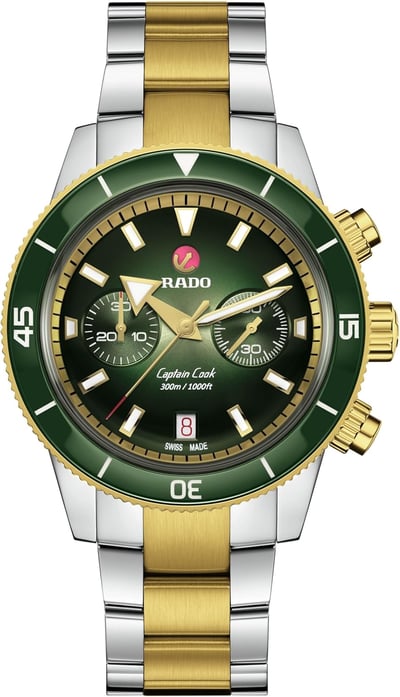
Within Rado’s family, the Green Horse sits alongside the Golden Horse and other mid-century automatics. The Golden Horse is the better-known name and has more collector traction, while the Green Horse remains a quieter alternative. Modern Rado has revisited its heritage with the Golden Horse 1957 and the Captain Cook, but the Green Horse ref. 11657 is a period piece, not a reissue. Its appeal is exactly that: it has not been smoothed out for contemporary taste.
Similar watches to consider
If the Green Horse appeals, the natural alternatives are other mid-century Swiss automatics with restrained cases and honest movements. A vintage Omega Seamaster automatic offers a more famous name and a broader parts network, at a higher price. A Longines Conquest automatic delivers comparable mid-century restraint. A Tissot Seastar automatic or Certina DS automatic can provide similar period charm at a lower entry point, though condition is always the deciding factor.
None of these is a substitute for the Rado if the Green Horse name and design speak to you. They are useful comparisons because they remind you what the market values: originality, service history, and a case that has not been polished into a different shape. The Rado competes on character and wearability rather than on brand prestige.
Investment and value
This is not an investment-grade watch in the modern sense. There is no meaningful auction history to cite, and prices are driven by condition, originality, and the presence of service records. The trend is stable rather than appreciating. A well-preserved, serviced example is the only version worth owning; project watches rarely make financial sense once restoration is added.
The value case is simple: the price buys period character, Rado’s automatic heritage, and a wearable vintage watch. It does not buy modern precision or guaranteed parts support. If you want a watch to wear and enjoy, that is a fair trade. If you want an asset, look elsewhere.
Service reality
Service intervals for vintage watches are not written in stone. A clean, well-running example may go several years between services; a watch with unknown history should be inspected sooner. A qualified independent watchmaker is the practical route. Rado’s authorized service network may not carry vintage Green Horse parts, and original components are increasingly scarce. Budget for a proper service and be suspicious of any example sold as freshly serviced without documentation.
Pros and cons
Pros: mid-century Rado automatic character without modern lifestyle pricing; compact, comfortable vintage proportions that suit daily wear; a straightforward Swiss lever movement that a qualified watchmaker can service.
Cons: vintage parts and original dials are difficult to verify; no modern water resistance or shock protection should be assumed; condition and prior polishing vary widely between examples.
Final verdict
The Rado Green Horse ref. 11657 is a thoughtful vintage choice for someone who wants a mid-century automatic with real history and no pretension. It rewards careful buying: condition, originality, and service records matter more than the model name. Buy it to wear, service it properly, and it will remain a quietly satisfying companion.