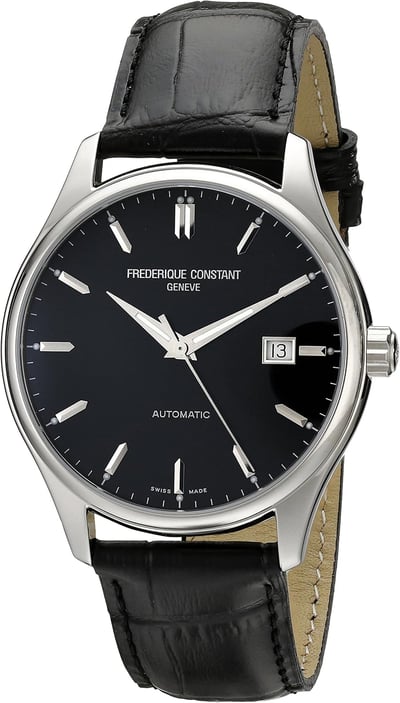
The thesis in one paragraph
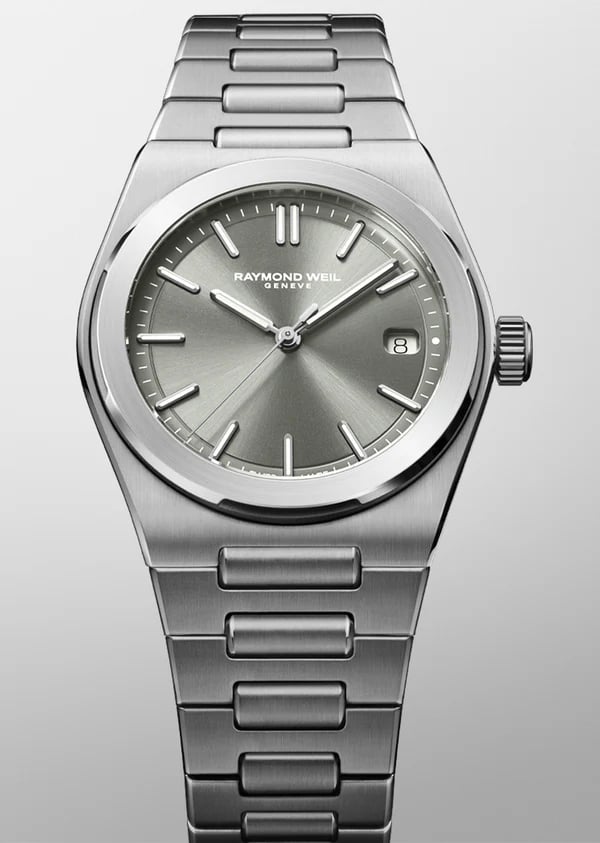
The Raymond Weil A.R.T. date, reference 1000-ST-50001, is a stainless steel automatic dress watch from a family-owned Genevan house that has spent five decades building competent, well-finished watches at the accessible end of Swiss luxury and selling them through jewellers rather than through hype. The A.R.T. was the brand's design-led line, the collection where Raymond Weil put case architecture and dial composition ahead of complication count. It is discontinued. It has no auction record. And its secondary price has fallen so far that the value conversation is no longer about investment at all — it is about whether the watch itself is any good. It is.
Raymond Weil, briefly
Raymond Weil founded the company under his own name in Geneva in 1976, which is later than most collectors assume and considerably braver than it sounds. The Swiss industry was still reorganising after the quartz shock, and the surviving independent names were the ones that found a defensible middle: real Swiss assembly, real finishing, honest movements, and pricing that undercut the group-owned brands without pretending to compete with them on prestige. Raymond Weil built its business on exactly that gap.
The house has stayed family-controlled across three generations, which matters more than the marketing suggests. It means the brand has never had to chase a group's quarterly volume targets by flooding the market with limited editions, and it also means the brand has never had the group's marketing budget to protect residuals. The A.R.T. line is a product of the 2000s, when Raymond Weil was pushing design harder than it had before or has since — sculpted cases, asymmetric details, dials that were meant to be looked at rather than read at a glance. Some of it worked commercially. Some of it did not survive the decade.
What that history buys the used buyer today is straightforward: a watch built to the same industrial standards as its peers, from a company that is still trading, still servicing its back catalogue, and still family-owned. What it does not buy is scarcity, cultural cachet or a price floor.
What the A.R.T. date actually is
Strip away the collection name and the reference is a simple proposition: steel case, sapphire crystal, automatic movement with a date, leather strap, pin buckle. The -ST- block in the reference number is Raymond Weil's own shorthand for a stainless steel case, with the closing digits denoting dial and strap configuration — a convention worth knowing when you are trawling listings, because it lets you sanity-check a seller's description against the reference they have quoted.
The honest caveat about this reference is documentation. Raymond Weil did not publish a deep, durable specification sheet for the A.R.T. line, and third-party listings for these watches disagree with each other on basic measurements in a way that suggests guesswork has been copied forward rather than verified. We have deliberately not quoted case dimensions, thickness, lug-to-lug or water resistance figures here, because we cannot verify them against a manufacturer source for this exact reference, and a wrong number is worse than no number. If those figures are decision-critical for you — and for a dress watch they usually are not — verify them on the caseback and with the seller before money changes hands.
What is not in doubt: the case is stainless steel, the crystal is sapphire, there is a date complication, and the watch is supplied on leather with a pin buckle. Those four facts carry most of the practical weight.
The movement: honest, generic, serviceable
Inside is a Swiss automatic three-hander with a date, running at 4 Hz with roughly 38 hours of power reserve. It is an outsourced base calibre — widely documented as ETA 2824-2 architecture — and Raymond Weil did not publish detailed finishing information for the A.R.T. references. That is not a criticism so much as an accurate description of the tier.
For a collector, this is good news, and the reason is serviceability. The ETA 2824 family and its clones are the most thoroughly understood automatic movements in the world. Parts are available, regulation is routine, and any competent independent watchmaker can strip, clean and rebuild one without needing a factory account. Compare that to a discontinued in-house calibre from a small brand, where a broken component can turn a cheap watch into a paperweight, and the arithmetic becomes obvious: a generic movement is a feature on a watch at this price point, not a compromise.
There is no chronometer certification and no decoration narrative. Nobody is buying this reference for the view through the caseback, which is just as well.
On the wrist
The A.R.T. wears like what it is — a dress watch with a steel case and no visual bulk. It sits close to the wrist, slides under a shirt cuff without argument, and does not announce itself. There is no heavy bracelet to swing the centre of gravity forward, no aggressive bezel to catch on a sleeve, no crown furniture pressing into the back of the hand. The whole experience is quiet.
The strap is where these watches live or die in 2024. A factory leather strap from this era is now old enough to be stiff, creased and faintly unpleasant, and a hardened original will make an otherwise decent watch feel like a flea-market find. If you buy one, put a replacement strap on it in the first week — a well-chosen calf or shell will do more for the ownership experience than any amount of polishing.
Balance is good; presence is deliberately low. This is not a watch that draws comment across a dinner table, and it is not trying to. If you want wrist authority, look elsewhere. If you want something that reads as considered rather than expensive, this is the right register.
Accuracy and daily life
Expect roughly plus-or-minus ten to fifteen seconds a day from a healthy example, and better if it has been freshly regulated by someone competent. In practice, the variance you will experience has far more to do with condition than design: a watch of this age that has never been serviced is likely to be running on degraded lubricant, and magnetisation from laptops and phone cases is a far more common cause of poor timekeeping than any inherent limitation.
So the accuracy question should be asked twice — once before purchase, and once after a service. If a seller quotes you a tight rate without service documentation, treat it as marketing rather than data.
The rest of daily life is unremarkable in the best sense. Sapphire crystal means you will not be polishing scratches out of acrylic. There is no lume to speak of, so this is a watch read under office lighting rather than in a stairwell. And it is a dress watch: do not plan on swimming in it, and do not treat a leather strap as a water-friendly arrangement. Wear it to the office, to dinner, to a wedding, and take it off before you do anything involving a pool.
The market: where the A.R.T. sits
Here is the part that matters most to a collector reading this with a calculator open. New, the A.R.T. date sat in the mid-four-figure range at retail — call it somewhere around the $1,300 to $1,700 band depending on year and market, with the usual caveat that reconstructed MSRP figures for discontinued references are approximations drawn from period price lists rather than audited data. Today, secondary examples trade in the roughly $350 to $750 band, with condition, box and papers doing most of the work at the top of that spread.
That is a depreciation curve of the brutal, unglamorous kind: not a crash, just a long grind down to the level where the watch is valued as an object rather than as a brand. And it is structural, not cyclical. There is no waiting list, no auction record, no influencer-driven revival, and no plausible mechanism by which a discontinued mid-market line from a non-collecting brand recovers its retail price. Anyone telling you otherwise is selling you something.
What the low price does buy you is optionality. At $400 to $500, the A.R.T. date competes directly with mid-range quartz and with the better end of the microbrand market — and it beats most of them on case finishing, crystal quality and the simple satisfaction of a Swiss automatic on the wrist. At $700 and above, it competes with used Longines Master Collection, used Oris Artelier and used Frederique Constant Classics, all of which offer stronger brand recognition and materially better residual support. The value case is entirely price-dependent, and the ceiling is lower than most sellers believe.
Service and ownership costs
Because the movement is an outsourced Swiss workhorse, you are not locked into the brand's own service network. Any competent independent watchmaker can service it, and the cost will land in the ordinary few-hundred-dollar range that applies to any three-hand automatic — not trivial relative to the purchase price, which is the awkward truth of buying cheap mechanical watches, but predictable and avoidable for a few years if the watch is running well.
Two ownership notes worth flagging. First, cosmetic parts for a discontinued line are the real risk, not movement parts: a damaged dial or a cracked bezel insert is a sourcing problem, not a servicing problem. Second, paperwork matters disproportionately at this price point — not because the watch is collectible, but because a box-and-papers example is meaningfully easier to resell and typically commands a visible premium over a loose one. If you are choosing between two examples at similar money, take the complete one.
What else to consider
The obvious alternatives are the used Longines Master Collection, the Oris Artelier Date and the Frederique Constant Classics Index — all three do the same job with stronger residual value. The Tudor 1926 costs more but is the value-retention benchmark in the category, and if you can stretch, it is the smarter financial decision. Below the A.R.T., the Orient Bambino and the Timex Marlin Automatic deliver most of the dress-automatic experience for a fraction of the money, with no pretence of resale value.
Where the Raymond Weil wins is design. The A.R.T. looks like nothing else in its bracket, and that is not nothing. Collectors who have spent years buying the correct answer eventually start buying the interesting one.
Hold, buy or pass
As an investment: pass. There is no case to make. The A.R.T. is depreciating, thinly documented, discontinued and unloved by the auction market. Holding it as a store of value is a category error.
As a watch: buy, at the bottom of the range. Target the lower half of the $350 to $750 band, insist on service history or price the absence of it in, and set aside money for a strap on day one. At that entry point you are getting a sapphire-crystal, stainless steel, Swiss automatic dress watch from an independent family house for less than the cost of a mid-tier smartwatch plus a decent dinner. That is a fair trade.
As a hold: hold it because you wear it, not because you expect it to appreciate. The correct exit is the one where you sell it for roughly what you paid, having enjoyed five years of a watch that never pretended to be more than it is. On those terms, the A.R.T. date is a genuinely good buy — just not the one your accountant would pick.