The proposition
There is a specific genre of Swiss watch built to make its rivals look overpriced: a steel case, a properly drawn dial, a proven automatic movement, and a price that lands just beneath the psychological two-thousand-dollar line. Raymond Weil's Millesime Central Seconds, reference 2925-STC-50001, is precisely that watch. It is also, for a certain kind of young collector, the most commercially sensible thing the Geneva house has produced in a decade.
The Millesime family arrived in 2023 and immediately did something Raymond Weil had not done in years: it earned critical respect rather than merely retail shelf space. The Automatic Small Seconds took the Challenge prize at that year's Grand Prix d'Horlogerie de Genève, which is the sort of recognition that usually goes to brands with a fraction of Raymond Weil's distribution. The Central Seconds is the version most buyers will actually live with, because it strips the concept back to a no-date, three-handed dress watch with genuine vintage literacy rather than costume nostalgia.
The problem is not the watch. It is the ownership economics. Raymond Weil occupies an awkward place in the collector hierarchy — respected enough to be merchandised alongside Longines and Baume & Mercier, but without the heritage narrative that props up their secondary values. What follows is an assessment of whether the Millesime is good enough to justify buying anyway, and how a serious collector should approach the transaction.
Raymond Weil in context
Raymond Weil founded the company bearing his name in Geneva in 1976, at a moment when the Swiss industry was being hollowed out by quartz and when a new brand needed either a gimmick or a very clear value argument to survive. Weil chose the latter, building a business on accessible Swiss mechanical watches sold with a patina of music and art-world marketing. The brand has remained family-owned throughout, and is now run by third-generation CEO Elie Bernheim.
That independence matters for how you read the Millesime. Raymond Weil is not a conglomerate sub-brand being positioned by committee; it is a mid-sized family firm that has to make design bets on its own balance sheet. The Millesime is the clearest bet the company has made in years — a deliberate pivot toward understated, design-led watchmaking aimed at buyers who know what a sector dial is and who have looked at the price of a vintage Patek and quietly closed the browser tab.
The relevant point for collectors is that the Millesime sits in the same conversation as the Longines Heritage Classic Sector Dial and the Nomos Tangente, not in the conversation about investment-grade horology. That is not a criticism. It is simply where the watch belongs, and the brand knows it.
Dial and case: where the money went
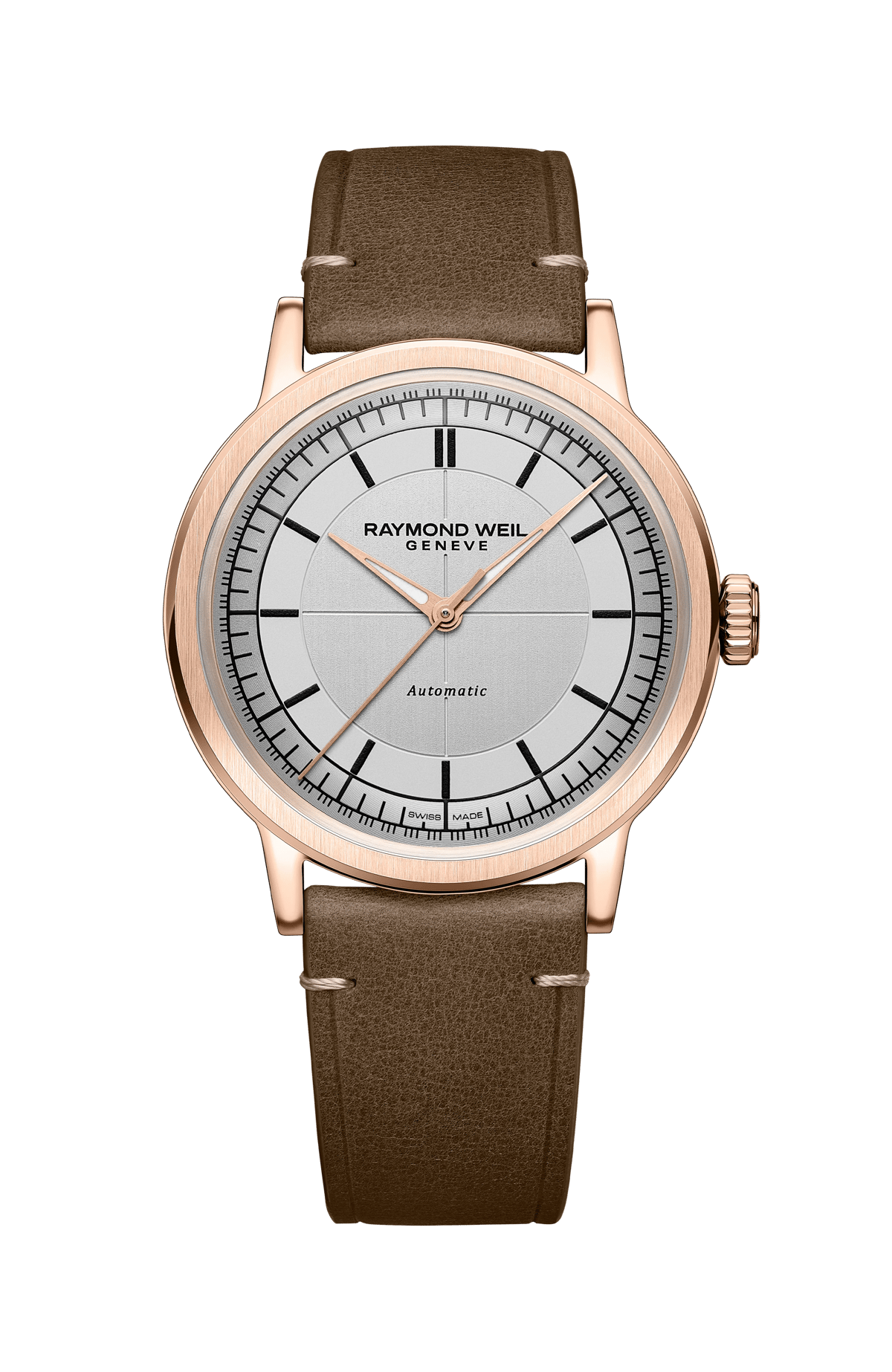
Everything interesting about this reference happens on the dial. The Millesime uses a sector layout — a concentric division of the dial surface into an inner field and an outer ring — with a fine printed minute track, applied polished baton indices, and a handset that reads as a restrained leaf-baton hybrid. The effect is architectural rather than decorative: it is a dial that relies on geometry and printing precision rather than on applied ornament or lacquer work.
The silver-toned base with blue accents is the classic configuration and the one most likely to age well. There is no date window, and that single omission does a great deal of work. A no-date dial means perfect symmetry, no risk of a misaligned date wheel, and a watch you can pick up after a week in a drawer without a setting ritual. Among collectors at this price point, the no-date variants are consistently the ones that hold their desirability longest, because the design ages without the constant reminder of its production era.
The case is stainless steel with a pared-back bezel that lets the dial dominate, which is the correct decision for a watch of this brief. The crystal is sapphire, which is now table stakes in this segment and no longer worth praising as a feature. Raymond Weil has resisted the temptation to over-decorate the case with mixed finishes or faux-vintage detailing, and the watch is better for it — the lugs are simple, the profile is clean, and the whole design reads as considered rather than styled.
What the case does not do is flaunt its finishing. This is a machine-finished case with polished and brushed surfaces executed to a competent but not exceptional standard. Compare it side by side with a Longines at a similar price and you will see slightly crisper transitions and a touch more refinement on the Longines. Compare it with anything cheaper and the Raymond Weil wins comfortably. It sits exactly where a value-driven Swiss watch should sit.
The movement
Inside is the Raymond Weil RW4200, which is the brand's designation for a Sellita SW200-1 base running in time-only configuration. This is a 38-hour automatic beating at 28,800 vibrations per hour — four hertz, 28,800 vph, the standard modern cadence — and it is about as well understood a movement as exists in Swiss watchmaking.
That is a feature, not an apology. The SW200-1 family has been in continuous production for years, sits in watches from a dozen brands, and is serviced by watchmakers in every city with a competent bench. There is no exotic architecture to worry about, no proprietary tooling requirement, and no reason a service should cost more than a few hundred dollars. For a watch positioned as an entry point, that reliability of ownership experience is worth more than an in-house badge nobody at a dinner party will ask about.
The trade-off is that the movement offers nothing to admire. Finishing is industrial, the winding action is functional rather than satisfying, and Raymond Weil does not submit this reference for chronometer certification. If you want a movement that rewards a loupe, this is the wrong watch and you already knew that. If you want an automatic that starts reliably in the morning after a weekend on the dresser, it is exactly right.
On the wrist
The Millesime is a watch that disappears under a cuff, which is the highest compliment you can pay a dress piece. The case profile is unobtrusive, the bezel is pared back to almost nothing, and the whole thing balances on the wrist without the top-heavy feel that plagues cheaper steel dress watches with deep mid-cases. There is no crown dig, no lug overhang, and no sense that you are wearing a compromise.
On the supplied leather strap it is comfortable from the first wear, with no break-in period. The pin buckle is simple and secure, and the strap tapers appropriately rather than staying slab-wide at the buckle. It is not a bracelet watch — those who want one should look at a different segment entirely — and the leather keeps the whole package light and quiet.
The strap itself is the weakest component. It is perfectly serviceable leather, but it is clearly cost-managed, and swapping it for a quality aftermarket strap — a suede, a fine-grain calf, or a slim alligator — transforms the watch's perceived value instantly. Do that before you form a judgment on the case finishing, because the case deserves better than the factory strap implies.
Accuracy and daily behaviour
The RW4200 is not COSC-certified and Raymond Weil does not publish a tightened tolerance for this reference. In real-world use, expect a Sellita SW200-1 to settle into roughly minus five to plus ten seconds per day, with many examples performing better once broken in. The movement is sensitive to positional variation, so a watch worn at a desk five days a week will show a different average rate than one worn continuously.
What matters more than the number is the absence of friction. There is no date to set, no quickset to fumble, no pushers to forget. You wind it, you wear it, you put it down. For a first serious mechanical watch, that simplicity is worth more than a chronometer certificate, because it removes the small daily irritations that cause people to stop wearing a watch.
How to wear it
This is a dress watch in the classical sense: it belongs with tailoring, with a white shirt, with a jacket. It works beautifully as a wedding or interview watch and it works as a daily office piece in any environment where a steel sports watch would feel loud. The silver-and-blue palette is neutral enough to wear with navy, charcoal, and tan without thought.
Where it does not work is anywhere requiring genuine sporting capability. There is no lume, and the case is not built for the pool or the trail. This is not a one-watch collection for someone with an active life — it is the second watch, the one you reach for when the occasion calls for restraint. Buy it as that and it will earn its keep; buy it as a do-everything watch and you will be disappointed.
The market: resale, depreciation and the hold-or-sell call
Here is where the review gets uncomfortable. Retail on the Millesime Central Seconds sits around $1,895, and the secondary market has settled into a band of roughly $850 to $1,200 for clean examples. That is a depreciation curve of forty to fifty percent from new, which is steep but not unusual for a brand without collector gravity.
The comparison that matters is Longines. A Heritage Classic Sector Dial transacts used at a meaningfully higher percentage of its retail price, because Longines has a long, well-documented archive and a collector base that treats the brand as a legitimate entry point rather than a stepping stone. Raymond Weil has neither the archive mythology nor the forum enthusiasm. The Millesime is praised in reviews and then traded quietly at a discount, which is the classic pattern for design-led watches from brands without heritage equity.
Demand cycles matter here too. Dress watches as a category have been soft relative to steel sports models since the post-2022 correction, and the affordable dress segment has held up primarily because value-seeking buyers moved into it as the sports market cooled. That has kept Millesime prices from falling further, but it has not created appreciation. There is no realistic scenario in which this reference outperforms inflation over a five-year hold.
The practical conclusion for a collector is straightforward. If you want one, buy pre-owned or negotiate hard on new — a discount of fifteen to twenty percent is achievable and should be expected. If you already own one and are considering selling within three years, price it against the used band rather than against retail, and accept that the gap is the cost of having worn a handsome watch. If you are holding for a decade, the depreciation becomes irrelevant because you will have extracted the value in wrist time. That is the honest hold-versus-sell judgment: hold only if you wear it, sell only if you have stopped.
There is no meaningful auction history for this reference, and there is unlikely to be one. The Millesime will not appear at Phillips, and that is fine. Not every watch needs to be an asset, and the collector who treats every purchase as a position is the one who ends up resenting the hobby.
Servicing and ownership cost
Because the RW4200 is Sellita-based, ownership costs are genuinely low. Plan on a service every five years at roughly $300 to $450 depending on your market and whether the watch needs parts beyond seals and lubrication. Any competent independent watchmaker can handle the work, though sourcing original Raymond Weil components is easier through the authorized network. There is no reason this watch should ever become a financial burden, which is more than can be said for a great many Swiss automatics at three times the price.
Alternatives worth considering
The most direct rival is the Longines Heritage Classic Sector Dial, which offers a very similar design brief with stronger brand equity and materially better resale. It costs more, and whether it is worth the premium depends entirely on how much you value liquidity you will probably never use.
At a modest step up, the Nomos Tangente 38 delivers an in-house movement and German design purity that appeals to a different sensibility entirely. It is less warm, less obviously vintage, and considerably more interesting to other watch people. The Baume & Mercier Classima remains the traditional default for a first Swiss dress watch, though its dial is less compelling than the Millesime's. Frederique Constant's Classics Premiere competes on the same value argument with more conservative styling, and Tudor's 1926 costs meaningfully more but brings the brand cachet and secondary-market liquidity that Raymond Weil cannot match.
For buyers testing the water before committing, the Timex Marlin Automatic and Orient Bambino capture the mid-century dress silhouette at a fraction of the price, while the Seiko Presage Cocktail Time offers dial-making that embarrasses watches costing several times more. None of them are substitutes for the Millesime, but all of them will tell you whether you actually wear a dress watch before you spend Swiss money on one.
Verdict
The Millesime Central Seconds is the best-designed watch Raymond Weil has made in years, and at pre-owned prices it is one of the smarter entry points into Swiss mechanical dress watchmaking. The dial is genuinely good, the movement is genuinely sensible, and the no-date layout is genuinely the right call. What it is not is an asset, and anyone buying it as one is making a mistake.
Buy it for the dial, keep it for the decade, and ignore the resale chart. That is the whole case, and it is a strong enough case to justify the purchase.