Raymond Weil Millesime Chronograph Review
A vintage-inflected Swiss tri-compax that gets the design right and the resale curve wrong — which is exactly why serious buyers should look at it pre-owned.
Why This Watch Matters
Raymond Weil has spent most of its existence as a brand that watch enthusiasts acknowledge politely and then walk past. Reliable, family-owned, widely distributed, reasonably priced — and almost entirely absent from collector conversation. The Millesime collection, launched in 2023, was the first genuine attempt in years to change that, and the fact that the Millesime Automatic Small Seconds walked away with the Challenge prize at that year's Grand Prix d'Horlogerie de Genève suggests the industry noticed.
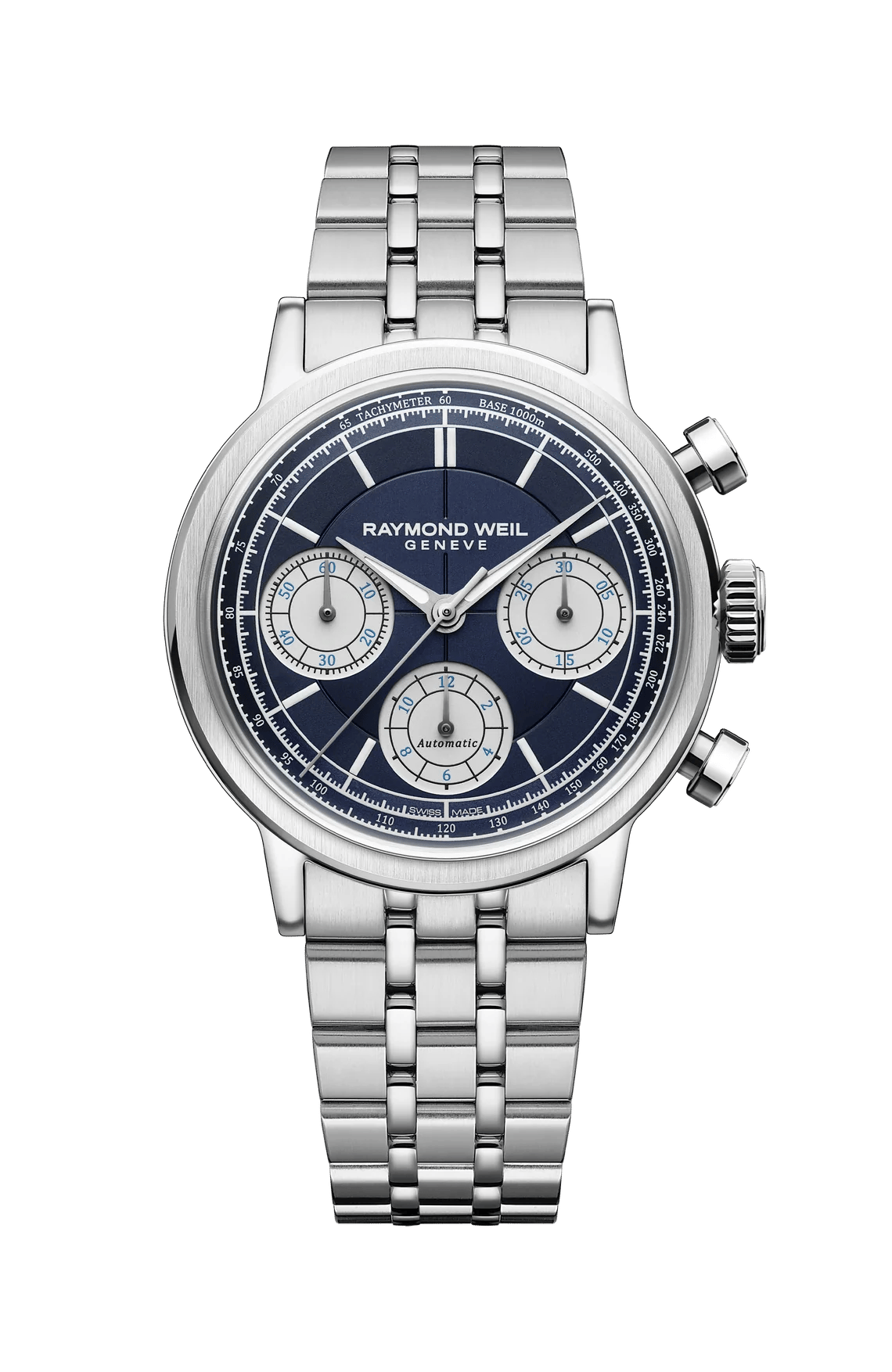
The Millesime chronograph is the most interesting watch in that family. It is a tri-compax chronograph with a sector dial — concentric finishing, a printed crosshair, applied indices, three recessed subdials — mounted in a polished steel case and driven by a Swiss automatic movement. It is, in other words, a watch designed by people who have looked closely at mid-century chronographs and understood what made them work, rather than people who have simply downloaded a vintage filter.
It is also a watch with a problem, and that problem is money. Raymond Weil is a high-volume brand with broad authorised-dealer distribution and a secondary market that discounts accordingly. Anyone buying this at full retail expecting it to behave like a Tudor or a Longines is going to be disappointed. Anyone buying it pre-owned, intending to wear it for a decade, is going to get one of the better value propositions in mechanical chronographs. This review is written for the second buyer.
The House Behind It
Raymond Weil founded his eponymous brand in Geneva in 1976, in the middle of the quartz crisis, at a moment when established Swiss houses were collapsing around him. The company survived by building well-finished, accessibly priced watches and selling them through a vast retail network rather than chasing complications or haute horlogerie credentials. It remains family-owned today, run by third-generation CEO Elie Bernheim, and it has never pursued the boutique-only scarcity model that has driven so much of the modern luxury market.
The Millesime line is the brand's attempt to convert decades of value positioning into something with actual design credibility. The collection leans heavily on mid-century references: sector dials, baton hands, thin bezels, warm colour palettes. It has worked. The Millesime small seconds is a genuinely handsome object, and the chronograph carries the same design language into a more complex and more useful format.
The Dial Is the Argument
Everything worthwhile about the Millesime chronograph happens on the dial. The sector layout — a concentric circle dividing the outer track from the inner field — gives the watch visual depth without adding clutter, and the printed crosshair anchors the composition in a way that a flat sunburst dial simply cannot. Applied indices sit slightly proud of the surface, catching light and giving the whole thing a jewellery-like quality that belies the price point.
The tri-compax arrangement is clean and legible: running seconds on one subdial, a 30-minute counter on another, a 12-hour totaliser on the third. There is no date window, which is a deliberate and correct decision — a date aperture at this position would break the symmetry and cheapen the whole effect. The hands are slim batons in the vintage idiom, matched to the index shape, and the typography is restrained rather than shouty.
Colourways matter here more than usual. The blue variant is the safest and most universally wearable, the anthracite reads dressier and photographs less dramatically, and the copper/salmon dial is the one that has driven most of the model's press coverage. Warm dials tend to hold marginally better on the secondary market, though the difference is not large enough to base a purchase on alone.
There is no lume, and Raymond Weil does not market this as a sports watch. It is a fair-weather, daylight, restaurant-lighting object. If you need a chronograph that performs in the dark or survives a pool, this is not it, and no amount of wishful thinking will change that.
The Movement
The Millesime chronograph runs the calibre RW5030, an automatic Swiss chronograph built on Sellita-derived architecture and beating at 28,800 vibrations per hour. It is cam-actuated rather than column wheel, with the chronograph module stacked on top of the base movement, and Raymond Weil quotes a power reserve of roughly 60 hours. A sapphire caseback shows the rotor, finished with Geneva striping, and the bridges beneath it with perlage.
Let's be clear about what this is and is not. It is not in-house, it is not a column wheel, and it is not COSC-certified. What it is, is a robust, well-understood, widely serviceable engine that any competent independent watchmaker can maintain without needing factory parts shipped from Geneva. For a watch at this price, that is a genuine advantage. The serviceability of a Sellita-based chronograph is one of the reasons long-term ownership costs stay sane, and it is one of the reasons this watch makes far more sense used than new.
On the Wrist
The case architecture is the second thing the Millesime gets right. Slim swept lugs, a thin bezel, and a polished-and-brushed alternation that reads as deliberate rather than cost-engineered. Because the design brief is a dress chronograph rather than a tool chronograph, the watch sits close to the wrist rather than perched on top of it, and the leather strap with its simple pin buckle keeps the assembly light. Collectors arriving from a Speedmaster or a Chronomat will find it notably more discreet; collectors arriving from a dress watch will find it entirely natural.
The trade-off is presence. This is not a watch that announces itself across a room, and on a larger wrist it can read slightly polite. It tucks under a shirt cuff without complaint, which is precisely what you want if your week is spent in tailoring and your weekends are not spent at a racetrack. Fit it to your wrist before you commit — the Millesime rewards the wearer who wants restraint, and mildly disappoints the one who wants heft.
Accuracy and Day-to-Day Behaviour
Do not expect chronometer performance. The RW5030 is not COSC-certified, and Sellita-based chronographs at this grade typically settle in the minus-five to plus-twelve seconds per day window, with positional variation and a healthy dependence on how consistently you wear the watch. Expect it to gain a little on the wrist and lose a little dial-up overnight, and expect to want regulation at the midpoint of a five-year hold if daily precision matters to you.
The chronograph action itself should feel crisp through the pushers and reset cleanly to zero every time. That function is the one place where a cheap module reveals itself, and on this watch it does not. If a new example stutters on reset, that is a warranty matter rather than a bedding-in period.
Value, Resale, and the Hold Decision
Here is where a serious collector needs to be honest. Raymond Weil does not have an auction market. The brand does not appear meaningfully in the major salerooms, there is no established collector base bidding up vintage examples, and there is no realistic appreciation path for the Millesime chronograph. Retail sits in the mid-three-thousand-dollar range; pre-owned examples trade considerably below that, and the gap widens the moment you walk out of the boutique.
That is not a scandal — it is the normal behaviour of a well-made, high-volume Swiss watch from a brand without collector scarcity. But it does dictate strategy. If you want this watch, buy it used. A pre-owned Millesime chronograph at a meaningful discount to retail is one of the better mechanical chronograph purchases available to a young collector, because you are paying for the dial and the case and the movement rather than for a brand premium that will not survive the transaction.
The hold recommendation is simple: this is a wear-it-forever watch, not a flip. Buy it because sector dials do something for you, because you want a mechanical chronograph that works under a cuff, and because you have made peace with the fact that the money is spent. If any of those three conditions is missing, buy a Longines instead and get the resale stability as well as the design.
What Else to Try
The obvious comparator is the Longines Master Collection chronograph, which offers similar vintage-leaning design, a stronger service network, and materially better residual values. The Frederique Constant Classics Chronograph is the closest match on price and the closest match on secondary-market softness. The Baume & Mercier Classima Chronograph trades some of the Millesime's sector-dial character for broader dealer coverage. And if you can stretch, the Tudor 1926 chronograph is where you begin paying for resale stability rather than just for looks.
Worth noting too: the Millesime small seconds, the model that won the GPHG prize, is the purer design statement. If you do not actually need a chronograph function, that watch makes the same argument more cheaply and with better proportions for a dress context.
Verdict
The Millesime chronograph is the best-looking watch Raymond Weil has produced in a generation. The sector dial is executed with genuine literacy, the case is slim and well-mannered, and the movement is a known quantity that will not bankrupt you at service time. It is also a depreciating asset with no auction history and no collector narrative, and pretending otherwise does nobody any favours.
Buy it pre-owned, wear it for a decade, and stop checking the resale listings. On that basis, it is one of the smarter chronograph purchases a young collector can make.