The Quiet Flex
There is a very specific kind of collector who has spent the last five years quietly bored. They own the dive watch. They own the chronograph. They have, at some point, convinced themselves that a steel sports watch on a rubber strap constitutes a personality. What they do not own — what almost nobody has made well at an accessible price — is a proper dress watch with a bracelet that feels like it was designed rather than sourced from a catalogue.
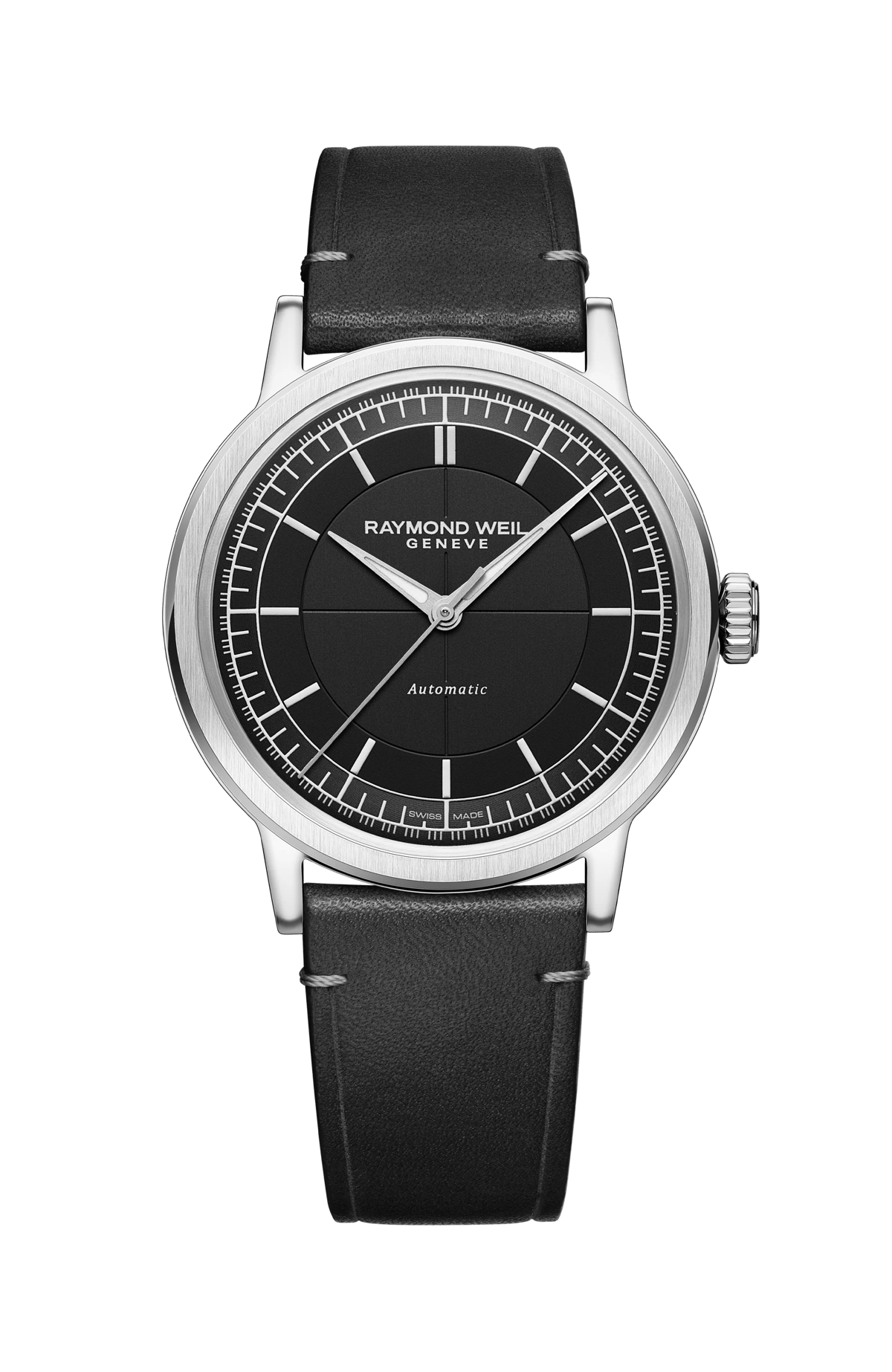
Raymond Weil's Millesime line exists for that collector. Launched in 2023 and immediately validated when the Millesime Small Seconds took the Challenge Watch Prize at the Grand Prix d'Horlogerie de Geneve, the collection was the Bernheim family's admission that the brand's future lay not in carbon-fibre chronographs but in the mid-century archive it never quite had. The Millesime Jubilee, reference 7776-STC-65501, is the second act: the same restrained case and sector-dial language, now bolted to a five-link steel bracelet.
It is the most self-assured thing Raymond Weil has released in a decade, and one of the most quietly interesting watches under three thousand dollars right now. Not because it does anything radical — it does not — but because it understands something most of its competition does not: that the bracelet is not an accessory. It is half the watch.
The Millesime Problem
Let us be honest about what Raymond Weil has been for the better part of twenty years. A family-owned Geneva house founded in 1976, at the precise moment the Swiss industry was being dismantled by quartz, it built a business on well-made, well-priced, slightly anonymous watches sold through shopping-mall dealers and airport boutiques. The Tango, the Nabucco, the Freelancer — competent, commercially savvy, and almost invisible to the collector class.
Elie Bernheim, the founder's grandson, has spent the last several years trying to change that calculation without abandoning the volume business that keeps the lights on. The Millesime was the pivot point. Instead of chasing the sports-watch boom everyone else was chasing, Raymond Weil went the other direction: a slim steel case, a sector dial, applied indices, small seconds at six, and a price that undercut the obvious Swiss alternatives by a wide margin. The GPHG jury rewarded it, and the line has since expanded into chronographs and, now, the Jubilee.
That name is worth pausing on. The Jubilee bracelet — five rows of links, three narrow and two wide, with polished centre links flanked by brushed outer links — was popularised in 1945 and has since become the default shorthand for a dress watch that wants to be comfortable rather than austere. It is the single most borrowed idea in watchmaking. Raymond Weil has borrowed it back, and done so with unusual care.
The Dial: Sector, Not Retro
Sector dials are having a moment, which is precisely the danger. Too many of them treat the 1930s as a costume: sepia prints, faux-patina indices, a self-conscious air of having been excavated. The Millesime Jubilee sidesteps that trap by refusing to be nostalgic at all. The dial here is a deep, cool blue with a crisp circular brushing in the centre zone and a tighter, finer texture on the outer track, separated by a raised chemin de fer that catches light along its inner edge.
The applied indices are faceted and slim, tapering slightly toward the centre, and the hands — dauphine-derived, sharp at the spine, with a subtle bevel running their length — are polished to a mirror that throws flashes of white across the blue whenever the wrist turns. There is no date window. The geometry is uninterrupted from crown to crown, which is a bolder decision than it sounds: deleting the date costs the brand a selling point and costs the buyer nothing but convenience.
What makes it work is proportion. Every element on the dial has been sized against every other element rather than dropped in from a parts bin. The minute track is legible without crowding the indices; the brand wordmark sits at the right visual weight; the small-seconds-register's absence keeps the lower half clean. In daylight the blue reads almost navy; under warm interior light it goes slate. It is the kind of dial that makes you look twice at your own wrist, which is the entire point of a dress watch.
The Bracelet Is the Story
Plenty of watches at this price get a dial right and then ruin it with a bracelet that feels like a hinge from a hardware store. The Millesime Jubilee does not. The five-link assembly alternates brushed outer links with polished inner links, and the contrast is executed with restraint — the polishing is bright but not chrome-sharp, the brushing fine enough to hold a soft sheen.
More importantly, the links articulate. Each row pivots independently, which means the bracelet curves around the wrist rather than standing off it at the lugs. The taper toward the folding clasp is gradual and deliberate. There is no rattle, no cheap stamped feel, and no sense that the bracelet was specified by a purchasing department trying to hit a cost target. On a watch at this price, that is genuinely rare, and it is the single strongest argument for the Jubilee over the leather-strap Millesime variants.
It also changes the character of the watch. On a strap, the Millesime is a formal object — beautiful, but narrow in its uses. On the five-link bracelet it becomes something more useful: a watch that wears with a suit on Tuesday and a heavyweight tee on Saturday and does not look like it is slumming it in either setting.
Under the Hood: The RW4200
The movement is Raymond Weil's RW4200, which is the brand's designation for a Sellita-derived automatic running at 28,800 vibrations per hour with roughly 38 hours of power reserve. That is not a headline specification, and Raymond Weil does not pretend it is. There is no in-house manufacture claim here, no COSC certificate, no silicon escapement. What there is, is a known quantity with a service network behind it and a reputation for reliability that the enthusiast community has thoroughly stress-tested over the last two decades.
What matters more is the execution. The finishing on the visible surfaces — the striping, the perlage on the plates — is done to a standard that would not embarrass a watch at twice the price, and the regulation out of the box is generally competent. This is the correct engineering decision for a watch in this bracket: the money goes into the case, the dial and the bracelet, where you will actually notice it, rather than into a proprietary movement that would push the price past the point where the whole proposition collapses.
It is worth saying plainly, because the enthusiast internet does not always say it: a Sellita-based movement in a $2,300 dress watch is not a compromise. It is a rational allocation of resources. The alternative is a watch with an in-house caliber and a dial that looks like it came out of a Christmas cracker.
On the Wrist
This is a watch that disappears in the best sense. The case is compact and sits close to the wrist, which means it slides under a shirt cuff without a negotiation. The five-link bracelet articulates tightly enough that it drapes rather than perches, and the tapering keeps the whole assembly centred instead of letting it rotate around the wrist. There is no crown dig, no caseback edge pressing into the wrist bone, no heft that announces itself when you type.
If you are coming from a chunky sports watch, the first hour will feel like you forgot to put your watch on. By the end of the week, the sports watch is the one that feels wrong. The sapphire crystal sits proud enough to catch light without creating a dome that distorts the dial at angles, and the absence of lume — there is none, and there is no pretence of it — keeps the dial clean of the puffy, applied plots that ruin so many dress watches trying to hedge their bets.
Presence is moderate. This is not a watch that gets noticed across a room, and it is not trying to be. It is a watch that gets noticed by the person sitting next to you at dinner, once, and then only if they know what they are looking at. That is a specific pleasure, and it is increasingly hard to buy at any price.
Living With It: Accuracy, Service, Value
The RW4200 is not chronometer-certified, so plan for something in the region of minus ten to plus fifteen seconds a day when new. Most examples settle into single digits after a few weeks of regular wear, and any competent watchmaker can regulate one closer without much fuss or expense. If you require certification paperwork before you can sleep, this is not your watch.
Servicing runs through Raymond Weil's authorized dealer network and its Geneva workshop, but the caliber's ubiquity is a genuine advantage: an independent watchmaker can handle it, which gives you options that owners of in-house movements simply do not have. The brand does not publish a fixed service tariff, so ask your dealer before you buy rather than after.
On value: the Millesime Jubilee retails in the low two thousands, and the used market has already settled into a predictable discount. That is the normal trajectory for a well-made, readily available steel watch from a non-hype brand, and it should be read as information rather than a warning. If you buy it pre-owned, you are getting an enormous amount of watch for the money. If you buy it new, you are paying for the pleasure of being the first wrist it wraps around. Neither is a mistake, but only one of them is an investment thesis, and it is not the second one.
There is no meaningful auction history here. Millesime references are too recent and too plentiful to have generated a secondary market of consequence, and they are unlikely to. Anyone who tells you otherwise is selling something.
The Competition
Nomos Glashutte's Tangente 38 remains the intellectual's choice — an in-house caliber, Bauhaus purity, and a design language so coherent it borders on dogma — but it is a strap watch, and the Nomos bracelet is an expensive afterthought. Longines' Heritage Classic Sector Dial has more archive credibility and a strong claim on the sector-dial brief, though its execution is more conservative and its bracelet less interesting. Tudor's 1926 delivers the five-link formula from a brand with genuine resale gravity, at a premium that is difficult to argue against if resale matters to you.
What none of them quite match is the specific combination on offer here: a dial with this much considered detail, a bracelet with this much articulation, and a case this comfortable, at a price that does not require a financing plan. The Millesime Jubilee wins on the totality of the object rather than on any single specification.
Should You Buy It?
Yes, if you are building a collection rather than a portfolio. The Millesime Jubilee is the watch you reach for when the occasion does not specify a watch — a wedding, a first day at a new job, a dinner where you want to look like you did not try. It is also the watch that will make you reconsider half of what is in your box, because once you have worn a properly proportioned dress watch on a properly engineered bracelet, the appeal of a thick sports watch on a rubber strap becomes considerably harder to explain.
No, if you need your purchases to hold value, if you require chronometer certification, or if you want a watch that other people will recognise. Raymond Weil has never been that brand, and the Millesime does not change the equation.
What it does change is the argument. For years, the case against buying a Raymond Weil was that the money could be spent somewhere with more cachet. The Millesime Jubilee makes that case harder to prosecute. It is a quiet flex — the sort of watch that says you know what you are doing, without saying anything at all.
Specifications
- Reference: 7776-STC-65501
- Case: stainless steel
- Crystal: sapphire
- Dial: deep blue sector dial with applied faceted indices
- Bracelet: steel five-link with folding clasp
- Lume: none
- Movement: Raymond Weil RW4200, automatic, 28,800 vph, approximately 38 hours power reserve
- Certification: not COSC-certified
- Complications: none — hours, minutes, seconds