Raymond Weil Toccata Classic 5024-P-97081 Hands-On Review
A slim quartz dress watch that asks whether elegance needs a mechanical heart.
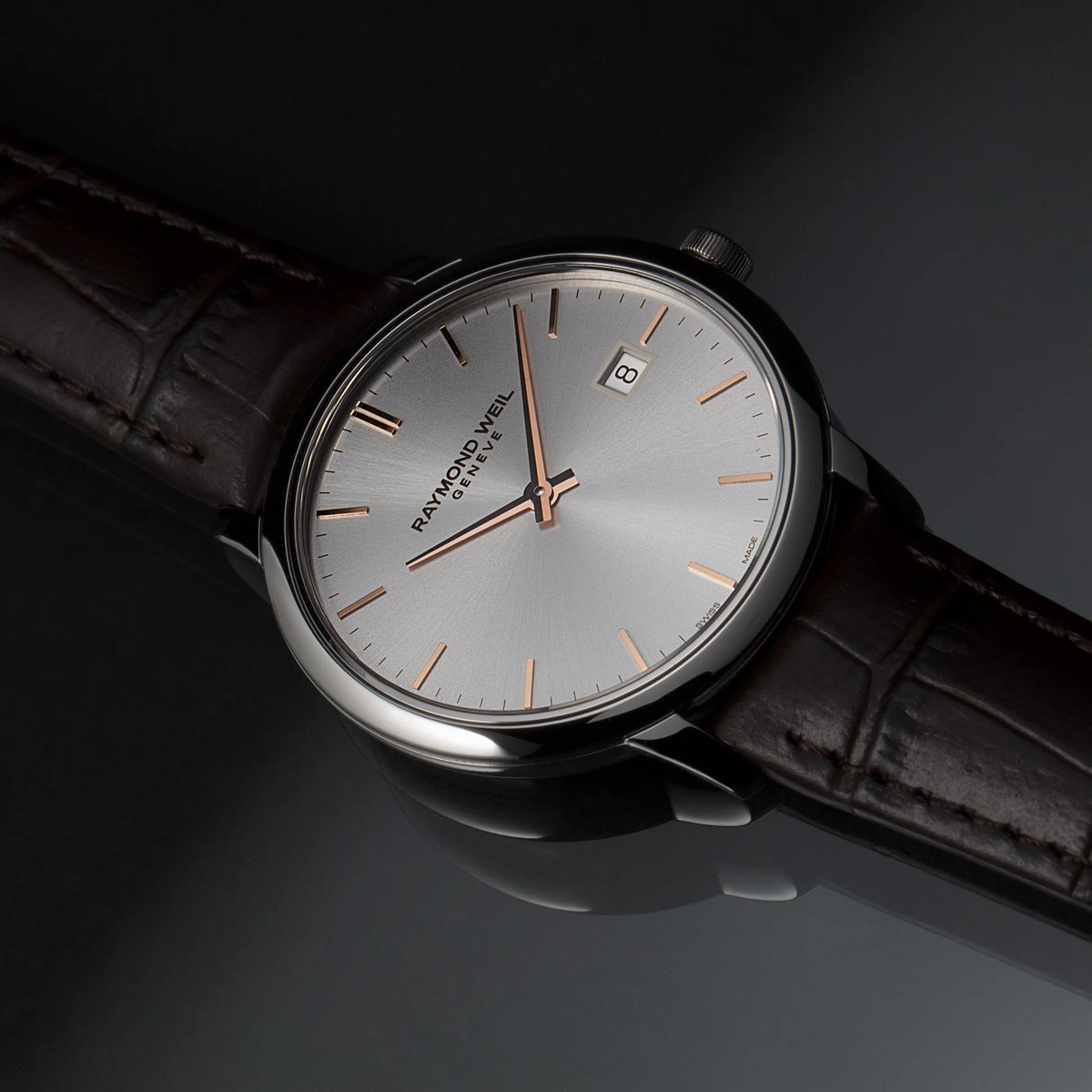
The Raymond Weil Toccata Classic 5024-P-97081 is not a watch that shouts for attention. It arrives with a rose-gold PVD case, a restrained silver-toned dial and a leather strap, and it asks to be judged the way a dress watch should be: on the wrist, under a cuff, across a dinner table, after a long day. In a market crowded with steel sports watches and ever-larger cases, that is a quietly contrarian brief.
I wore this Toccata Classic as a daily dress watch for a week, pairing it with tailoring, knitwear and the kind of ordinary office days that expose a watch's real character. The question was not whether it could survive a hike or a swim, but whether it could remain comfortable, legible and emotionally satisfying from breakfast to last orders. On those terms, the answer is more nuanced than its price tag might suggest.
This review focuses on the exact reference 5024-P-97081: its wearability, its quartz movement, its place in the Raymond Weil line-up and what a discerning young collector should realistically expect from owning one.
First impressions and wrist feel
The first thing that strikes you about the Toccata Classic is how little it imposes itself. The case is slim and the profile is low, so it slides beneath a shirt cuff without the usual tug-of-war between watch and tailoring. The rose-gold PVD finish gives the stainless steel case a warm, slightly vintage cast, but it stops short of looking gaudy. This is a watch that reads as formal without looking as though it belongs in a safe.
On the wrist, comfort is excellent. The leather strap is supple enough to curve around the wrist quickly, and the pin buckle keeps the whole package light and simple. Because the watch is not heavy, it does not swing around during the day, though strap fit is important: a loose setting will let the case rotate slightly, while the correct hole keeps it centred and unobtrusive. The crown sits close to the case and does not dig into the back of the hand, which matters more than spec-sheet heroics when you are typing, driving or resting your wrist on a desk.
This is not a watch with wrist presence in the sports-watch sense. It will not be noticed from across a room, and it will not start conversations with strangers. What it does offer is a close-up elegance: the case edges catch light, the dial remains quiet, and the whole thing feels deliberately understated. For some collectors that will be a limitation; for others it will be the entire point.
Dial and legibility
The silver-toned dial is the Toccata Classic's strongest argument. It is clean without being sterile, and the applied markers give it enough depth to avoid looking like a printed afterthought. The hands are slim and traditional, which suits the dress-watch brief, though it means legibility depends on contrast rather than lume. In daylight and office lighting, reading the time is effortless. In a dim restaurant or a dark cinema, the watch disappears, because there is no luminescent treatment at all.
That is not necessarily a criticism. A formal watch with no lume is a coherent object; adding Super-LumiNova to a rose-gold PVD dress watch would be like fitting running shoes to a dinner jacket. The date window at 3 o'clock is small but usable, and it does not upset the dial's balance too badly. If you prefer a pure three-hander, you may find the date aperture unnecessary, but it is a practical addition for a watch that can plausibly be worn to work every day.
The crystal is sapphire, which is a welcome detail at this price point. It keeps the dial protected and clear, and it contributes to the sense that the Toccata Classic is built for ordinary life rather than careful storage. The caseback is closed, so there is no movement to admire, but that also keeps the watch thin and the price sensible.
Case, crystal and real-world durability
Raymond Weil has not positioned the Toccata Classic as a rugged watch, and the ownership experience should be framed accordingly. The rose-gold PVD finish is attractive, but PVD is a coating rather than a solid metal, so it can show wear over time, particularly on edges and around the caseback. Treat it as a dress watch and it will age gracefully; treat it like a tool watch and the finish will eventually tell the story.
The sapphire crystal is a genuine plus for daily wear, offering good resistance to scratches and the kind of minor knocks that accumulate in an office or a restaurant. The leather strap is the more vulnerable component. It will darken, crease and eventually need replacing, which is normal for a dress watch and should be budgeted for. The pin buckle is simple and reliable, and it keeps the strap easy to swap if you want to change the watch's character.
I would not treat this as a swim watch or a holiday beater. The Toccata Classic is at its best when it is kept away from chlorine, salt water and impact, and worn as a companion to tailoring, knitwear and smart-casual outfits. That is not a weakness; it is a clear brief. The watch knows what it is.
Movement and accuracy
The Toccata Classic 5024-P-97081 runs on a Swiss quartz movement, and Raymond Weil does not publish the exact caliber for this reference. That is not unusual in this segment, and it is not a practical problem. Quartz watches are bought for convenience, accuracy and low maintenance, and this one delivers on all three. Expect a few seconds of deviation per month in normal use, with battery replacement every couple of years depending on how the watch is run.
The trade-off is emotional rather than technical. There is no rotor to listen to, no sweeping seconds hand and no mechanical relationship between your wrist and the movement. For a collector who enjoys the ritual of winding and the romance of escapements, the Toccata Classic will feel like an appliance. For someone who wants a formal watch that is always ready and never needs setting after a weekend in a drawer, it is exactly right.
Servicing is straightforward. Battery replacement is the main maintenance item, and a full service is rarely required unless the watch is damaged or suffers water ingress. Raymond Weil does not publish a fixed service interval for this quartz reference, so the sensible approach is to replace the battery when needed and have the watch checked if it starts behaving erratically. The closed caseback means there is little to see, but it also means there is little to worry about.
The Toccata Classic in the Raymond Weil family
Raymond Weil founded his namesake brand in 1976, in Geneva, at a moment when Swiss watchmaking was being reshaped by quartz. The company remains family-owned and independent, and its collections span dress watches, sports watches and more fashion-led pieces. The Toccata line sits in the classic dress camp, and the Toccata Classic is its most traditional expression: clean dials, modest cases, leather straps and a deliberate absence of showmanship.
Within the Raymond Weil portfolio, the Toccata Classic is the quiet cousin of the Maestro, which often leans more decorative, and the Freelancer, which is sportier and more overtly contemporary. The Nabucco and Parsifal lines occupy different stylistic territory, while the Shine collection pushes further into jewellery-adjacent design. The Toccata Classic is for the collector who wants a simple, elegant watch that does not try to be everything at once.
Raymond Weil has offered Toccata Classic variants with different dial colours, bracelets and finishes, but exact references vary by market and season. This review is specific to 5024-P-97081, the rose-gold PVD and leather configuration. If you are considering a different variant, the same broad character applies, but the strap or bracelet will change the wrist experience more than the dial colour.
Alternatives and homages
At or near this price, the obvious alternatives come from Longines, Baume & Mercier and Tissot. The Longines Elegant Collection offers a comparable restrained Swiss dress-watch brief with more brand heritage, though it often costs more. The Baume & Mercier Classima is another accessible classic with a clean dial and a similar office-to-evening remit. The Tissot Tradition is the more affordable Swiss option, and it shares the Toccata's traditional, understated approach.
If you are willing to look beyond Switzerland, the Seiko Presage Cocktail Time is a compelling alternative. It offers more dial craft and mechanical character for a similar real-world spend, though it has a very different personality and a larger wrist presence. For collectors who want a watch with a story to tell, the Presage will feel more romantic; for those who want fuss-free formal wear, the Toccata Classic remains the simpler proposition.
On the homage side, the Orient Bambino is the obvious affordable dress watch with a classic silhouette and an automatic movement. The Timex Marlin captures the mid-century mood at a fraction of the price, though with less refinement. The Tissot Everytime is a slim quartz dress watch that prioritises clean legibility and easy daily wear. None of these will match the Toccata's specific combination of rose-gold PVD warmth and Swiss quartz convenience, but they show how much of the dress-watch formula can be had for less.
Value, investment and ownership
At retail, the Raymond Weil Toccata Classic 5024-P-97081 sits in the accessible Swiss dress-watch bracket. At the time of review, U.S. retail is around $895, and pre-owned examples typically trade between $350 and $550 depending on condition, box and papers. That depreciation is normal for a quartz dress watch from a brand that is not collectible in the auction sense. There is no major auction history to speak of, and it is unlikely to become a speculative asset.
The right way to buy this watch is to treat it as a pleasure purchase rather than an investment. If you find one pre-owned in good condition, it becomes a sensible daily formal option with a sapphire crystal, a comfortable case and a movement that costs little to maintain. If you buy it new, you are paying for the pleasure of ownership, the warranty and the ability to choose the exact configuration. Either way, the value case rests on wearability rather than resale.
Ownership is straightforward. The leather strap will need replacing eventually, the battery will need changing every couple of years, and the PVD finish will reward a little care. There is no winding ritual, no service anxiety and no need for a watch winder. For a young collector building a rotation, that simplicity is a feature: the Toccata Classic can be the watch you grab when you do not want to think about your watch.
Final verdict
The Raymond Weil Toccata Classic 5024-P-97081 succeeds as a polite, comfortable dress watch with a useful quartz heart. It is not the watch for someone who wants mechanical theatre or long-term value, but it is a genuinely wearable formal companion for the price. The rose-gold PVD case gives it warmth, the silver dial is easy to read in daylight, and the sapphire crystal and quartz movement make it easy to live with.
Buy it if you want elegance without fuss, especially at a pre-owned price. Pass if you need your watch to be the conversation, or if you expect a quartz dress watch to hold its value. The Toccata Classic is at its best when it is worn often, under a cuff, doing ordinary things beautifully.
Pros and cons
- Pros: slim, unobtrusive dress profile; sapphire crystal; clean and legible dial; quartz convenience and low maintenance; warm rose-gold PVD finish.
- Cons: not an investment piece; quartz movement lacks mechanical romance; no lume or sports-watch versatility; PVD finish can wear over time.