The Case for the Rectangle
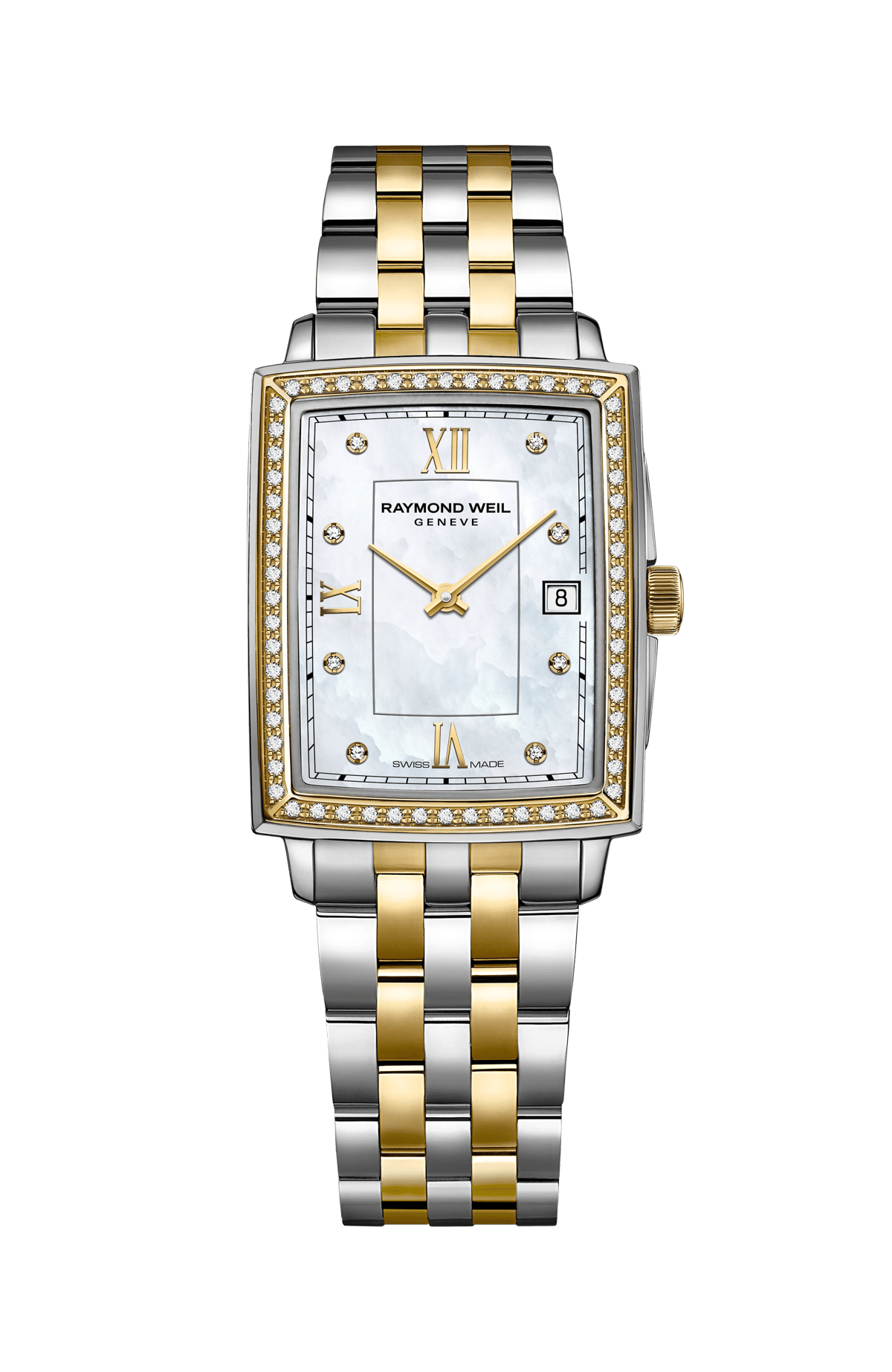
There is a particular kind of confidence in a watch that refuses to shout. The Raymond Weil Toccata Square, reference 5925-ST-00300, is that kind of watch. It arrives in a rectangular stainless-steel case, its dial silvered and calmly legible, and it makes no claim to be a tool, an heirloom, or a status signal. What it claims to be is a well-proportioned dress watch from a family-owned Genevan house — and it makes that claim convincingly.
Rectangular watches have always carried a whiff of dissent. The Cartier Tank and the Jaeger-LeCoultre Reverso established the form as the intellectual's alternative to the round watch, and for decades the rectangle lived almost exclusively at the top of the market. The Toccata Square sits downstream of that lineage, at a price that puts genuine rectangular design within reach of a first serious purchase. It is not a copy of anything; it is a considered, independent answer to the same question.
Raymond Weil in Brief
Raymond Weil founded his eponymous house in Geneva in 1976, launching at the height of the quartz crisis — a moment when a new Swiss brand had to be either very brave or very clear-eyed about what the market would bear. Weil was the latter. The company built its reputation on well-finished watches at accessible prices, sold through a carefully managed network of dealers, and it has remained independent and family-owned throughout. Elie Bernheim, the founder's grandson, now leads the house.
The brand's identity has always been organised around music. Parsifal and Nabucco take their names from opera; Maestro and Freelancer from the performer's life. Toccata refers to the virtuoso keyboard form — a piece written to display touch and velocity, famously in Bach's Toccata and Fugue in D minor. It is a fitting name for a watch whose appeal lies in proportion and precision rather than complication. The Toccata collection has long been the house's most classical line, and the Square variant takes that classicism into the one case shape that genuinely tests a designer's eye.
Case and Dial: Architecture at Small Scale
The reference suffix tells you what you need to know before you see the watch: ST for stainless steel. The case is a true rectangle in the classical sense — longer than it is wide, with straight flanks and a bezel that exists only to retain the sapphire crystal. There is nothing cushion-shaped or softened about it. The finishing follows conventional dress practice rather than sports-watch ornament: flat surfaces that catch light, edges kept crisp, and a restraint that keeps the watch from looking like a scaled-down carriage clock.
The sapphire crystal is a meaningful inclusion at this price. It resists the daily scuffs that acrylic and mineral glass collect within months, and it keeps the dial reading clean for years. There is no anti-reflective coating to speak of, which is typical of the class and rarely missed on a dial this legible.
The dial is where the watch earns its keep. A silvered ground — opaline rather than high-gloss, so it absorbs light instead of throwing it back — carries Roman numerals around the periphery and a fine minute track that runs to the very edge of the aperture. The hour and minute hands are slender and appropriately long, reaching the numerals rather than stopping short of them, which is a detail budget watches routinely get wrong. A date aperture sits at three o'clock, squared off to match the geometry of the case rather than left as a circular puncture.
There is no luminous treatment anywhere on the dial, and that is the correct decision. Lume on a Roman-numeral dress watch looks like a necktie worn with a wetsuit. The consequence is that the Toccata Square is a daylight and interior-lighting watch; in a dark restaurant it will be a silhouette. Owners of classical dress watches have lived with that trade for a century.
The Movement: Quartz, Honestly
The Toccata Square is powered by a Swiss quartz movement. Raymond Weil does not publish a caliber designation for this reference, and the caseback is solid, so there is no architecture to admire through glass. What matters instead is what the choice of quartz buys: a case that stays genuinely slim, a movement that requires no winding ritual, and a level of timekeeping that mechanical watches at ten times the price cannot match.
Quartz has spent forty years being apologised for by people who should know better. In a dress watch, it is not a compromise but a design decision. A thin, flat rectangle is the hardest case shape to build around a mechanical movement — the rotor and mainspring take up volume that a rectangle cannot easily hide — and a quartz calibre lets the designer keep the profile and the proportions honest. The battery will last a few years; the watch will not need winding, setting, or fussing in the interim.
What you give up is the pleasure of the mechanism itself: the sweep of a seconds hand rather than a tick, the ritual of the morning wind, the sense of a small engine running on your wrist. That is a real loss, and collectors should be honest about it. But it is a loss in a register this watch never claims. The Toccata Square is not asking to be admired through a display back. It is asking to be worn.
On the Wrist
A rectangle wears nothing like a circle, and that is the entire point. The Toccata Square sits flat and close against the wrist, its mass distributed across a long horizontal footprint rather than a wide circular one. Because the corners of the case extend further than a round watch of comparable presence would, the strap meets the case at a pronounced angle. The result is that the watch reads as a small, deliberate object rather than an accessory that happens to tell time.
Under a shirt cuff it slips away entirely, which is precisely what a dress watch should do. The leather strap is supple from the outset and the pin buckle is unobtrusive, if less elegant in the hand than a folding clasp. On a warm day the strap conforms quickly; on a cold wrist it takes a few minutes to settle. The absence of lume and the flat sapphire mean there is nothing to catch the light aggressively — the watch is a matte, private pleasure rather than a public one. It is comfortable enough to forget, which is a higher compliment than it sounds.
One caveat worth raising for anyone considering their first rectangle: the shape does not suit every wrist. Where a round watch can be forgiven for overhanging, a rectangle exposes the fit, because the corners either sit on the wrist or they do not. Try before you buy, and pay attention to how the lug-to-lug span reads on your wrist rather than to the nominal case measurement.
Accuracy and Daily Life
Swiss quartz movements in this class are typically rated to within roughly fifteen seconds a month, and there is no reason to expect the Toccata Square to deviate from that standard. In practice, that means the watch is effectively always right: you set it when you change the battery, and you do not think about it again. There is no positional variation to learn, no daily rate to track, no winding ritual to observe.
For a collector who owns mechanical watches, this is either a profound relief or a small philosophical loss — but for the purpose this watch serves, the trade is sensible. It is a watch you pick up and put on, not a watch you attend to. It also makes the Toccata Square an excellent travel companion for short trips where a single dress watch has to do everything: no winder, no setting, no anxiety at airport security.
Raymond Weil does not market this reference as a sports watch, and it should be treated accordingly. Rain and handwashing are not a problem; swimming and showering are. That is the normal contract of a dress watch, and buyers who need more should look elsewhere in the catalogue.
Ownership and Service
Quartz ownership is simple. Battery replacement every few years can be handled by any competent watchmaker, and the case and crystal are best serviced through Raymond Weil's authorized network when the time comes. There is no elaborate service interval to plan around and no oil to degrade in a way that punishes a watch left in a drawer. This is the quiet advantage of the format: a Toccata Square that sits unworn for six months will start ticking the moment you pick it up, with no intervention required.
Seals should still be checked periodically if the watch is worn near water, and the strap is a consumable — leather in a dress watch will need replacing every couple of years under regular wear. Those are the only meaningful running costs, and they are modest.
The Alternatives
The obvious comparison is the Cartier Tank Must, which invented the visual language this watch speaks and charges considerably more for the privilege. If the Tank's Roman numerals and brancards are what you actually want, save for the Tank; the Toccata Square will not scratch that itch. Longines offers the DolceVita in a similar rectangular register with a comparable sense of restraint. NOMOS builds the Tetra, a square mechanical watch with an in-house calibre at roughly double the money, and it is the choice for anyone who cannot accept quartz on principle. Baume & Mercier's Hampton and Frederique Constant's Classics Carrée round out the Swiss options in the same bracket.
Below the Toccata Square, the Seiko SWR049 and the Timex Marlin offer rectangular character for a fraction of the price. They are honestly good watches. But they do not offer the same case finishing, and the difference is visible in the hand even if it is invisible in a photograph.
Value and Verdict
At retail, the Toccata Square buys genuine rectangular design, a sapphire crystal and Swiss assembly at a figure that a mechanical equivalent would double. On the secondary market it is one of the more undervalued dress watches in its class, because quartz dress watches outside the haute horlogerie tier depreciate quickly and then stabilise. Buy it to wear and the arithmetic works; buy it to hold and it does not.
The larger point is that this watch has a point of view. It does not pretend to be a Tank, and it does not need to — its proportions, its silvered dial and its quiet finishing are coherent on their own terms. Buy it as a first dress watch, a second watch for tailoring, or a corrective to an over-built collection, and it will serve you for years without asking for attention. In a market that rewards noise, that is a rare and rather admirable thing.