A Different Kind of Dial
Most watches ask you to look at a surface and read two rotating lines against a printed scale. Ressence asks you to look at a system. The TYPE 9 ARM 'Scattering Sun' is built around the Belgian manufacture's ROCS module — Ressence Orbital Convex System — in which the hours, minutes, seconds and day/night indication are carried on four separate discs that rotate within a shallow, convex plane. Nothing floats above the dial. There are no hands, no central pinion, no visual hierarchy imposed by a pair of batons. The information is simply there, arranged in orbital registers that continuously rearrange themselves as the watch runs.
This is not novelty for its own sake. Benoît Mintiens founded Ressence in Antwerp in 2010 after a career in industrial design, and the brand has always behaved more like a design studio with a machining department than like a traditional maison. The ROCS system is patented, it is made in-house, and it is the reason the company exists. Every model — the TYPE 1, the oil-filled TYPE 3 and TYPE 5, the larger TYPE 8 — is an argument built on the same premise. The TYPE 9 is simply the most compact and most wearable version of that argument.
The 'Scattering Sun' Finish
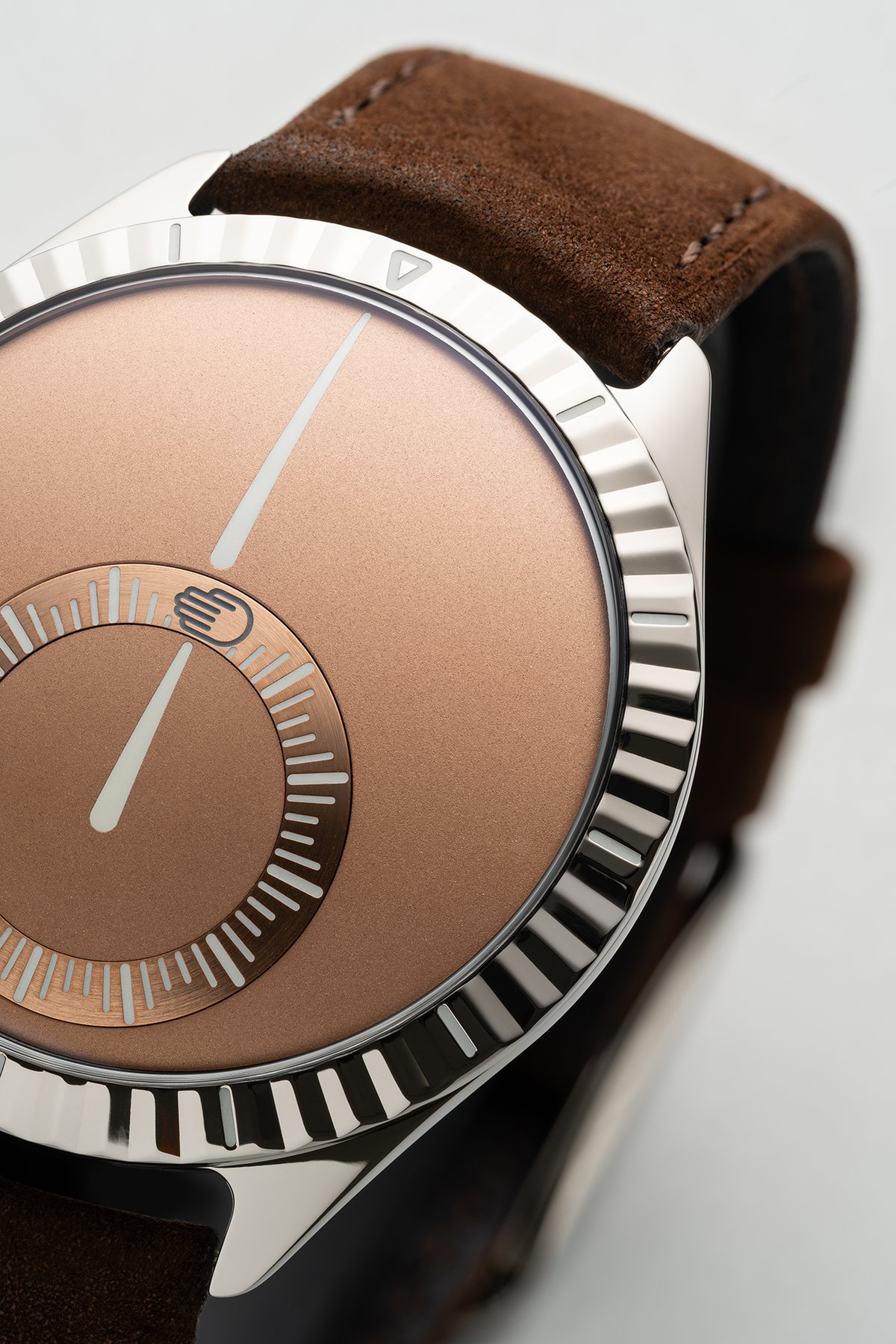
The reference name is the tell. Ressence has generally treated the dial as a legibility substrate: matte, dark, deliberate, with markings engraved and filled so that they read cleanly against the rotating planes. The 'Scattering Sun' treatment changes the terms of that contract. The surface is finished so that light does not sit on it but breaks across it, producing a fine radial shimmer that shifts as the wrist moves and as the ambient light changes.
In practical terms, this means the TYPE 9 is never quite the same watch twice. Under direct, warm light the dial reads almost bright, with the engraved markings standing in slight relief against a brushed, sunburst-like field. Under the cool, diffuse light of an office or an overcast day, the surface compresses and darkens, and the sub-registers become the dominant visual element. This is a watch that rewards movement and punishes static photography — which is presumably exactly the point, given how aggressively the brand has moved away from the flat product shot.
The trade-off is honest: a light-diffusing surface reduces contrast. In very low, very diffuse light, the separation between the orbital registers and the surrounding dial is less crisp than on a matte reference, and the eye has to work a little harder. It is not a legibility failure — the discs remain readable because the markings are engraved and filled rather than printed — but it is a reminder that this is a designed object first and a tool second. The lume-filled engraving does more work here than on a conventional dial, and that is a good decision.
How ROCS Actually Works
It is worth being precise about the mechanism, because the TYPE 9's entire character follows from it. The base movement provides a single output at the canon pinion. The ROCS module takes that output and, through a train of reduction gears, distributes it to four discs that sit in a shallow convex arrangement beneath the sapphire. Each disc carries its own engraved and lume-filled markings, and each rotates at a different rate. The hour disc turns slowly; the minute disc turns faster; the seconds disc faster still; the day/night disc rotates once a day to indicate whether the watch is reading AM or PM.
The engineering constraint is torque. Every additional plane in the display adds friction, and the module must draw as little as possible from the base caliber so that the amplitude and rate of the movement are not compromised. Ressence addresses this with treated gear surfaces, low-friction pivots and a lubrication regime designed for the module rather than inherited from the base movement. The result is a display mechanism that is genuinely a mechanism — not a printed disc sitting on a pinion — and it is assembled and regulated as a unit.
Finishing follows the same logic. There is no Geneva striping here, no anglage for its own sake. Plates are bead-blasted, surfaces are treated for friction reduction, and the gearing is finished to tolerances rather than to a decorative standard. You will only ever see it through the caseback or under a loupe, and Ressence has clearly decided that a watchmaker's appreciation matters more than a collector's. It is the correct decision, and it is consistent with the brand's industrial-design DNA.
Case and the Crownless Ritual
The TYPE 9's case is grade 5 titanium, and the design language is immediately recognisable as Ressence: a smooth, pebble-like form with no crown anywhere on its circumference and no conventional lugs projecting from the flanks. The sapphire crystal sits in a shallow dome, following the convexity of the display beneath it, and the whole assembly reads as a single continuous volume rather than as a case with parts attached to it.
The absence of a crown is the detail that divides owners. Winding and setting are performed through the caseback, using a folding lever and the caseback itself as the interface. This means that correction — after a few days off the wrist, or when travelling across time zones — requires taking the watch off. There is no way around it, and there is no pusher hidden in the flank as a compromise. For some collectors this is an elegant refusal of an unnecessary protrusion, and the resulting purity of line is worth the inconvenience. For others it is a daily friction point that never quite stops being annoying.
Our view is that the trade is defensible precisely because the case is otherwise so well resolved. Removing the crown allowed Ressence to eliminate the lugs as well, anchoring the strap low and close to the caseback. The result is a watch that sits flat against the wrist with a minimum of visual bulk, and a profile that slips under a cuff in a way that few pieces of comparable presence manage.
Movement and Daily Running
The TYPE 9 runs on a self-winding base caliber beneath the ROCS module. Ressence has not published detailed figures for the base in this reference, and we have not substituted generic numbers for them. What can be said is that the base is a known, serviceable architecture rather than an exotic — the brand's philosophy has always been to put its innovation in the display, not in an over-complicated escapement — and that regulation is performed with reference to the module as well as to the movement.
Accuracy expectations should be framed accordingly. The rate is set at the base movement, and the module translates that rate without introducing an independent oscillator, so chronometer-adjacent performance is a reasonable standard to hold. But an orbital display is judged on alignment as much as on rate: the relationship between the hour and minute planes is visible in a way that a conventional handset forgives, and small positional discrepancies show up under scrutiny. Expect a couple of seconds a day of positional variation to be entirely normal, and judge the watch on the consistency of its registration rather than on a single timing-machine reading.
Service is the practical consideration. The module requires a watchmaker trained on the ROCS system, which effectively means Ressence or an authorised partner. There is no realistic path to independent servicing of the display, and any buyer should factor that into the cost of long-term ownership rather than treating it as a footnote.
On the Wrist
Wearing the TYPE 9 is a surprisingly quiet experience given how much is happening on the dial. Titanium has almost no thermal signature and very little perceived mass, and because the strap is anchored low and close to the case, there is no gap beneath the case to catch on a sleeve or rock against the wrist bone. The watch sits flush, flat and unobtrusive. In a shirt cuff it disappears entirely; on a bare wrist in summer it reads as a smooth, dark object with a slowly turning interior.
The dial, by contrast, is loud. People notice it. The 'Scattering Sun' surface catches light in a way that conventional sunburst finishes do not, and the orbital layout produces a moment of visible confusion in the observer before the reading resolves — which is, frankly, part of the appeal. This is a watch that starts conversations with strangers and requires a thirty-second explanation. Owners of Ressence pieces tend to describe this as a feature. It is.
Ownership, Value and Alternatives
Pricing for the TYPE 9 ARM sits at the accessible end of the Ressence catalogue — below the TYPE 3 and TYPE 5, and broadly in line with the TYPE 8's positioning in the market. You are not paying for gold, for a chronograph, or for a heritage case shape. You are paying for a patented display architecture, a module assembled and regulated in-house, and a titanium case executed with genuine design rigour. Judged on those terms the price is defensible; judged against a conventional three-hander at the same money, it is indefensible. The TYPE 9 only makes sense if you accept the premise.
Values on the secondary market have been broadly stable rather than speculative. Ressence is a small independent with controlled production and real patents, which supports prices better than most niche brands, but the market is thin and liquidity — not value — is the real constraint. Buyers should expect to hold rather than to trade, and should expect the pre-owned spread to reflect the difficulty of finding a specific reference rather than any particular premium.
Alternatives depend on what you are actually after. If it is orbital or unconventional display architecture, Urwerk's UR-100V occupies the same conceptual territory at a considerably higher price with far greater visual aggression. If it is reductionist disc-based display, Ochs und Junior's Settimana takes a different route to a similar refusal of hands. If it is simply a well-made independent daily wearer with a distinctive face, Behrens offers unorthodox displays at a fraction of the money, though without the same level of case and module refinement. There are no meaningful homages: the ROCS system is patented, and no one has attempted a serious copy.
Verdict
The TYPE 9 ARM 'Scattering Sun' is not a watch for someone who wants a familiar object rendered expensively. It is a piece of industrial design that happens to keep time, executed with real technical seriousness and finished with enough restraint to be worn every day without ceremony. The crownless, back-set ritual is the price of entry, and it is a price some owners will never stop resenting.
But the display itself — a genuine mechanism rather than a decorative conceit — remains one of the few original ideas in contemporary watchmaking, and the 'Scattering Sun' finish gives it the one thing orbital displays have historically lacked: a sense of light as an active ingredient. If the ritual suits you, this is among the most rewarding objects at its price. If it does not, no amount of shimmer will convert you, and that is entirely fair.