Ressence Type 9 JWB: The Orbital Entry Point, Reviewed
The independent avant-garde is full of watches that look like puzzles and wear like penance. Ressence has spent more than a decade arguing the opposite: that a radical display can still be a daily companion. The Type 9 JWB is the clearest expression of that argument yet, a genuine entry point into the brand's orbital world and, for a collector who has tired of the same three-hand rotation, possibly the most interesting watch at its price.
The reference under review, T91X-JWBF-VBA, is the JWB execution — a signature dial finish that gives the Type 9 a warmer, more contemporary character than the standard catalog pieces. Ressence does not publish every specification, and we have deliberately left unconfirmed figures out of this review rather than guess. What follows is what we can stand behind: the design logic, the wearing experience, the market behavior, and the ownership math.
The short version: the Type 9 is not a flip and it is not a safe. It is the rare avant-garde watch that earns its place on the wrist rather than in the vault. Buy it to wear and it rewards; buy it to speculate and you will be disappointed.
Why the Type 9 Matters
Ressence was founded in Antwerp in 2010 by industrial designer Benoît Mintiens, and it has always been a design house first and a movement house second. That is not a criticism. The brand's contribution to modern horology is a display system — the Ressence Orbital Convex System, or ROCS — that replaced hands with rotating discs. The entire dial turns as one convex unit, and the hours, minutes, and seconds orbit within it.
The Type 9 sits at the accessible end of that family. Where the Type 3 adds an oil-filled chamber and the Type 5 leans into sports-dive territory, the Type 9 is the purest distillation of the idea: the display, the case, nothing else. It is the model the brand points to when a new collector asks where to start. The JWB reference leans into that role with a dial treatment that reads as more approachable than the stark black-and-white catalog standards.
For the market, that positioning matters. Ressence has built a following among collectors who want something the person next to them at dinner has never seen, but who are not prepared to pay MB&F or Urwerk money. The Type 9 is the answer to that brief, and it is why secondary demand for the brand's entry pieces has held up better than for many independents of similar size. The Type 9 is not the cheapest way into the brand — the Type 8 occupies that slot — but it is arguably the most balanced: more presence than the entry piece, less complexity than the oil-filled flagship.
The ROCS System, Without the Jargon
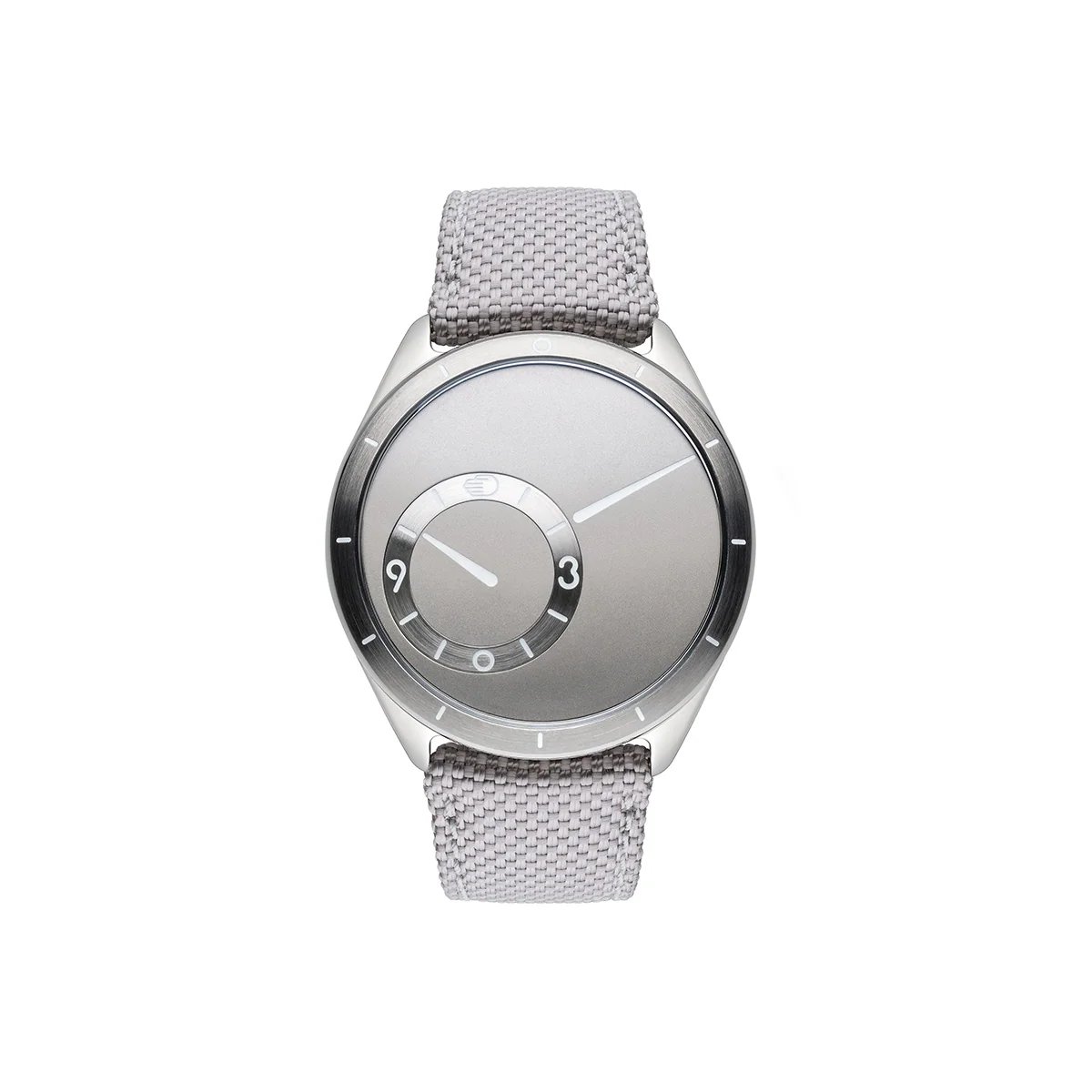
Forget the marketing. Here is how it works: there are no hands. The dial is a convex disc that rotates as a unit, carrying the hour, minute, and second indicators with it. Each indicator is itself a small rotating disc, and the whole assembly is driven by a central gear train. The effect is that time appears to move around the dial rather than across it.
What this buys you is legibility of a different kind. Once your eye learns the pattern — and it takes about a day — reading the time becomes instinctive. The bigger win is visual: the dial is in constant, slow motion, and the watch feels alive in a way that a static three-hander never does. It is the closest thing in watchmaking to a kinetic sculpture you can wear.
What it costs you is low-light performance. There is no lume. There is no traditional hand to catch a glance. In a dark restaurant or a theater, you will tilt the watch toward whatever light exists and read it deliberately. That is a real limitation, and it is the single most common complaint from owners. Ressence has decided the design is worth it; you have to decide whether you agree.
The system is also the reason the watch has no crown. On the wrist, that means no protrusion, no pressure point, and a silhouette that is essentially symmetrical. Setting the time is done through the caseback, which sounds fiddly on paper and becomes second nature within a week. It is one of those design decisions that you stop noticing precisely because it works.
Design and Dial
The Type 9 is a study in restraint. The case is smooth and rounded, the lugs flow into the midcase, and the dial is the only thing that draws the eye. The JWB execution is the more characterful of the Type 9 variants, with a finish that reads warmer in person than in press images. It is the kind of detail that does not photograph especially well and rewards an in-the-metal viewing — which is true of most Ressence pieces.
The convex crystal is essential to the effect. It magnifies and distorts slightly at the edges, so the dial appears to float. Combined with the orbiting display, the result is a watch that feels deeper than it is and more dynamic than any static dial. It is a genuinely original piece of industrial design, and that is the real value proposition here — not the movement, not the materials, but the idea.
Movement and Mechanics
The Type 9 runs on an automatic movement with the ROCS 9 orbital module stacked above the base calibre. Ressence builds the display architecture in-house and sources the underlying automatic movement, which is standard practice at this price point and not a mark against the watch. The module is the engineering story; the base movement is the reliable engine underneath it.
The brand is tight-lipped about power reserve and frequency, and we have left those figures out rather than invent them. What we can say is that the watch winds itself, runs reliably in daily use, and does not demand the winding ritual that some independents impose. The architecture is industrial rather than haute-horlogerie — you will not find hand-bevelled bridges or a display back full of anglage — but that is consistent with the price and with the design-first brief. The finishing you do see is on the dial side, and it is excellent.
One practical note: the crownless case is not just an aesthetic choice. Without a crown, the profile is uninterrupted and the watch sits flush against the wrist. Setting the time is done through the caseback, which is a learned behavior but quickly becomes second nature. The trade-off is that the watch is not intended for quick adjustments on the fly; it is a set-it-and-forget-it daily.
On the Wrist
The first thing you notice is how little there is to snag. No crown, no protruding lugs, no sharp edges — the case is a smooth, rounded form that disappears under a cuff and sits comfortably against the skin. The convex crystal and dial create a subtle dome that catches light from every angle, which is the source of the watch's wrist presence. It reads larger than its footprint because the dial is constantly in motion and the eye is drawn to it.
Weight is balanced and the strap is supple leather with a pin buckle, which suits the dressier end of the brief. On a smaller wrist the watch sits centered and secure; on a larger wrist it reads as a deliberate, jewel-like object rather than a statement piece. This is not a watch that announces itself across a room. It is a watch that rewards the person who leans in. That is exactly the right personality for the category.
Comfort over a full day is excellent, and the lack of a crown means no digging into the back of the hand during desk work. If you wear a watch under a shirt cuff, the Type 9 is one of the least intrusive pieces in its class — which is not something you can say about most avant-garde designs.
Accuracy and Daily Life
Expect typical automatic-movement accuracy — within a handful of seconds per day in normal wear, with variation depending on position and activity. There is no COSC certification here, and Ressence does not market the Type 9 as a chronometer. If you need quartz certainty, this is not your watch; if you accept that a mechanical display is a living thing, the Type 9 is entirely dependable.
Daily life with it is easier than the concept suggests. It slips under a shirt cuff, works with tailoring, and does not draw the wrong kind of attention in a meeting. The lack of lume is the one genuine compromise, and it pushes the watch toward daytime and well-lit evening wear. For travel, the lack of a quick-set date or GMT is a non-issue because there is no date and no GMT — you set the time and go. It is a simple watch disguised as a complex one, which is the highest compliment you can pay a design-led piece.
The Market Case: Resale, Demand, and Hold-versus-Sell
Ressence is one of the better-behaved independents on the secondary market. The brand does not flood the market, production is limited, and demand from design-literate collectors has been steady rather than hyped. The Type 9 follows that pattern. Pre-owned examples trade below retail but not dramatically so, and clean, complete sets move quickly when priced sensibly.
This is a stable, not an appreciating, asset. Do not buy a Type 9 expecting it to fund a retirement; do buy it expecting it to hold most of its value if you keep it in good condition and retain the box and papers. The JWB dial treatment adds a small premium in collector circles because it is the more characterful execution, but do not overpay for that — the base watch is the story, and the dial is a bonus.
On hold-versus-sell: if you bought at retail and the watch is not getting wrist time, the honest answer is to sell into the next wave of demand rather than wait for a spike that is unlikely to come. If you wear it, hold. Ressence owners tend to be loyal, and the brand's collector base is growing rather than shrinking, which supports the long-term floor.
Demand cycles matter here. Ressence pieces tend to move in step with the broader independent market: strong when collectors are flush and looking for design-led alternatives to the big brands, softer when liquidity tightens. The Type 9, as an entry-level model, is more liquid than the brand's flagships and therefore easier to exit if you need to. That liquidity is worth something, and it is part of why the watch is a sensible buy rather than a pure passion play.
Service and Ownership Costs
Ressence services through authorized partners, and the orbital module requires factory-trained technicians. That means you should budget for authorized-only service and plan to keep the watch within the brand's network rather than handing it to a local watchmaker. Service intervals and costs are not published in a way we can quote responsibly, so we have left those figures out. The practical advice is simple: ask your authorized dealer for the current service schedule before you buy, and factor it into the total cost of ownership.
The other ownership consideration is the strap. Leather is the right choice for a dress-leaning piece, but it is a wear item. Plan for a replacement every couple of years if you wear the watch daily, and treat the buckle as part of the watch rather than an afterthought — a worn pin buckle undermines the look more than a worn strap.
Alternatives
If you want the same conceptual thrill at a higher price, MB&F and Urwerk are the obvious ports of call, but both sit meaningfully above the Type 9 and demand a different level of commitment. Closer to home, the rest of the Ressence line — the Type 3 for oil-filled drama, the Type 8 for a more conventional entry — are the natural comparisons. Outside the brand, affordable orbital-style displays exist, but none replicate the ROCS architecture, and the gap in execution is obvious in person.
For collectors weighing the Type 9 against a more traditional dress watch, the decision comes down to what you value. A conventional piece will be easier to service, easier to resell, and easier to explain. The Type 9 will be more interesting to live with, more distinctive on the wrist, and more likely to start a conversation. Neither choice is wrong; they are simply different value systems.
Final Verdict
The Type 9 JWB is the rare avant-garde watch that works as a daily. It is beautifully resolved on the wrist, mechanically interesting without being fragile, and priced at the edge of what the concept is worth. It will not make you money, and it will not suit everyone — the lack of lume and the learned time-reading are real. But for a collector who wants a watch that feels like nothing else in the box, it is one of the smartest buys in the independent space right now.
Buy it to wear. That is the whole thesis, and the Type 9 delivers on it more convincingly than almost anything else at its price.