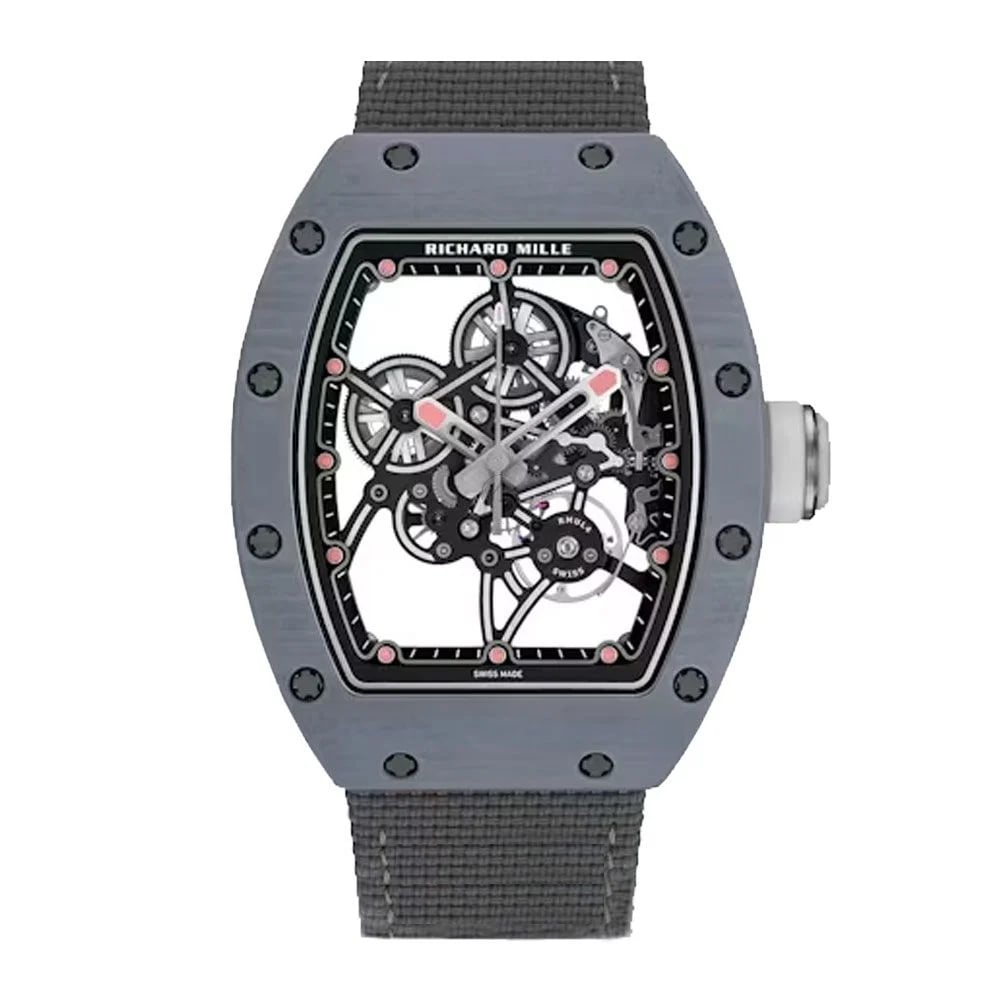
Richard Mille built its reputation on a simple provocation: that a wristwatch could be engineered like a racing car and finished like a piece of architecture. The RM 55-01 is that provocation in its most concentrated form. There is no dial to speak of, no date, no decorative guilloché, no concession to the conventions of classical watchmaking. What is left is a grade 5 titanium tonneau, a sapphire crystal, a rubber strap and Calibre RMUL2, a skeletonised automatic whose bridges have been cut back until the movement reads like a load-bearing truss.
This matters because Richard Mille's catalogue has become crowded. Between the tourbillons, the split-seconds chronographs and the sapphire-cased showpieces, it is easy to lose sight of the brand's core proposition. The RM 55-01, sitting in the lineage of the RM 055 and, before it, the RM 005 and RM 010, restates that proposition without embellishment. It is a lightweight automatic sports watch in which the movement is the dial, the case is the frame and the engineering is the point.
The movement: Calibre RMUL2
Calibre RMUL2 is an automatic, skeletonised calibre running at 28,800 vibrations per hour, four hertz, with a power reserve of around 55 hours. Those figures are unremarkable in isolation. What distinguishes the calibre is its architecture. The baseplate and bridges are not decorated and then assembled; they are designed as structure and then cut away until almost nothing remains but the paths that carry load from the mainspring to the escapement. Look through the front crystal and you are not looking at a dial with a hole in it. You are looking at the watch's skeleton, and the skeleton is the watch.
The regulating organ is a free-sprung balance with variable-inertia screws. There is no index, no regulator arm, no lever to nudge. Rate is adjusted by turning small screws set into the rim of the balance, changing its inertia rather than the effective length of the hairspring. It is a system that costs more to make and takes longer to regulate, and it is more stable in service because there is nothing to drift out of position. Richard Mille has used it across the catalogue for years, and it remains one of the quiet technical signatures of the brand.
Finishing is where Richard Mille divides opinion. The brand does not chase Geneva stripes or black-polished steel in the classical sense. Instead the surfaces are microblasted, the flanks are straight-grained, the bevels are polished only where the structure benefits from the highlight. The result is a movement that reads as industrial rather than decorative, closer to a machined aerospace component than to a nineteenth-century pocket watch. Collectors who came up through traditional horology sometimes find it cold. Collectors who came up through motorsport and industrial design tend to find it honest. Either way, the execution is consistent and deliberate, and the skeletonisation is structural rather than cosmetic, which is more than can be said for a great deal of the genre.
Legibility is the trade-off, and it is worth being honest about it. With no dial, the hands read against the movement itself, and the contrast comes from the finishing of the bridges rather than from printed indices. In daylight this works well; the broad hands and the polished bevels catch light and separate cleanly from the microblasted surfaces behind them. Indoors, under warm and diffuse lighting, the effect is softer and you find yourself tilting the wrist. This is a watch you read actively rather than glance at, and for most owners that is part of the ritual rather than a criticism.
Case, crystal and strap
The case is a tripartite tonneau in grade 5 titanium, assembled with Richard Mille's signature spline screws. Grade 5, Ti-6Al-4V, is the aerospace alloy rather than the softer commercially pure grade, and Richard Mille uses it for its strength-to-weight ratio as much as for its finish. The surfaces are a mix of satin brushing and polished bevels, with the curvature of the tonneau designed to follow the line of the wrist rather than sit on top of it. The sapphire crystal is domed and treated with an anti-reflective coating on both faces, which matters more than usual here: a skeletonised dial behind a flat crystal becomes a hall of mirrors, and the curvature plus the coating keeps the movement legible from most angles.
The spline screws deserve a moment. They are not fasteners in the ordinary sense; they are part of the visual language of the case, set into the bezel and caseback and machined to tight tolerances so that the heads sit flush and aligned. On a lesser watch this would be decoration. Here it is a reminder that the case was designed as a system rather than assembled from parts, and it is one of the reasons the RM 55-01 photographs as well as it does.
The strap is rubber, integrated into the case with a titanium pin buckle. This is the correct choice. A leather strap on a watch like this would be a costume; rubber is what the case was designed for, and the integration means there is no gap between case and strap to break the line. The buckle is simple, well finished and unobtrusive, which is exactly what a buckle should be. It is also, for collectors, one of the details that matters most when assessing originality on the secondary market.
On the wrist
The first thing you notice is the weight, or the absence of it. Grade 5 titanium and a skeletonised movement combine to produce a watch that effectively disappears on the wrist. You become aware of it when you look at it, not when you move. That sounds like marketing copy until you have worn a heavy gold sports watch through a working day and felt the difference at four in the afternoon. The RM 55-01 is a watch you can forget you are wearing, which is a rarer virtue than the industry likes to admit.
The second thing you notice is the balance. A tonneau case with an integrated strap can sit awkwardly if the curvature is wrong, but Richard Mille has been refining this geometry for two decades and it shows. The case wraps rather than perches, the strap follows the wrist without needing to be cinched, and the whole assembly stays put during movement. The crown is large and knurled, easy to grip, and positioned so that it does not dig into the back of the hand. It is not a subtle watch, because the tonneau silhouette and the openworked dial are visible from across a room, but it is a comfortable one, and comfort is the part of the design that reviewers tend to skip.
Accuracy and daily life
The RMUL2 is not COSC-certified, and Richard Mille does not make a great deal of noise about chronometric certification. In practice, a free-sprung balance with variable-inertia screws, properly regulated, is capable of very good stability, and most examples settle into a handful of seconds a day in either direction. Expect it to be sensitive to the usual variables, namely state of wind, temperature and the position it rests in overnight, and expect a watchmaker to be able to bring it back to spec at service. It is not a quartz watch and it is not sold as one.
Daily life with the RM 55-01 is easier than the design suggests. The rubber strap is comfortable in heat and water, the titanium case shrugs off knocks that would mark gold, and the sapphire crystal is effectively scratch-proof in normal wear. Water resistance is modest by sports-watch standards, so this is not a dive watch and should not be treated as one, but it is sufficient for rain, hand-washing and the ordinary accidents of a working week. The lack of lume is a deliberate consequence of the skeletonised design. This is not a watch for reading in the dark, and it does not pretend to be.
The range
The RM 55-01 sits within the RM 055 family, the lightweight automatic line that Richard Mille has developed and refined over more than a decade. The RM 055 Bubba Watson established the template: grade 5 titanium, skeletonised automatic, rubber strap, a case designed around the wrist rather than on top of it. The RM 55-01 continues that approach, and collectors should think of it as part of a continuum rather than as an isolated reference. Earlier siblings in the same lightweight-automatic tradition include the RM 005 and the RM 010, both of which are worth understanding if you are trying to place the RM 55-01 in context.
Richard Mille's catalogue is wide, and it is worth being clear about what the RM 55-01 is not. It is not an RM 011, the flyback chronograph that has become the brand's most recognisable complicated sports watch. It is not an RM 027 or RM 035, the Rafael Nadal tourbillons built to survive professional tennis. It is not an RM 056, the sapphire-cased tourbillon that functions as a piece of engineering theatre. The RM 55-01 is the quieter proposition: a time-only skeleton automatic in titanium, and its restraint is exactly why some collectors prefer it.
Alternatives
If you are shopping in this territory, the comparison set is small. The Audemars Piguet Royal Oak Concept offers a similarly architectural approach to skeletonisation, with a rather more classical finishing philosophy and a different case geometry. The Hublot Big Bang MP-11 takes the industrial-skeleton idea in a more baroque direction, with a dramatic inline power reserve. MB&F's Horological Machines occupy adjacent conceptual ground, machines for the wrist designed by an engineer's eye, but they are more experimental and less wearable on a daily basis. Roger Dubuis's Excalibur Spider line competes on visual drama and skeletonisation, though its finishing language is different again. None of these is a substitute for the RM 55-01. They are different answers to the same question, and the right one depends on whether you want your skeleton watch to feel like a machine, a sculpture or a statement.
Ownership, investment and service
Richard Mille is one of the few brands whose secondary-market performance has been genuinely strong over the past decade, and the lightweight automatics have participated in that. The RM 55-01 is a limited-production piece and was never a volume model. Examples trade on the secondary market rather than sitting in dealer cases, and pricing reflects scarcity as much as specification. As with any Richard Mille, condition, completeness, meaning box, papers and service history, and originality of the strap and buckle matter enormously to value. Buy the best example you can find rather than the cheapest, and buy from a specialist who understands the model.
Servicing is a specialist matter. Richard Mille movements are not routine work for a general watchmaker, and the brand's authorised service network is the sensible route for anything beyond a strap change. Expect service intervals measured in years rather than decades, and expect the cost to reflect the complexity of a skeletonised calibre with a free-sprung balance. Budget for it at the point of purchase rather than treating it as a surprise.
Verdict
The RM 55-01 is not for everyone, and it is not trying to be. It is a watch for collectors who have stopped needing a dial to tell them what time it is and have started wanting to see how the time is made. The grade 5 titanium case is light and tough, the RMUL2 movement is structurally honest, and the whole object is put together with a consistency that rewards close looking. It is expensive, it is conspicuous, and it makes no attempt to be classical. What it does, it does with conviction, and in a market full of skeletonised watches that are merely openworked, conviction is worth paying for.