Two cages, one reading
Roger Dubuis has never been a maison content with the merely sufficient. Since the Excalibur line first drew its sword in 2005, it has served as the brand's stage for the most theatrical expressions of Geneva watchmaking, and few pieces carry that mandate further than the Excalibur Double Flying Tourbillon, reference RDDBEX0920.
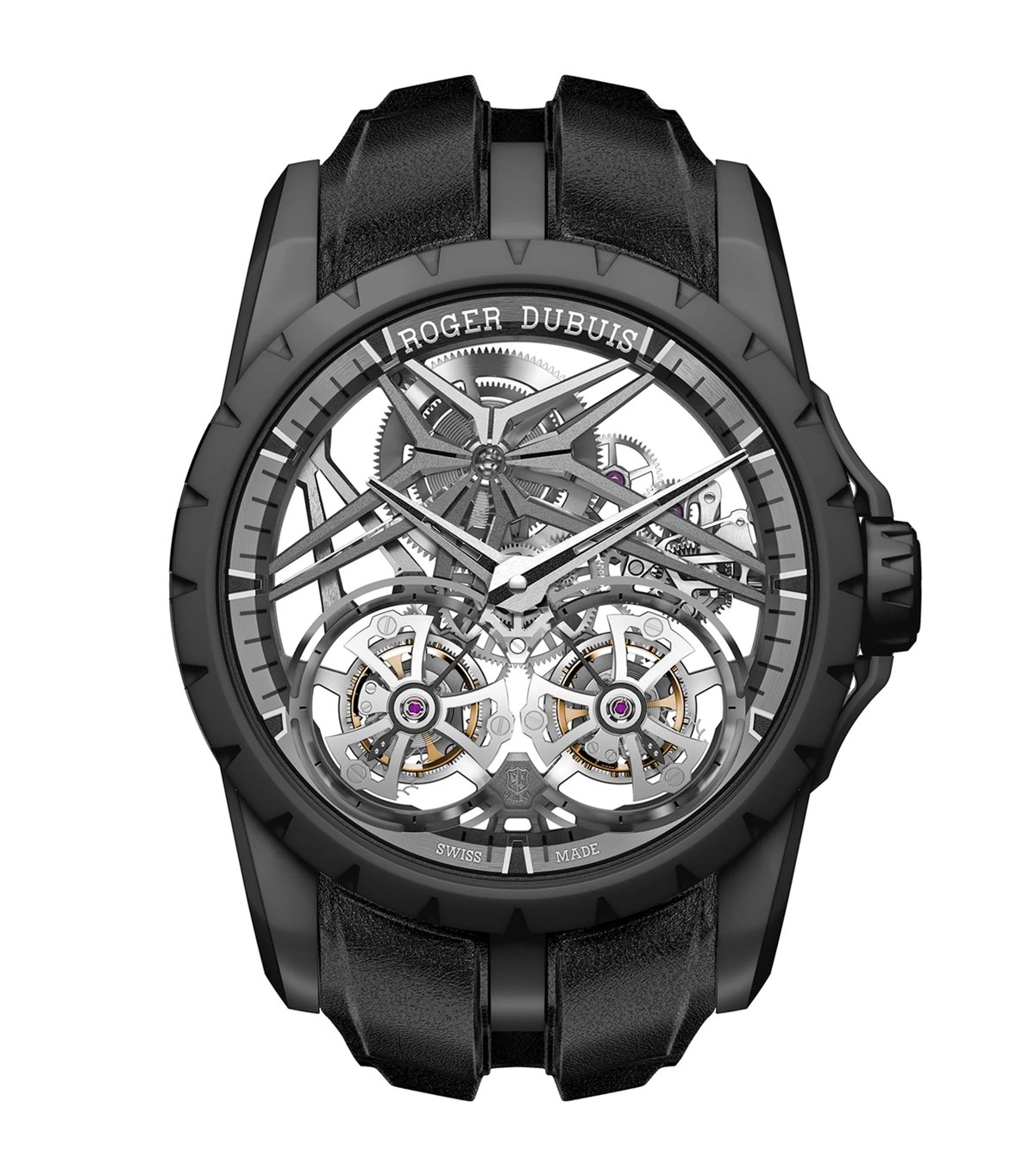
Where most tourbillons ask you to admire a single rotating cage, this watch asks you to consider two, suspended at opposite ends of an openworked movement and bound together by a differential that averages their rates into a single reading. It is architecture as spectacle and spectacle as architecture, a piece that treats the regulating organ not as a hidden necessity but as the entire point of the object.
This is not a watch purchased for discretion. It is a statement of technical intent, a piece that rewards the collector who reads a movement the way others read a dial. It asks to be understood before it is admired, and it repays both. What follows is our full assessment of what the reference does, how it wears, and whether it earns its place in a considered collection.
House history: Geneva, complication and a certain stubbornness
Roger Dubuis was founded in Geneva in 1995 by the watchmaker Roger Dubuis and the entrepreneur Carlos Dias. From the outset the maison positioned itself at the complication end of the market, and it was among the few houses to pursue the Poinçon de Genève across its movements, an external certification of both chronometric performance and the quality of finishing that remains a useful shorthand for the brand's ambitions.
The Excalibur collection arrived in 2005 and quickly became the house's flagship, a canvas for flying tourbillons, skeletonised calibres and outsized horological gestures. The double-tourbillon line sits at the top of that hierarchy: it is the model that most completely expresses the brand's belief that a movement should be seen, not merely housed. The reference is not a quiet watch, and the maison has never pretended otherwise.
Movement: the RD108 and the logic of two tourbillons
The heart of the reference is the hand-wound Calibre RD108, a movement built around twin flying tourbillons. A single flying tourbillon is already a demanding object. The cage is cantilevered from one side, with no upper bridge, so the whole assembly appears to float. Doubling it multiplies the challenge of both construction and regulation, and it changes the character of the movement from a complication into an architecture.
Roger Dubuis answers the obvious question, why two, with a differential. The two tourbillons sit at opposite ends of the calibre, and a differential averages their rates into a single output to the hands. In principle this is a stability argument: two regulating organs, averaged, can smooth out positional variation. In practice it is equally an argument about beauty, because the differential gives the movement a visual logic, a mechanical conversation between two cages that the eye can follow from one side of the dial to the other.
The calibre is finished to Geneva standards. Look closely and you find polished bevels that catch the light along every bridge, black-polished steel components and circular-grained surfaces that reward a loupe. The skeletonisation is purposeful rather than decorative: material is removed so that the architecture can be read, and the finishing is applied to surfaces that most owners will never see except through the dial-side aperture. That is the quiet discipline beneath the theatre, and it is what separates a genuine high-complication movement from a showpiece.
The movement runs at 21,600 vibrations per hour and carries roughly four days of autonomy, a useful reserve for a hand-wound piece that will often sit in a safe between outings. It is not a COSC-certified chronometer; its credentials are Geneva's, not COSC's, and the twin-tourbillon architecture is aimed at rate stability and spectacle rather than at chasing a certificate. That is the correct framing for this watch. It is a demonstration of what the maison can do, and it is meant to be enjoyed as one.
Finishing and the Geneva Seal
The Poinçon de Genève is not a marketing line. It is a third-party inspection regime that covers both the regulation of the movement and the quality of its finishing, from the geometry of the bevels to the treatment of the steelwork. On a skeletonised watch this matters more than usual, because the finishing is not hidden behind a solid caseback. It is the dial. Every angle the eye can see is an angle the inspector has seen.
What that means in practice is a movement that reads as deliberate rather than busy. The bridges are shaped so that the eye travels between the two cages, and the differential is presented as a feature rather than concealed. The black-polished steel and the circular graining provide the contrast that makes the architecture legible. It is the kind of finishing that grows on an owner over years, because it rewards the loupe and the raking light rather than the initial photograph.
Case, dial and the theatre of the openworked face
The reference is presented in a precious-metal case, and the choice is consistent with the model's position: this is a piece intended to be worn as jewellery as much as machinery. The case is finished with the crisp alternation of polished and satin surfaces that the Excalibur family has made its signature, a broad and confident form that frames rather than competes with the movement.
The dial is where the watch declares itself. There is no conventional dial in the usual sense; instead, the movement is the face. The twin tourbillons are the visual anchors, and the bridges and differential are arranged so that the eye travels between them. Applied indices and hands are restrained, almost skeletal themselves, so as not to interrupt the architecture. It is a demanding design, legible enough for the time but designed first to be admired.
The sapphire crystal is treated to keep reflections in check, which matters on a watch whose entire appeal is the visibility of its interior. There is no luminous treatment, and none is needed; this is an evening and occasion piece, not a tool. The alligator strap and folding clasp complete the composition, and the clasp is a sensible choice on a watch of this mass, keeping the head secure and the strap intact.
On the wrist
Complicated watches can wear badly. A movement this open and this tall can turn a case into a paperweight on the wrist, and a precious-metal case can make the whole thing feel heavier than its proportions suggest. The Excalibur Double Flying Tourbillon avoids the worst of that trap through balance: the case is generous enough to distribute the mass, the strap is substantial enough to hold the head in place, and the openworked dial keeps the visual weight low even as the physical weight is real.
It wears as a statement piece, and it should be approached as one. This is not a watch you forget you are wearing; it is one you feel, and for the right collector that is part of the appeal. On a smaller wrist it will read large, and that is a design decision rather than an accident: the Excalibur is meant to dominate. The folded clasp and the cut of the strap help, but they do not disguise the watch's intent. It is a piece for an owner who wants the movement to be the conversation.
Accuracy and daily expectations
A Geneva Seal movement is regulated and finished to a high standard, and owners should expect performance in the range of a few seconds per day, with the usual caveats about how the watch is worn and stored. The twin tourbillons are not a guarantee of superior chronometry; their purpose is the averaging of two regulating organs and the visual and mechanical drama that follows. It is worth saying plainly, because the marketing rarely does: a tourbillon is a solution to a problem that the wristwatch no longer really has, and its value today is architectural and aesthetic rather than purely functional.
In practice the watch is best treated as an occasion piece. Hand-wound, it asks for a ritual: a few turns in the morning, a check of the reserve, a moment of attention. That ritual is part of the ownership experience, and collectors who enjoy it will find the watch more rewarding than a self-winding alternative. As with any high-complication piece, regular servicing by the manufacture's authorised network is essential and should be budgeted for as part of ownership rather than as an afterthought.
Occasions and presence
This is a formal and dress watch by temperament and a collector's piece by design. It belongs at an evening event, a gallery opening, a dinner where the conversation might turn to movements. It is not a daily driver in the conventional sense, though a confident owner could wear it more often than the category suggests. Its wrist presence is considerable: it announces itself without a logo doing the talking, because the movement is the logo. That is a rare thing, and it is the core of the watch's appeal.
The family and the alternatives
Within the Excalibur line, the double-tourbillon sits above the single flying tourbillons and alongside the Quatuor, the brand's other great architectural statement. Earlier generations of the Excalibur double tourbillon established the template, and the current reference refines it. Sibling references in alternate metals and dial treatments exist, and collectors should compare configurations carefully, because the metal and dial treatment change the character of the watch more than the specification sheet suggests. A pink gold case reads warmer and more classical; a white metal reads more technical.
Beyond the maison, the double flying tourbillon competes with a small group of watches that treat multiple regulating organs as a design principle. Greubel Forsey's Double Tourbillon 30° is the purest comparison, a watch built entirely around the idea of averaged tourbillons. Breguet's Classique Double Tourbillon is the classical counterpoint, and Jacob and Co.'s Astronomia is the maximalist one. Each approaches the same question, what is a tourbillon for, from a different direction, and the Roger Dubuis answer is the most overtly architectural of the group.
Investment and ownership
High-complication Roger Dubuis pieces have historically softened on the secondary market, and this reference should be approached as a collector's object rather than a store of value. The price of entry buys two tourbillons, a Geneva Seal and a movement that is genuinely worth looking at; it does not buy the resale certainty of a steel sports watch. Buyers who want the watch should look seriously at pre-owned examples, where the value equation is more favourable, and should buy on condition and completeness rather than on the promise of appreciation.
Auction appearances are infrequent, and there is no meaningful public auction record for this reference to anchor expectations. That is normal for a piece at this level, but it does mean the secondary market is thin and price discovery is largely a matter of dealer relationships. The collector who buys well here is the one who buys the watch and the relationship, not the spreadsheet.
Servicing is a specialist undertaking. A twin-tourbillon calibre should go only to the manufacture's authorised network, and the cost should be treated as part of the ownership plan rather than a surprise. Ownership of a watch like this is a relationship, not a transaction, and the maison's after-sales structure reflects that reality.
Verdict
The Excalibur Double Flying Tourbillon is Roger Dubuis at its most uncompromising. It is theatrical, technical and unapologetically itself, a watch that turns the movement into the dial and asks the owner to enjoy the consequences. It is not the rational purchase in its class, but it may be the most exciting, and for the collector who prizes architecture over convention, that is argument enough.