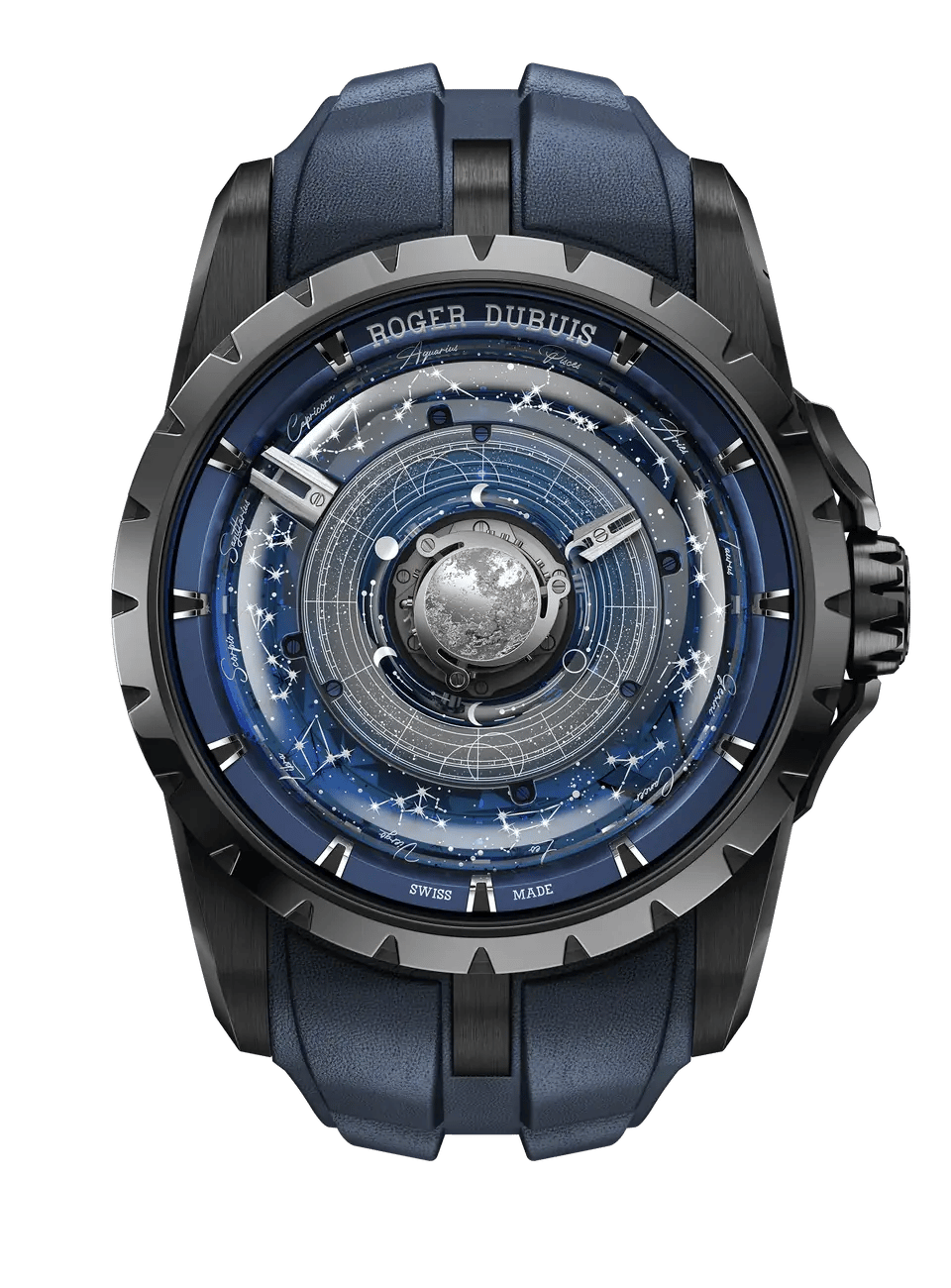
Roger Dubuis Excalibur Moonlight (DBEX1221): The Connoisseur's Excalibur
Roger Dubuis has spent two decades selling excess: skeletonised tourbillons, sapphire cases, hypercars in watch form. The Excalibur Moonlight is the other Roger Dubuis — the one that remembers it is a Geneva maison with a Poinçon de Genève stamp on its movements. Take the Excalibur's signature notched bezel and triple lugs, render them in warm pink gold, drop a moon-phase into a night-sky dial and cap production at a small limited run, and you have a watch that reads far more like a collector's dress piece than a statement machine.
Why This Reference Matters
Most of the Excalibur catalogue is designed to be seen across a room. Openworked bridges, flying tourbillons, cases built from materials that did not exist a decade ago — that is the brand's commercial engine, and it works. But it leaves a gap. Collectors who admire Roger Dubuis's finishing but do not want to wear a sculpture to dinner have had very little to choose from, and the Moonlight fills that gap almost alone.
The proposition is straightforward. You get the Excalibur silhouette — the notched bezel, the three-lug architecture, the broad polished case flanks — executed in pink gold rather than carbon or sapphire. You get a moon-phase display treated as the central event of the dial rather than an afterthought. And you get a movement certified to the Geneva Seal, which at this price bracket is a genuine differentiator rather than marketing copy.
That combination is rare enough that the reference deserves attention from serious collectors. It is also rare enough that the market has never really worked out how to price it, which is where the opportunity sits.
Manufacture Context
Roger Dubuis was founded in Geneva in 1995 by the watchmaker of the same name and entrepreneur Carlos Dias. The early maison built its reputation on hand-finished movements certified to the Poinçon de Genève at a time when very few young brands bothered — a decision that gave the company credibility with collectors long before it had commercial scale.
Richemont took control in 2008 and pushed the brand decisively toward bold, high-complication, low-volume pieces. That shift built the modern Excalibur identity and, incidentally, made quieter references like the Moonlight more interesting in retrospect: they are the exception in a catalogue built on exception, and exceptions within a niche brand tend to age well with the collectors who actually know the history.
The Geneva Seal connection is the part worth holding onto. Roger Dubuis certifies its in-house calibres to the Poinçon, which governs both decoration and rate precision. In practice that means hand-bevelled bridges, Côtes de Genève, circular graining and a level of finishing you would otherwise have to look at A. Lange & Söhne or Patek Philippe to find. It is the strongest argument for buying this watch over a comparably priced gold moon-phase from a brand with a bigger marketing budget.
The Movement
The Moonlight runs on a Roger Dubuis in-house self-winding calibre with the moon-phase display integrated into the movement rather than bolted on as a dial-side novelty. That distinction matters more than buyers usually admit: moon-phase modules that sit on top of a base movement add height, add drag and add service complexity, and Roger Dubuis has handled the display within the calibre architecture rather than simply layering it on.
The finishing is the headline. Geneva Seal certification means the parts you cannot see are finished to the same standard as the ones you can — anglaged bridge edges, polished screw heads, Geneva stripes laid down properly rather than stamped. On a watch with an exhibition caseback this is not an abstract virtue; it is the thing you will look at most often.
Two caveats worth stating plainly. First, moon-phase displays in this class generally do not self-correct after the watch has been stopped, so you will be resetting the indication with a pusher or crown each time the watch comes out of the safe — a small ritual, but a ritual. Second, this is a gold dress complication, not a sports movement. Do not expect the shock resistance or the service intervals of a steel automatic.
Case, Dial and Presence
The Excalibur case is one of the most recognisable shapes in modern watchmaking and it does not soften in gold. The notched bezel creates a serrated ring of highlights that shifts constantly as the wrist moves, and the triple-lug construction gives the watch a broader, more architectural stance on the wrist than a conventional four-lug case of similar proportions would.
Pink gold is the right metal for this reference. The Moonlight's whole premise is warmth — a night-sky dial, a moon, a case that glows rather than glints. In steel the same design would read as a sport watch pretending to be a dress watch; in gold it reads correctly. The alligator strap completes the picture, and the deployant clasp is the sensible choice for a watch that will be taken on and off regularly, even if it does add bulk under the wrist.
There is no lume here and no pretense of versatility. This is a watch for a dinner, a wedding, an evening at the opera — occasions where the case catching candlelight is the entire point. Roger Dubuis has never been subtle, and the Moonlight is not subtle either; it is simply quieter than its siblings, which is a different thing.
How It Actually Wears
This is a substantial gold watch, and it feels like one. The mass sits relatively high because the case is generously proportioned for a moon-phase dress piece, and the triple-lug geometry pushes the strap attachment points outward, so the watch reads wider on the wrist than the caseback footprint suggests. If you are used to a slim, under-the-cuff dress watch, the first ten minutes will feel like a lot of watch.
Strap fit does most of the comfort work. On the factory alligator with the deployant the watch sits flat and secure, but the deployant hardware adds bulk underneath and the gold case wants a snug fit to stop it rotating. Buyers with smaller wrists should absolutely try before committing: the Excalibur architecture is unforgiving of a loose fit, and the bezel notches have a well-documented appetite for shirt cuffs.
The verdict on wearability is the same as for most gold complications. As an evening watch it is superb — balanced, warm, and heavy in the way collectors actually want gold to feel. As a daily it is merely acceptable. If you are buying one watch to do everything, this is not it; if you are buying a fourth or fifth watch for the evenings, the Moonlight earns its place.
Accuracy and Day-to-Day Ownership
Geneva Seal regulation is tighter than what most buyers are used to from mass-produced automatics, so a healthy example should hold within a few seconds a day across positions. The caveat is that a moon-phase mechanism adds drag to the going train, and a watch that has been sitting in a safe will usually need a day or two on the wrist before it settles into its rhythm.
Expect positional variation rather than a flat rate. That is normal for a hand-regulated movement and not a fault. What matters on the secondary market is condition: a Moonlight running noticeably slow or fast is telling you it is due for service, not that the calibre is compromised.
Service is the ownership cost that surprises first-time buyers. Budget roughly a five-year interval and around fifteen hundred dollars at the lower end, more if the moon-phase module needs attention. Geneva Seal-certified calibres realistically go back to the factory or an authorised service centre, because parts access and certification renewal sit with the brand. Independent watchmakers can perform a basic clean, but you should not expect them to source a moon-phase component.
The Market: What It Costs and What It Returns
This is where the Moonlight gets interesting, and where the analyst帽子 comes off. The reference is discontinued and no longer part of the current catalogue, which means every purchase is a secondary-market purchase. Original retail sat in the high five figures depending on year, market and any boutique premium applied at the time. Current pre-owned pricing has settled well below that — expect to transact in the mid-twenties to high-thirties in US dollars for a complete, well-presented example, with condition, box and papers moving the number meaningfully.
The trend is depreciating, and it would be dishonest to dress that up. Roger Dubuis's secondary market is thin: fewer buyers, fewer listings, wider spreads. The references that hold value are the ones with a story and a silhouette nobody else can copy — the skeleton tourbillons, the Knights of the Round Table series, the carbon and sapphire showpieces. A pink gold moon-phase dress watch does not carry that mystique, however well made it is.
Auction data is essentially absent. Roger Dubuis appears rarely at Phillips, Christie's or Sotheby's, and when it does the results cluster around the high-complication pieces. There is no meaningful auction history for this reference, which cuts both ways: no public price discovery to anchor a sale, but also no public record of a disastrous result to talk a buyer down.
Hold or Sell?
If you own one and wear it, hold. The watch is a better object than its market price suggests, and selling into a thin market at a wide discount to realise cash you probably do not urgently need is poor discipline. The exception is if the watch is sitting unworn: liquidity is not going to improve, the discount will not narrow, and every year in the safe is a year closer to a service bill you will pay before selling.
If you are buying, be ruthless on price. At the low end of the range you are acquiring a Geneva Seal gold moon-phase for less than the cost of a steel Patek sports watch, and that is a genuinely good trade for a wearer. At the top end you are within reach of an A. Lange & Söhne Saxonia Moon Phase, which is a better-resolved watch with a secondary market that actually clears. Price discipline is the entire thesis here.
Alternatives Worth Considering
The obvious comparison is Lange. The Saxonia Moon Phase offers German finishing, a clean dial and residuals that hold up over time; it costs more, and it is worth the difference if resale matters to you. Jaeger-LeCoultre's Master Ultra Thin Moon is the volume option — far deeper liquidity, a fraction of the drama, and a sensible entry into moon-phase ownership. Patek's moon-phase references sit above all of this on price and below none of them on desirability.
Within Roger Dubuis itself, the only real internal competitor is the broader Excalibur automatic line, which offers the same case architecture without the moon-phase premium. If the moon display is not the reason you are buying, buy the simpler watch and save the money.
Final Verdict
The Excalibur Moonlight is the most grown-up watch Roger Dubuis makes and the least rewarded by the market: a pink gold, Geneva Seal moon-phase that trades at a serious discount to its original list. For a collector who wants a dinner watch with real finishing and does not need to exit quickly, it is a smart, contrarian buy at the right number. For anyone buying with resale in mind, the answer is simple — this is not that watch.