The Architecture of Centrality: A Review of the Roger Dubuis Excalibur Orbis in Machina
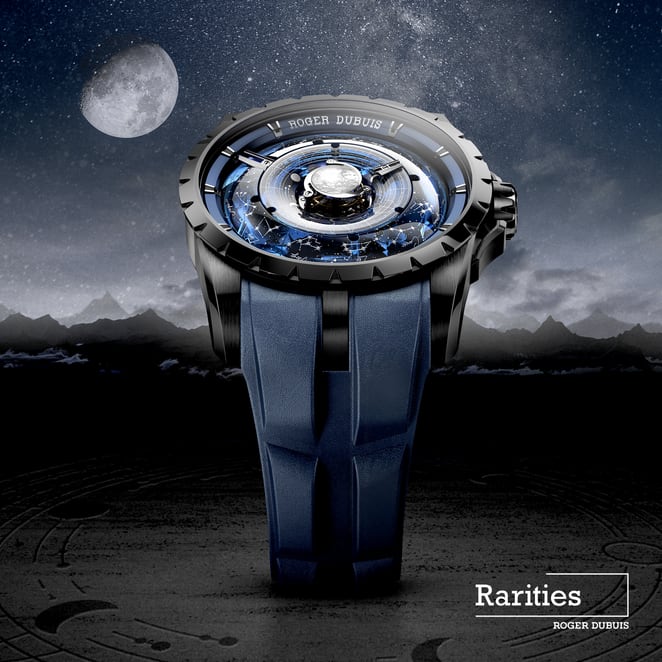
In the world of high-end horology, the tourbillon has often been relegated to a supporting role, tucked away at 6 o'clock or 9 o'clock on a dial. Roger Dubuis, a brand that has spent the last decade reinventing itself as the purveyor of 'Hyper Horology,' has decided to flip the script. With the Excalibur Orbis in Machina Moonlight, the tourbillon is no longer a guest; it is the host. By placing a flying tourbillon at the dead center of the timepiece, Roger Dubuis has created a work of kinetic art that challenges our perceptions of movement architecture and market positioning.
As an analyst at Vivir, I look at watches through two lenses: the emotional resonance of the craftsmanship and the hard data of market liquidity. The Orbis in Machina is a fascinating case study in both. It is a watch that ignores the current industry trend toward smaller, 'quiet luxury' timepieces, instead leaning into a bold, 45mm statement of technical superiority. But beneath the flash of the Moonlight Gold case lies a movement that is as traditional as it is futuristic, bearing the prestigious Poinçon de Genève.
Technical Mastery: The RD115 Calibre
The heart of this watch is the RD115 manual-winding calibre. Creating a central tourbillon is a notoriously difficult engineering challenge. In a standard movement, the hands are driven by a central pinion. To place a tourbillon in that same central space, the entire gear train must be rerouted around the periphery of the escapement. This requires a level of micro-engineering that few manufactures can execute.
The flying tourbillon itself is a marvel. Because it is 'flying,' it is supported only from one side, giving the illusion that it is floating in the center of the watch. The cage is made of lightweight materials to ensure the 72-hour power reserve is not compromised by the energy required to rotate the heavy central assembly. The concentric circles that radiate outward from the tourbillon serve as the hour and minute indicators, using a system of discs that maintain the watch's perfect symmetry. This design choice is not just aesthetic; it is a functional solution to the problem of legibility in a skeletonized, central-escapement watch.
Furthermore, the finishing on the RD115 is exemplary. Every bridge and plate is hand-beveled and polished, meeting the rigorous standards of the Geneva Seal. This certification is a crucial value-add for the collector. In an era where many brands are moving toward industrial finishing to increase margins, Roger Dubuis remains committed to a level of hand-finishing that ensures the watch will be serviceable and respected by watchmakers a century from now.
Materials and Wearability: The Moonlight Gold Factor
The case is crafted from 'Moonlight Gold,' a proprietary 18K pink gold alloy. While standard pink gold can oxidize and lose its luster over time, Moonlight Gold is formulated to remain stable, retaining its specific hue even after years of exposure to the elements. This is a subtle but important detail for the long-term collector who views the watch as a legacy asset.
At 45mm in diameter and 14.41mm thick, the Orbis in Machina is a large watch. However, the ergonomics are surprisingly well-considered. The lugs are short and sharply angled, allowing the strap to drop vertically down the side of the wrist. This prevents the 'overhang' that often plagues large-diameter watches on wrists under 7 inches. The 100 meters of water resistance is also a welcome surprise for a tourbillon of this complexity, suggesting that Roger Dubuis intends for this watch to be worn, not just kept in a safe.
The Investment Landscape: Hold vs. Sell
From a market-driven perspective, Roger Dubuis occupies a complex space. The brand does not enjoy the immediate 'value-retention' profile of Rolex or Patek Philippe. Historically, Roger Dubuis watches have seen a steep decline in value on the secondary market—often losing 30% to 50% of their MSRP within the first year. However, we are seeing a shift in the demand cycle for the brand’s limited-run boutique pieces.
The Orbis in Machina is limited to just 88 pieces. In the world of ultra-high-end horology, 88 is a small enough number to create genuine scarcity. For the sophisticated young collector, the play here is a long-term hold. The initial depreciation is inevitable, but as the brand continues to elevate its status within the Richemont Group and the 'Hyper Horology' niche becomes more crowded, these early, technically pure examples of the Excalibur line are likely to find a floor. Buying this watch at retail is an emotional decision; buying it pre-owned is a savvy tactical move.
Compared to a Richard Mille, which might trade for multiples of its retail price due to hype, the Roger Dubuis offers more 'horology per dollar.' You are getting a Geneva Seal, a central flying tourbillon, and a precious metal case for a price that is often lower than a titanium time-only RM. For the collector who prioritizes substance over social media clout, the value proposition is clear.
Market Comparisons and Competitors
When evaluating the Orbis in Machina, one must look at the few other central tourbillons on the market. The Omega De Ville Central Tourbillon is perhaps the most famous, but it is a much more conservative, dress-oriented piece. Bulgari’s Octo Roma Central Tourbillon Papillon is another competitor, offering a similarly futuristic aesthetic. However, neither of these carries the Poinçon de Genève, which remains the gold standard for Swiss finishing.
The real competition for this watch comes from independent watchmakers like MB&F or Urwerk. Those brands offer a similar level of 'wild' watchmaking, but they often lack the industrial infrastructure and service network that a Richemont-backed brand like Roger Dubuis can provide. For a young collector, the peace of mind that comes with a global service network is a non-trivial factor in the purchase decision.
Final Judgment
The Roger Dubuis Excalibur Orbis in Machina Moonlight is a triumph of design and engineering. It successfully bridges the gap between the brand's flamboyant past and its technically rigorous future. While it faces headwinds in terms of secondary market liquidity, its intrinsic value—driven by the Geneva Seal and the complexity of the RD115 movement—is undeniable.
For the collector who already owns the 'standard' icons and is looking for a piece that represents the pinnacle of modern Swiss engineering, the Orbis in Machina is a compelling choice. It is a watch that demands to be seen, but more importantly, it is a watch that rewards the wearer for looking closer.