Roger Dubuis Excalibur Spider Flyback Chronograph: Skeletonized Spectacle, Sober Resale
Roger Dubuis does not build wallflowers. The Excalibur Spider Flyback Chronograph is a watch that announces itself from across a room: openworked movement, architectural case, red or blue accents, and a flyback chronograph complication that is as much theatre as it is tool. For young collectors who came to horology through independent brands and social media rather than inherited dress watches, the Spider is catnip. For collectors who treat watches as assets, it is a more complicated proposition.
This review focuses on the core titanium Excalibur Spider Flyback Chronograph, the reference family that best represents the model line. We will cover the manufacture, the RD185 movement, the wearing experience, real-world accuracy, alternatives, and the resale math. The short version: buy this watch because you love the design, not because you expect it to fund a future Daytona.
Manufacture history
Roger Dubuis was founded in 1995 by Roger Dubuis and Carlos Dias in Geneva. The brand built its reputation on high-complication watchmaking and, critically, on the Poinçon de Genève — the Geneva Seal — at a time when few independent houses could claim that level of finishing certification across a collection. That heritage matters here: the Excalibur Spider Flyback Chronograph is not a fashion chronograph with a skeleton dial slapped on. It comes from a manufacture that built its identity around openworked, architectural movements and bold case design.
Roger Dubuis has always been a niche player. It does not have the broad collector base of Rolex, Patek Philippe, or Audemars Piguet, and its resale performance reflects that. But within the independent luxury segment, the Excalibur line is recognizable, and the Spider sub-family — with its skeletal dials and spider-web motifs — is arguably the brand’s most contemporary statement.
Movement and architecture
The Excalibur Spider Flyback Chronograph is powered by the in-house Calibre RD185, an automatic flyback chronograph. Roger Dubuis lists a power reserve of 48 hours and a frequency of 28,800 vph. The movement is the reason to pay attention. A flyback chronograph allows the wearer to reset and restart the chronograph with a single pusher press, rather than stopping, resetting, and restarting. In daily use, that is a small convenience; in a skeletonized watch, it is also a demonstration of mechanical confidence.
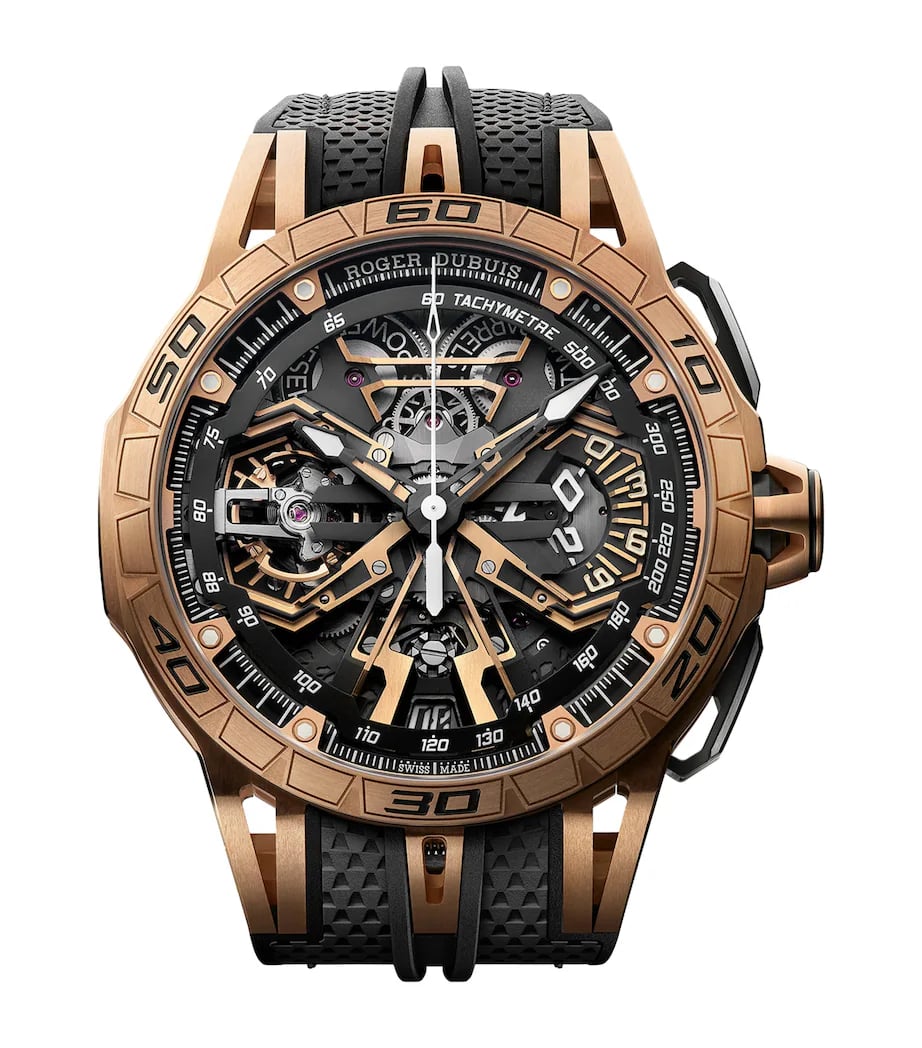
The RD185 is openworked, which means the movement is the dial. Bridges, levers, wheels, and the chronograph mechanism are visible from the front, framed by the Excalibur case architecture. Finishing is done to a high standard, consistent with Roger Dubuis’s Geneva Seal heritage, though the visual effect is more aggressive than classical. This is not a movement you admire for subtle anglage under a loupe in a quiet room; it is a movement you wear as sculpture.
Because the chronograph is a flyback and the movement is in-house, service complexity is higher than a modular chronograph from a mainstream brand. That is not a reason to avoid the watch, but it is a reason to buy a well-documented example and to budget for authorized service.
Case, dial, and wrist feel
The case is titanium, which is the right call for a watch this visually loud. Titanium keeps the watch from feeling like a paperweight, and it gives the Excalibur Spider a darker, more technical character than steel or gold. The case is architectural: angular lugs, a prominent bezel, and a mix of brushed and polished surfaces that catch light from every angle. The sapphire crystal is standard for the class, and the rubber strap is integrated into the case design rather than treated as an afterthought.
The dial is the headline. It is skeletonized to the point where conventional dial-reading rules barely apply. The chronograph subdials, hands, and applied markers are arranged in a way that rewards a second look. The red accents on the core reference give it a racing-inspired energy, while the openworked date aperture — where present — is integrated into the movement architecture rather than cut into a solid dial. Legibility is acceptable for a skeleton watch, but it is not a pilot-style instrument. You read this watch in glances, not in a single clean sweep.
On the wrist, the Excalibur Spider feels large and intentional. I am not going to quote case dimensions here because the exact figures vary by reference and source, and this is a watch where the subjective impression matters more than the millimeter count. The titanium case distributes weight well, and the rubber strap hugs the wrist without the stiffness of a new leather strap. The deployant clasp is secure and keeps the strap from flapping. The watch sits tall on the wrist — that is part of the presence — so it works best with sleeves that can accommodate it or with short sleeves that let it breathe.
Comfort is good for a watch of this visual scale, but it is not a stealth piece. If you are used to a 39mm dress watch, the Spider will feel like a statement. If you are used to a Royal Oak Offshore or a Hublot Big Bang, it will feel familiar.
Accuracy and daily use
Roger Dubuis does not market the RD185 as a COSC-certified chronometer, so I would not expect chronometer-paper precision. A well-regulated example should hold within a few seconds per day in normal wear, with the usual positional variation you get from an automatic chronograph. The flyback function adds mechanical complexity, but it does not inherently make the watch inaccurate. The bigger variable is service history: a watch that has been properly maintained will keep better time than one that has sat in a safe for years.
For daily use, the Excalibur Spider is more practical than its looks suggest. The automatic movement means no winding ritual, the rubber strap is comfortable in heat, and the chronograph is useful for timing everything from coffee to parking meters. The date, where fitted, is a genuine daily convenience. The caveat is legibility: in low light or at a glance, the skeletonized dial can be harder to read than a conventional chronograph. That is the trade-off for the architecture.
Occasions and wrist presence
This is a sport-luxury watch with formal-adjacent ambitions. It works with a suit if the suit is modern and the wearer has the confidence to let the watch do the talking. It works better with smart casual, denim, and weekend wear. It is not a dress watch in the traditional sense, and it is not a beater. Think of it as an occasion watch for collectors who do not want a plain round chronograph.
Wrist presence is a 5/5. The Excalibur Spider is recognizable from across a table, and the skeletonized dial gives it a kinetic quality that changes as the wrist moves. It is the kind of watch that starts conversations, which is both the point and the risk. If you want a watch that disappears under a cuff, this is not it.
Reference variants and family
The core reference family is the titanium Excalibur Spider Flyback Chronograph, with the RDDBEX0571 serving as a representative example. That version pairs a skeletonized dial with red accents and a black rubber strap. Other colorways and limited editions have appeared over the years, often with different accent colors or case finishes. The underlying architecture — flyback chronograph, openworked movement, Excalibur case — stays consistent.
Within the broader Excalibur Spider family, siblings include the Excalibur Spider Skeleton Flying Tourbillon, the Excalibur Spider Pirelli, and the Excalibur Spider Huracán. These are more extreme in both price and design. The Flyback Chronograph is the relatively accessible entry point into the Spider aesthetic, though “accessible” is relative in the Roger Dubuis universe.
Other notable Roger Dubuis models include the Excalibur Quatuor, the Excalibur Double Tourbillon, and the Velvet line. These help place the brand: Roger Dubuis is at its best when it is doing something mechanically audacious and visually extreme. The Spider Flyback fits that brief.
Comparable watches and homages
If you are shopping this watch, you are likely also considering the Audemars Piguet Royal Oak Offshore Chronograph, the Hublot Big Bang Unico, and perhaps a Richard Mille RM 11-03. The Royal Oak Offshore offers stronger brand equity and better resale, but it is more common and less openly skeletal. The Big Bang Unico is the closest spiritual rival: bold, skeletonized, and unapologetically modern. The RM 11-03 is in a different price and collector tier entirely, but it shares the same “watch as sculpture” ethos.
True homages are thin on the ground because the design is so specific. Budget alternatives that capture the skeletonized-chronograph mood include the Stührling Original Monaco Skeleton Chronograph and the Invicta S1 Rally Skeleton Chronograph. Neither is a substitute for the Roger Dubuis in finishing, movement, or presence, but they show how far the aesthetic has trickled down.
Investment case
The Excalibur Spider Flyback Chronograph is not an investment-grade watch in the sense that a steel Patek Philippe Nautilus or a Rolex Daytona is. Roger Dubuis has a narrow collector base, and the brand’s bold designs do not appeal to the widest possible audience. That means resale is soft relative to retail. On the secondary market, examples typically trade well below the original MSRP, which is good news if you are buying and less good news if you are selling.
At the time of writing, the retail price is roughly in the mid-five-figure range, while pre-owned examples can be found in the $30,000-$45,000 band depending on condition, box and papers, and variant. That spread tells the story: the first owner takes the depreciation hit. If you want this watch, buy it pre-owned from a reputable dealer with full documentation. Let someone else pay for the initial thrill.
Auction history is limited. You will occasionally see Roger Dubuis Excalibur pieces at specialist auctions, but the Spider Flyback is not a frequent lot. That lack of auction liquidity is a factor to consider if you think you might flip the watch. For a collector who intends to wear it, the auction question matters less.
Service and ownership
The RD185 is a complex in-house flyback chronograph, and service should be handled by Roger Dubuis or a watchmaker authorized to work on Geneva Seal movements. I would not hand this watch to a generalist independent unless they have specific experience with modern Roger Dubuis calibers. Service costs are not cheap, and parts availability can be a consideration for older references. Buy a complete set, ask for service records, and factor a service into your ownership budget.
Ownership is ultimately about whether the design continues to excite you. This is not a watch you buy for the movement alone, because the movement is hidden behind a skeletonized dial that makes it a piece of visual art. If the Excalibur Spider aesthetic speaks to you, the ownership experience is rewarding. If you need a watch that blends in, look elsewhere.
Final verdict
The Roger Dubuis Excalibur Spider Flyback Chronograph is a brilliant, polarizing piece of modern horology. The in-house RD185 flyback chronograph, titanium case, and openworked architecture give it genuine mechanical credibility, while the design ensures it will never be mistaken for a safe choice. The investment case is weak at retail and more sensible pre-owned, where the depreciation has already been absorbed by someone else.
My recommendation: buy it used, buy it complete, and buy it because you love the way it looks on your wrist. If you are looking for a flyback chronograph that holds value like a blue-chip sports watch, this is not that watch. If you want a skeletonized statement piece with real watchmaking behind it, the Excalibur Spider is one of the most distinctive options in its price range.