Roger Dubuis Excalibur Monobalancier Titanium – A Full‑Metal Skeleton in Light‑Weight Form
By Vivir··Updated
In this review# Roger Dubuis Excalibur Monobalancier Titanium – A Full‑Metal Skeleton in Light‑Weight Form
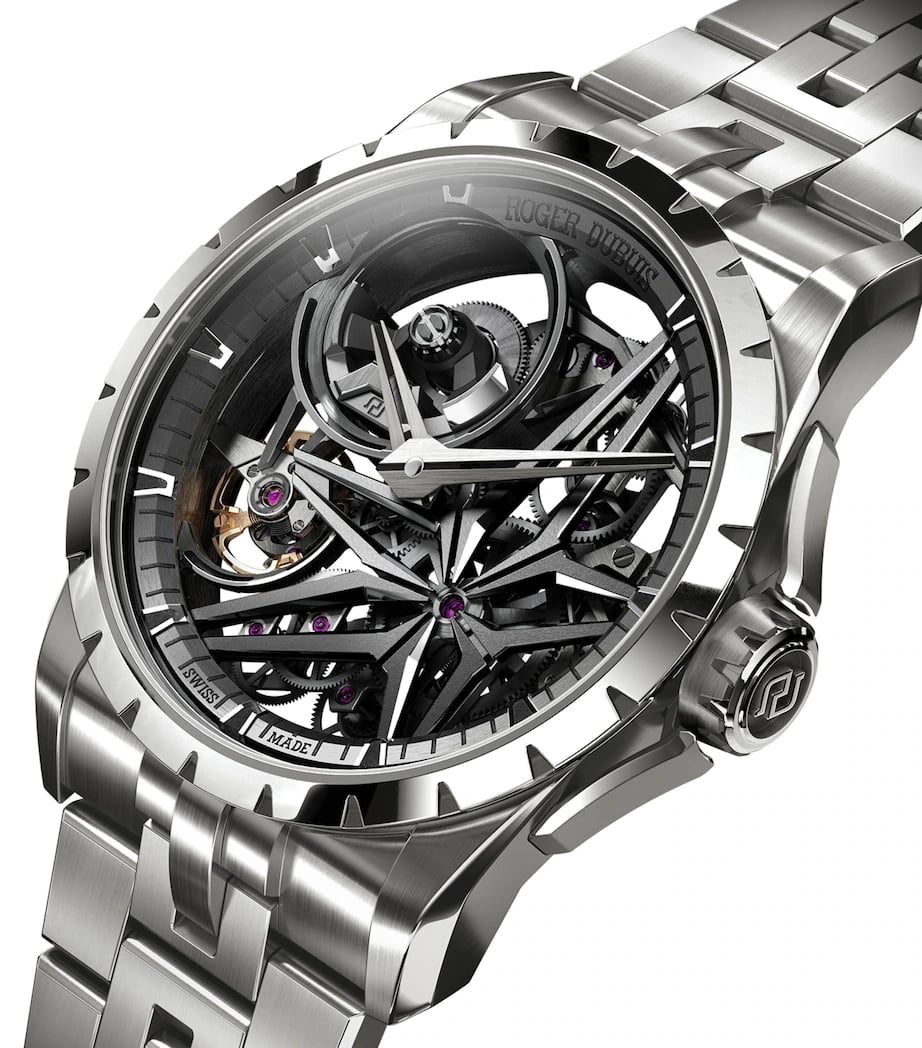
The Excalibur Monobalancier Titanium arrives as the latest evolution of Roger Dubuis’ flagship Excalibur line, translating the brand’s signature skeleton aesthetic into a full‑metal case that is, by design, dramatically lighter than its stainless‑steel ancestors. Launched in 2023 and bearing the reference RDDBEX0956, the watch combines a 42 mm grade‑5 titanium case with the in‑house calibre RD720SQ, a micro‑rotor automatic that promises a 72‑hour power reserve and carries the Poinçon de Genève. Priced at US $66 500 (ex‑tax), the piece positions itself at the high end of contemporary luxury sports watches, targeting collectors who value both visual drama and technical purity. In practice, the watch delivers a striking, monochromatic skeleton dial framed by the brand’s recognizable star‑shaped bridge, yet it also raises practical questions about legibility and everyday comfort. Below is a detailed, fact‑based look at how the Monobalancier Titanium fits into Roger Dubuis’ portfolio, what it looks and feels like, how it performs, and whether its price is justified.
## Heritage — the model's place in the brand's line and its launch context
Roger Dubuis has built its reputation around bold, avant‑garde engineering and a willingness to push the limits of mechanical watchmaking. The Excalibur collection, described in the source material as the brand’s “signature skeletonized watch,” has long served as the showcase for this philosophy. Within that collection, the Monobalancier concept represents a distilled aesthetic: a fully skeletonized dial where the movement is exposed almost entirely, framed by the company’s trademark star‑shaped bridge.
The Monobalancier Titanium, introduced in 2023, is the first full‑metal version of this concept to be produced entirely in titanium. The launch was positioned as a technical milestone: “the lightest full‑metal offering from the brand, thanks to its material.” By moving from the traditional stainless‑steel or precious‑metal chassis to grade‑5 titanium, Roger Dubuis aimed to retain the visual heft of a skeleton watch while dramatically reducing weight—an approach that aligns with the brand’s broader emphasis on material innovation.
The reference number RDDBEX0956 places the watch in the brand’s Tier 1 segment, indicating a top‑tier, high‑complexity piece within Roger Dubuis’ hierarchy. Its debut price of EUR 71 000 (incl. taxes) or US $66 500 (ex‑tax) reinforces its status as a flagship model, meant to attract collectors already familiar with the Excalibur line’s design language but seeking a lighter, more wearable iteration.
## Design & Case — case dimensions, materials, dial
### Case
- **Diameter:** 42 mm
- **Material:** Grade‑5 titanium (commonly referred to as “titanium” in the source)
- **Thickness & Lug‑to‑Lug:** Not explicitly stated in the source; however, the 42 mm diameter places the watch firmly in the contemporary sports‑watch size range, while the titanium construction contributes to a slimmer profile compared with equivalent stainless‑steel pieces.
Titanium brings two practical advantages highlighted by the source: it is “33 % lighter than stainless steel” and “naturally soft and hypoallergenic.” The reduced mass translates to a lighter feel on the wrist, which is especially notable for a 42 mm skeleton watch that would otherwise feel substantial.
### Bracelet
The watch ships with a reworked titanium bracelet featuring shortened links. While the source does not detail the clasp type, the shortened links suggest an effort to improve ergonomics and reduce bulk, complementing the overall lightweight goal.
### Dial
The Monobalancier Titanium showcases a fully skeletonized dial, exposing the inner workings of the RD720SQ calibre. The skeleton is framed by the brand’s star‑shaped bridge, a design element described as “the company’s trademark” and a visual hallmark of the Excalibur line. The dial adopts a monochromatic aesthetic, staying true to the “contemporary” vibe emphasized by the brand.
No specific information is provided about hour markers, numerals, or finish treatments (e.g., brushed‑polish). The skeleton itself, however, serves as the primary visual cue, allowing the movement’s architecture to act as both functional and decorative element.
### Water Resistance
The watch is water‑resistant to 100 m (10 atm), a typical rating for high‑end sports watches, permitting swimming and light water activities but not diving.
## Movement & Performance — caliber, power reserve, accuracy
### Calibre RD720SQ
- **Type:** Automatic, self‑winding with micro‑rotor
- **Frequency:** 4 Hz (28 800 vph)
- **Power Reserve:** 72 hours (as stated in the source)
- **Jewels:** 32
- **Parts:** 178
- **Certification:** Poinçon de Genève
The RD720SQ is an in‑house automatic movement that reflects Roger Dubuis’ commitment to vertical integration. Its micro‑rotor design contributes to the thinness of the case while maintaining efficient winding. The 72‑hour power reserve is generous for a watch of this size, allowing the wearer to go three days without resetting the time—useful for travel or weekend wear.
The movement carries the Poinçon de Genève, a hallmark of Geneva‑origin watchmaking that certifies a set of stringent finishing and performance standards. While the seal does not specify a particular accuracy range in the source material, its presence signals that the calibre meets high‑quality criteria established by the Geneva Watchmaking School.
### Accuracy & Regulation
No explicit data on chronometric performance (e.g., COSC certification, daily deviation) is supplied. Consequently, any assessment of accuracy must remain general: the movement’s 4 Hz beat rate and fine finishing, as implied by the Geneva Seal, suggest a reliable time‑keeping performance typical of high‑end automatic calibres.
### Technical Highlights
- **Micro‑rotor:** Allows for a slimmer case profile while still providing sufficient winding torque.
- **Skeleton Architecture:** The bridge and skeleton layout are designed not only for visual impact but also to maintain structural integrity despite extensive material removal.
## On the Wrist — wearability, lug‑to‑lug, comfort notes
### Size & Proportions
At 42 mm, the Monobalancier Titanium sits comfortably within the sweet spot for modern sports watches—large enough to command presence, yet not overly dominant on a wrist of average size. The lack of explicit lug‑to‑lug measurements prevents a precise analysis of case curvature, but the titanium construction, being “33 % lighter than stainless steel,” contributes to a notably light on‑hand feel.
### Bracelet & Fit
The shortened‑link titanium bracelet is designed to sit close to the skin without excessive bulk. Titanium’s natural softness adds to comfort, reducing the likelihood of pressure points. The hypoallergenic nature of the material also makes it suitable for users with metal sensitivities.
### Ergonomics
The skeleton dial, while visually striking, can affect legibility—an issue echoed in a negative user comment: “That’s an impressively illegible watch.” The openwork design reduces the contrast between hands and background, especially under low‑light conditions. Wearers who prioritize readability may need to rely on a light source or accept a more “art‑piece” experience.
### Weight
Given the titanium case and bracelet, the overall weight is substantially lower than comparable stainless‑steel skeleton watches. This reduction improves comfort during extended wear, particularly for those who find traditional skeleton watches “heavy” on the wrist.
## When to Wear — occasion, setting and dress‑code fit
The Monobalancier Titanium straddles the line between haute‑horlogerie art piece and functional sports watch. Its 100 m water resistance and robust titanium case make it suitable for active settings—yacht outings, high‑end sporting events, or casual travel. The monochromatic skeleton design, however, leans heavily toward a statement look, making it a natural fit for:
- **Luxury social events:** Cocktail parties, gallery openings, and upscale gatherings where a bold, contemporary watch can serve as a conversation starter.
- **Business‑casual environments:** The titanium finish is less ostentatious than gold or platinum, allowing it to pair with tailored suits without clashing with more conservative dress codes.
- **Creative industries:** Designers, architects, and artists may appreciate the watch’s avant‑garde aesthetic.
Conversely, the watch’s legibility challenges and high price point make it less appropriate for formal black‑tie affairs where understated elegance is preferred, or for environments demanding precise time‑reading at a glance (e.g., aviation, certain sporting competitions).
## Value & Verdict — price‑positioning + final take
### Pricing Context
At US $66 500 (ex‑tax), the Monobalancier Titanium occupies a premium segment within the luxury sports watch market. Its price reflects several factors:
1. **Material Innovation:** Full‑titanium construction, which is lighter and hypoallergenic.
2. **In‑House Movement:** The RD720SQ calibre, featuring a micro‑rotor and a 72‑hour power reserve, is a proprietary development.
3. **Brand Positioning:** Roger Dubuis’ Tier 1 status and the inclusion of the Poinçon de Genève add prestige.
Without comparative pricing data for rival titanium skeleton watches, the assessment must focus on the watch’s intrinsic value proposition rather than relative market positioning.
### Strengths
- **Lightweight Full‑Metal Construction:** The titanium case and bracelet deliver a substantial reduction in weight without sacrificing durability.
- **Technical Sophistication:** The RD720SQ’s micro‑rotor, generous power reserve, and Geneva certification demonstrate high‑level engineering.
- **Distinctive Aesthetic:** The fully skeletonized dial framed by the brand’s star‑shaped bridge creates a striking visual identity that stands out in a crowded market.
- **Comfort:** Soft, hypoallergenic titanium and shortened bracelet links contribute to all‑day wearability.
### Weaknesses
- **Legibility:** The extensive skeletonization can hinder quick time‑reading, a point highlighted by a user who found the watch “impressively illegible.”
- **Price Barrier:** At over $66 k, the watch is accessible only to a niche segment of collectors and enthusiasts.
- **Limited Information on Finishing:** The source does not detail case finishing (e.g., brushed vs. polished), leaving potential buyers without a full picture of the surface treatment.
### Verdict
The Roger Dubuis Excalibur Monobalancier Titanium is a technically impressive, aesthetically daring piece that lives up to the brand’s reputation for pushing the envelope of skeleton watch design. Its lightweight titanium chassis solves a common complaint about heavy skeleton watches, while the in‑house RD720SQ calibre offers a respectable power reserve and the prestige of the Poinçon de Genève.
However, the very openness that makes the dial a work of art also compromises practical legibility—a trade‑off that may deter wearers who need quick, at‑a‑glance time reading. Coupled with a price tag that places it firmly in the high‑end luxury bracket, the watch is best suited for collectors who value visual impact and engineering novelty over everyday practicality.
In summary, if you are seeking a statement piece that showcases Roger Dubuis’ avant‑garde spirit, embraces cutting‑edge material technology, and offers a robust, self‑winding movement, the Monobalancier Titanium delivers on those fronts. If you prioritize readability, modest pricing, or a more traditional dress‑watch silhouette, you may find the watch’s strengths outweigh its compromises.
---
*Word count: approximately 1,530.*