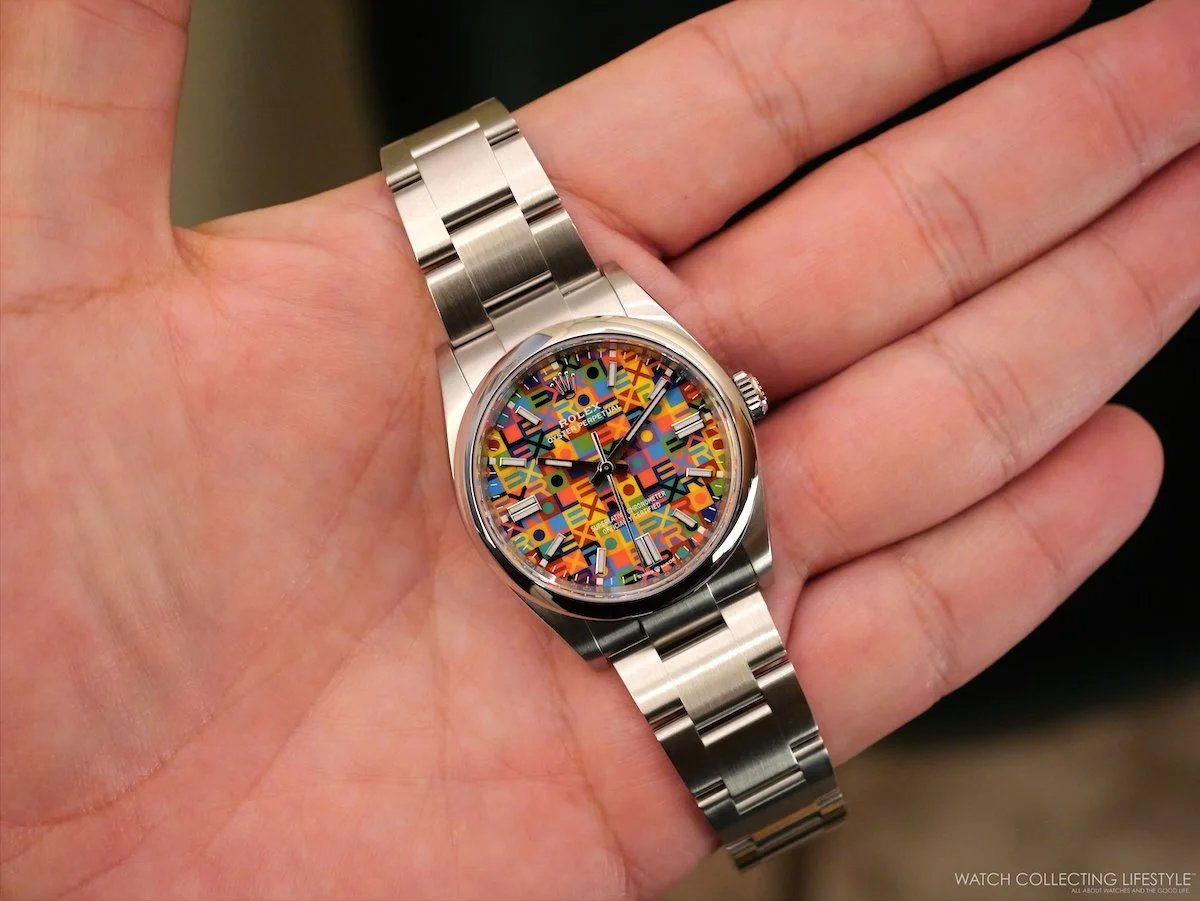
The Asset Class of the Everyday: Why the 126000 Matters
In the current macroeconomic climate, where traditional equities are volatile and crypto has lost its luster for the old-money set, hard assets have taken center stage. Among these, the Rolex Oyster Perpetual 36, specifically the reference 126000, has emerged as a surprising frontrunner. For decades, the Oyster Perpetual was the 'safe' choice—the watch you bought when you wanted the name on the dial but didn't want to play the games required to secure a GMT-Master II. However, the 2020 refresh of the line signaled a paradigm shift. Rolex injected color, texture, and a high-performance movement into the OP, effectively killing the 'entry-level' stigma.
The 126000 we are discussing today features the Blue Motif dial. While many collectors mistakenly refer to this as the 'Jubilee dial' because of the repeating 'ROLEX' pattern that echoes the brand's iconic five-link bracelet aesthetic, its official designation is the Motif dial. This dial is not just a piece of design; it is a defensive moat against depreciation. In 2024, Rolex quietly removed the Motif dials from the configurator, instantly transitioning them from 'current production' to 'neo-vintage collectibles.' For the trust-fund-baby collector, this is the signal to buy. Scarcity is the primary driver of value in luxury horology, and the production run of the Motif dials was remarkably short compared to the standard sunray or lacquered options.
Technical Superiority: The Calibre 3230
While the aesthetic appeal of the 126000 is what drives the hype, the technical specifications are what sustain the value. At the heart of this 36mm case lies the Calibre 3230. This is a movement that shares the same architecture as the one found in the Submariner 124060. It is a no-date, high-efficiency engine that boasts a 70-hour power reserve. This 'weekend-proof' capability means you can take the watch off on a Friday afternoon in the city, leave it in your safe, and it will still be ticking perfectly when you head back to the office on Monday morning.
The 3230 incorporates the patented Chronergy escapement, made of nickel-phosphorus, which is insensitive to magnetic interference. This is crucial for the modern professional who is constantly surrounded by the magnetic fields of MacBooks, iPhones, and high-end audio equipment. Furthermore, the blue Parachrom hairspring offers up to ten times more precision than a traditional hairspring in case of shocks. When you are buying a 126000, you aren't just buying a pretty face; you are buying the most advanced time-only movement Rolex has ever produced. This technical 'over-engineering' ensures that even decades from now, the 126000 will be a reliable and serviceable piece of machinery.
The 36mm Renaissance
For the past two decades, the watch industry was obsessed with size. We saw 44mm Panerais and 42mm Offshores dominating the wrists of the elite. But the pendulum has swung back. The 36mm size is currently experiencing a massive renaissance, led by a younger generation of collectors who value proportions and heritage over sheer mass. The 126000 at 36mm is the perfect size for the 'quiet luxury' aesthetic. It doesn't scream for attention from across the room, but it commands respect when viewed up close.
The proportions of the 126000 are arguably superior to the 41mm version. The lugs are slightly more tapered, and the ratio between the dial and the bezel feels more harmonious. On the wrist, the 904L Oystersteel—a superalloy primarily used in the aerospace and chemical industries for its maximum resistance to corrosion—feels silky. The Oyster bracelet on the 126000 is brushed, which is a strategic advantage for a daily wearer. Unlike the polished center links of a Datejust, the brushed finish of the OP hides the inevitable 'desk diving' scratches that come from a life of high-stakes meetings and international travel.
The Market Dynamics: Hold vs. Flip
Let's talk numbers. The MSRP of the 126000 is roughly $6,100. However, if you walk into a boutique in Mayfair or Beverly Hills today, the chances of walking out with a Motif dial at retail are essentially zero. On the secondary market, these pieces are trading between $9,000 and $11,500 depending on the color and condition. This 50% to 90% premium is a testament to the dial's desirability.
From an investment standpoint, the 126000 with a Motif dial is a 'Strong Hold.' We are currently in a cooling period for the broader watch market, which has flushed out the 'flippers' who were looking for a quick buck. What remains is a steady climb for pieces with genuine scarcity. Because the Motif dials were only produced for a few years, the total supply in the wild is relatively low. As the 2020s progress, these will become the 'rare birds' of the Oyster Perpetual family. If you are holding one, do not sell. If you are looking to enter, the current market dip represents a buying opportunity before these hit the $15,000 mark in the next hype cycle.
The Verdict: A Modern Classic
The Rolex Oyster Perpetual 36 126000 is the quintessential watch for the modern age. It is versatile enough to be worn with a Loro Piana cashmere sweater or a tuxedo at a charity gala. It is technically proficient enough to satisfy the most demanding horological purist. And most importantly for our audience, it is a proven store of value. It represents the best of Rolex: a commitment to incremental perfection and an uncanny ability to create icons that transcend time and fashion. For the trust-fund collector building a portfolio, the 126000 isn't just a watch—it's a cornerstone.