Rolex Sea-Dweller 16600: The Last Classic Diver
The Rolex Sea-Dweller 16600 occupies a precise point in Rolex's professional dive-watch timeline. It is the last of the classic-generation Sea-Dwellers: a stainless steel saturation diver with a helium escape valve, a date, no cyclops, and a black dial that keeps the tool-watch brief front and center. For collectors who came of age with neo-vintage Rolex, the 16600 is the reference that bridges the old guard and the modern era without the bulk or maxi-dial language of later Sea-Dwellers.
What makes the 16600 compelling is not novelty. It is discipline. The watch carries a genuine 1,220 m water resistance rating, a sapphire crystal, and Rolex's Cal. 3135 automatic movement, yet it avoids the visual noise that often accompanies modern professional watches. The result is a diver that reads as purposeful on the wrist and remains easy to live with away from the water. It is also one of the last Sea-Dwellers that feels like a direct descendant of the COMEX-era tool watches rather than a luxury object first and a dive instrument second.
This review covers the 16600 as a wearable watch, a movement, a collector asset, and a daily companion. It is not a museum piece. It is a professional Rolex with real depth capability, real service needs, and a market that has settled into a stable neo-vintage niche. That combination is exactly why it deserves a closer look.
Manufacture history
Rolex was founded in 1905 and built its reputation on the Oyster case, the Perpetual rotor, and a long line of professional watches designed for specific environments. The Submariner arrived in 1953, and the Sea-Dweller followed in the late 1960s as saturation diving pushed watches beyond the limits of standard dive cases. The helium escape valve was the key technical addition: it allowed trapped helium to escape during decompression and helped prevent the crystal from popping off after long exposure at depth.
The 16600 arrived in the late 1980s and remained in production until around 2008. It was the final classic Sea-Dweller before Rolex moved the line into larger, more modern territory with the 116600 and later the 126600. For that reason, the 16600 is often described as the last old-school Sea-Dweller: a compact professional diver with a no-cyclops dial, a date, and the unmistakable Sea-Dweller caseback engraving. It is a Rolex of the pre-maxi era, and that matters to collectors.
Movement and architecture
The 16600 uses the Rolex Cal. 3135, a self-winding movement that is one of the most respected workhorses in modern watchmaking. It runs at 28,800 vph, carries 31 jewels, and delivers approximately 48 hours of power reserve. It is COSC-certified and entirely in-house. The architecture is built for durability: bidirectional automatic winding, a robust balance bridge, and a date mechanism that has proven itself across millions of Rolex watches. The finishing is industrial rather than exhibition-grade, but that is the point. The Cal. 3135 is a movement you service and trust, not one you admire through a sapphire back.
In daily use, the 3135 feels immediate and secure. The crown action is precise, the date changes cleanly, and the winding efficiency is excellent for a movement of this generation. It is not a high-beat showpiece or a silicon-equipped modern caliber, but it is deeply understood by watchmakers and well supported by the parts network. For a neo-vintage Rolex, that combination of simplicity and serviceability is a major advantage.
Case, dial, and bracelet
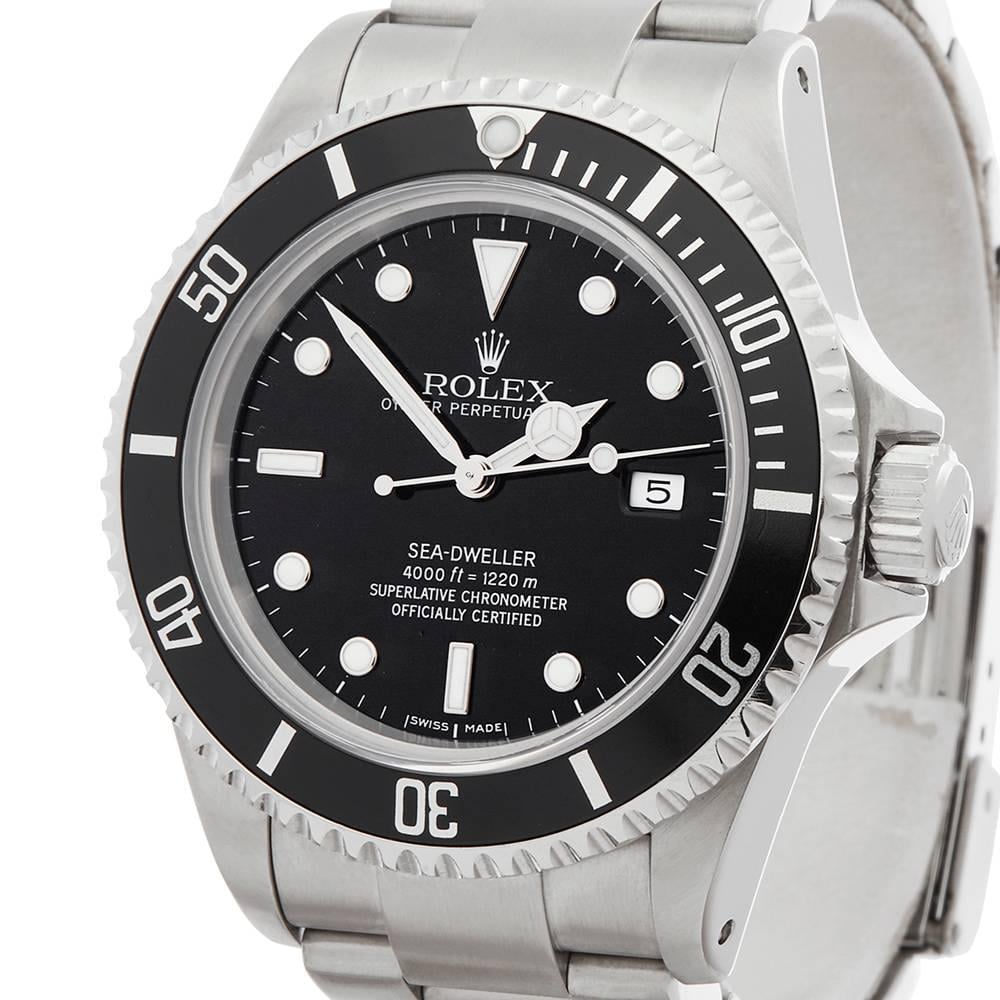
The 16600 is stainless steel, sapphire crystal, and Oyster bracelet. The case is classic Sea-Dweller: a rotating dive bezel, a protected crown, a helium escape valve at nine o'clock, and a caseback engraved with the Original Gas Escape Valve text. The dial is black with a date at three o'clock and no cyclops, which gives the watch a cleaner, more symmetrical face than a Submariner Date. The bezel is unidirectional and easy to grip, with a 60-minute scale that remains one of the most legible in the business.
Lume varies by production era. Early 16600 examples used tritium, which now shows the warm patina collectors either love or avoid. Later examples moved to Luminova and then Super-LumiNova, which is more practical for actual nighttime use. Most 16600s predate Chromalight, so buyers should not expect the blue glow of a modern Rolex. The bracelet is the period-correct Oyster with a folding clasp and dive extension. It is comfortable and secure, though it lacks the tool-free micro-adjustment of modern clasps. Bracelet stretch is the most common wearable issue on older examples, and a tight bracelet makes a significant difference in how the watch feels.
On the wrist
On the wrist, the 16600 reads as a classic professional diver rather than a modern statement piece. It has a reassuring heft without feeling slab-like, and the case sits low enough for daily wear. The Oyster bracelet balances the head well, and the no-cyclops dial keeps the profile clean under a cuff. It is compact by modern Sea-Dweller standards, which is precisely why many collectors prefer it. The watch feels like a tool first and a luxury watch second, and that is its greatest strength.
Comfort depends heavily on condition. A 16600 with a tight bracelet and a healthy clasp wears beautifully; one with stretched links and a worn clasp can feel loose and rattly. The lack of modern micro-adjustment means buyers should be prepared to fine-tune the fit with the period-correct extension or a careful bracelet adjustment. Once dialed in, the watch is an easy daily companion. It has enough presence for a casual outfit and enough restraint for a working day. It is not a dress watch, but it does not pretend to be one.
Accuracy and daily performance
The Cal. 3135 is COSC-rated, and a healthy 16600 should run within a few seconds per day. Expect roughly plus or minus two to five seconds per day in good condition, with some positional variation. Examples that have never been serviced can drift more, and a watch that has sat unused for years should be checked before it is trusted for daily wear. The movement is robust, but it is not immune to age. A service and regulation can bring a tired example back to COSC parameters.
In practice, the 16600 is the kind of watch you set once and forget. The date is useful, the bezel is easy to use, and the crown is secure. It does not have the instant-set convenience of a modern movement, but that is part of the neo-vintage experience. Buyers should value condition and service history over the last fraction of a second per day. A well-maintained 16600 is accurate enough for daily life and reliable enough for travel.
Occasions and wrist presence
The 16600 is a sport watch at heart, but it is flexible enough for daily wear and travel. It is not a formal watch, and it does not need to be. Its best role is as a robust everyday diver that can handle a desk, a beach, and a flight without drama. The no-cyclops dial gives it a focused, professional look, and the stainless steel case and Oyster bracelet keep it casual. Wrist presence is 4/5: it has real tool-watch authority without modern bulk.
Reference variants and family context
The 16600 is a single core reference, but production-era differences matter. Early examples with tritium dials have collector appeal and patina. Later examples with Luminova or Super-LumiNova are more practical for daily use. The bracelet and clasp can also vary by era, and full sets with original boxes and papers command a premium. The core recipe remains the same: black dial, date, no cyclops, helium escape valve, and Oyster bracelet.
Within the Sea-Dweller family, the 16600 follows the 1665 and 16660 and precedes the 116600 and 126600. The 16660 is the earlier sapphire-crystal Sea-Dweller with a similar tool-watch character, while the 116600 and 126600 moved to larger cases and more modern dial architecture. The Deepsea references 116660 and 126660 sit in a different, more extreme branch of the family. The 16600 is the sweet spot for collectors who want classic Sea-Dweller capability without the modern size.
Similar watches and alternatives
Buyers who like the 16600 but want a different flavor should consider the Omega Seamaster Planet Ocean 600M, which offers comparable depth capability with a modern co-axial movement and a broader case. The Tudor Pelagos is a titanium dive watch with a helium escape valve and a more modern tool-watch feel. The Blancpain Fifty Fathoms is the historic luxury diver with higher finishing and a very different price point. The Seiko Prospex Marinemaster 300 is a Japanese professional diver with a monobloc case and a similarly serious tool-watch intent.
Homages exist, as they do for most iconic divers. The Steinhart Ocean One 39 offers Submariner and Sea-Dweller-inspired case language at an entry price, while the San Martin SN008-G delivers a dive bezel, date, and Oyster-style bracelet for a fraction of the Rolex. These are not substitutes for the real thing, but they are useful for buyers who want the look without the commitment. The 16600 remains the reference because of its movement, case construction, and historical position, not because of its silhouette alone.
Investment value and market
The 16600 is discontinued, so current retail is not applicable. Original MSRP is not a useful benchmark today, and buyers should focus on the pre-owned market. Clean examples generally trade in the $8,000 to $12,000 range, with full sets, unpolished cases, and tight bracelets commanding the top end. The trend is stable rather than explosive. The 16600 is a neo-vintage Rolex with real collector demand, but it is not a rare vintage grail. That makes it a sensible hold for buyers who want to wear the watch rather than lock it away.
Auction history for standard 16600 examples is not dramatic. Exceptional full sets and unusually original examples can trade at a premium, but the model is not known for headline auction results. The hold recommendation is straightforward: buy the best condition you can afford, keep the service history, and wear it. The 16600 has already passed through its speculative phase and settled into a stable collector niche. It is unlikely to disappoint as a long-term ownership proposition, provided the entry price is fair.
Service and ownership
Rolex does not publish a single mandatory service interval for every watch, and the 16600 is old enough that condition matters more than a calendar. A healthy example can go years between services, but a watch with unknown history should be inspected. Service costs vary by provider and parts needs. Rolex service centers and independent watchmakers familiar with Cal. 3135 can both handle the work. Authorized-only service is not required, but parts policy and provenance should be confirmed before purchase.
Ownership is generally straightforward. The Cal. 3135 is well supported, the case is robust, and the bracelet can be rebuilt or replaced. The main risks are polished cases, stretched bracelets, incorrect replacement parts, and dials that have been relumed or damaged. Buyers should ask for clear photos of the case flanks, lug holes, dial, hands, and bracelet clasp. A full set is nice, but condition is more important than paperwork on a watch like this.
Pros and cons
Pros: true 1,220 m water resistance with a helium escape valve; no-cyclops dial and classic Sea-Dweller proportions; robust Cal. 3135 with easy serviceability; stable neo-vintage collector appeal. Cons: discontinued, so examples can show bracelet stretch and polished-case wear; most examples lack modern clasp adjustment and Chromalight; the date without a cyclops sacrifices quick legibility for purists; neglected examples can be costly to service.
Final verdict
The Rolex Sea-Dweller 16600 is the last classic Sea-Dweller, and that alone gives it a secure place in the Rolex canon. It is not the most modern diver, the most collectible, or the most luxurious. It is, however, one of the most honest. The 1,220 m rating, helium escape valve, no-cyclops dial, and Cal. 3135 movement make it a professional watch with real capability and real serviceability.
For a discerning young collector, the 16600 is a strong choice if you want a neo-vintage Rolex that can be worn hard and valued for what it is. Buy condition first, confirm service history, and avoid overpaying for a full set with a tired watch inside. The 16600 rewards that discipline with a watch that feels purpose-built every time it goes on the wrist.