The Genesis of the Date: Why the 1680 Matters
To understand the Rolex Submariner Date 1680, one must first understand the era in which it was conceived. By the late 1960s, the Submariner had already established itself as the preeminent diving tool. However, Rolex recognized a shifting demographic: the professional diver was being joined by the 'executive diver'—individuals who required the robustness of a tool watch but the functionality of a daily calendar. The 1680 was the answer. It was the first Submariner to feature a date window, a move that was initially controversial among purists but ultimately proved to be a stroke of marketing genius.
From an investment perspective, the 1680 is the pivot point. It retains the vintage 'soul' of the 5513—the matte dial, the tritium lume, and the plexiglass crystal—while offering the date complication that makes it vastly more practical for the modern user. This combination of vintage aesthetics and modern utility is precisely why the 1680 remains one of the most liquid assets in the horological market.
The Technical Workhorse: Caliber 1575
At the heart of the 1680 beats the Caliber 1575. For the uninitiated, the 1575 is essentially the 1570 (a legendary time-only movement) with the addition of a date wheel. In fact, if you open a 1680, you will almost certainly see '1570' engraved on the bridge. This movement is the backbone of Rolex’s golden era. Operating at 19,800 vibrations per hour, it is not a high-beat movement by modern standards, but its durability is peerless.
The 1575 features a Microstella regulating system and a free-sprung balance, allowing for high precision over long periods. For the collector, this movement is a dream because it is remarkably serviceable. Unlike the later 3035 and 3135 movements which introduced more complexity, the 1575 can be maintained by any competent watchmaker with access to the vintage parts pipeline. This serviceability adds a layer of security to the investment; as long as the movement is not rusted or severely damaged, it can be kept running indefinitely.
The Aesthetic Signature: The 'Top Hat' Crystal
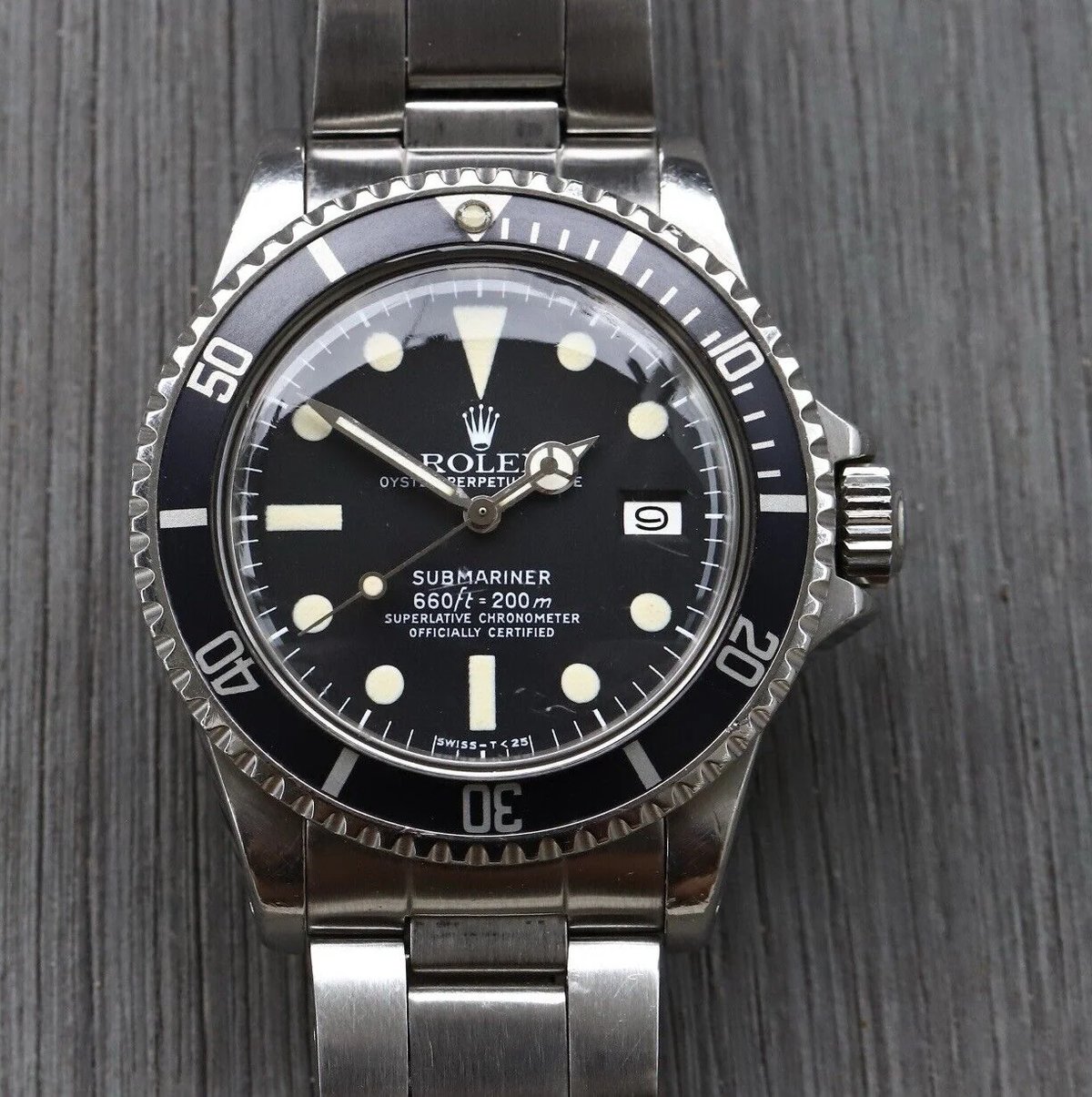
If there is one defining physical characteristic of the 1680, it is the 'Top Hat' crystal. The reference 1680 utilized a Cyclops 127 acrylic crystal that stands nearly 3mm above the bezel. This creates a dramatic, architectural profile that is immediately recognizable from across a room. The way the light hits the edges of the acrylic creates a 'halo' effect on the dial, a warmth that modern sapphire crystals simply cannot replicate.
However, this crystal is also the 1680’s Achilles' heel. Because it sits so high, it is prone to chipping along the edge. In the vintage market, a 'service crystal' is common, but purists will always hunt for the original, sharp-edged 'Top Hat.' When evaluating a 1680 for purchase, the condition of the crystal—and whether it is a period-correct acrylic or a later replacement—can influence the price by several hundred dollars, though the dial beneath it remains the primary value driver.
The 'Red Sub' vs. 'White Sub' Market Dynamics
The 1680 market is bifurcated into two distinct categories: the 'Red Sub' and the 'White Sub.' Between 1969 and approximately 1975, the 'Submariner' text on the dial was printed in red. These 'Red Subs' are the darlings of the auction world. Within the Red Sub category, there are six recognized dial variations (Mark I through Mark VI). Mark I, II, and III dials are 'Meters First' (200m = 660ft), while Mark IV, V, and VI are 'Feet First.'
As an analyst, I look at the 'Meters First' Red Subs as the high-alpha play. They were produced in smaller quantities and represent the earliest execution of the reference. A Mark I Red Sub in original condition is a 'holy grail' for many, often commanding a 50-100% premium over a standard White Sub. The 'White Sub,' produced from 1975 until the reference was discontinued in 1979, is the 'blue-chip' entry point. It offers the same case, movement, and crystal but with all-white text. While less rare, the White Sub is incredibly liquid; it is the watch that every vintage collector eventually owns or has owned.
Investment Thesis: Why Hold the 1680?
In a volatile market, the Rolex 1680 acts as a stabilizer. Unlike modern 'hype' watches that see massive parabolic moves followed by sharp corrections, the 1680 has shown a consistent, upward trajectory over a twenty-year horizon. Its value is underpinned by three factors: rarity (especially for high-grade examples), historical significance, and global brand recognition.
For a discerning buyer, the strategy should be 'Condition First.' A White Sub with a flawless matte dial, original tritium plots that have aged to a creamy 'pumpkin' or 'ivory' patina, and a thick, unpolished case will always outperform a mediocre Red Sub. In the current market, we are seeing a flight to quality. Collectors are no longer buying 'any' 1680; they are buying the *best* 1680s. This means that 'Full Set' examples (original box, punched papers, and booklets) are currently commanding a 30-40% premium, a gap that I expect to widen as the supply of complete sets continues to diminish.
The Importance of Patina and Bezel Inserts
In the world of the 1680, color is money. The tritium luminous material on the dial and hands reacts to environmental factors over decades, turning various shades of yellow, tan, or orange. A 'matching' patina—where the hands and dial markers are the exact same shade—is the gold standard. Furthermore, the bezel insert plays a massive role in valuation. 'Fat Font' inserts, where the numerals are thicker, are highly coveted. Some inserts have faded over time to a grey or 'ghost' blue, which can add thousands to the price tag depending on the visual appeal.
Conversely, a 1680 with 'service parts' (a later Luminova dial or hands replaced by Rolex during a service) is a significant detractor for investment value. As an analyst, I advise clients to avoid service-dial 1680s unless they are looking for a 'budget' entry-level piece to wear without worry. From a capital preservation standpoint, original tritium is non-negotiable.
Conclusion: The Portfolio Anchor
The Rolex Submariner Date 1680 is the quintessential vintage watch. It is recognizable, durable, and historically vital. While the 'Red Sub' offers the potential for significant appreciation, the 'White Sub' provides a level of market liquidity that is almost unmatched in the vintage world. If you are looking to move capital into a hard asset that you can also enjoy on your wrist, the 1680 is the logical choice. It is a watch that tells the time, tells a story, and—most importantly for the Vivir reader—tells the market that you understand the value of a true classic.