The Misunderstood Nautical Masterpiece
For decades, the Rolex Yacht-Master has occupied a curious space in the brand’s catalog. When it was first introduced in 1992, it was seen as an evolution—perhaps even a replacement—for the Submariner. That never happened. Instead, the Yacht-Master carved out its own niche as the 'Professional' watch for those who spend more time on the deck of a boat than under the hull. As a daily-wear reviewer, I often find that the 'tool-est' of tool watches are the ones that actually fail the 'week on the wrist' test. They are too thick, too sharp, or too heavy. The Yacht-Master, however, is a revelation in wearability.
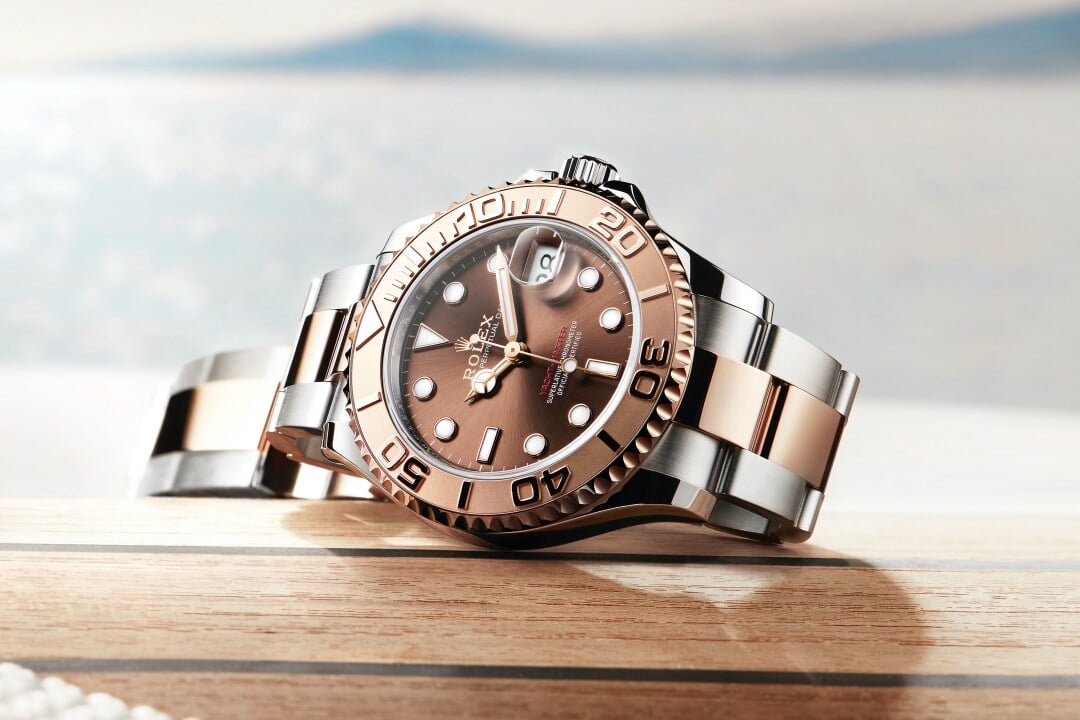
The reference 126622, specifically the 'Rolesium' model combining 904L Oystersteel with a solid 950 platinum bezel, represents the pinnacle of this collection's philosophy. It doesn't try to be a piece of survival equipment. It tries to be a high-end companion for a life well-lived. In this review, we’re going to look past the marketing and focus on the ergonomics: the lug-to-lug height, the bezel action, and how that platinum surface holds up to the rigors of a real work week.
Case Geometry: A Lesson in Ergonomics
If you place a Submariner 126610 and a Yacht-Master 126622 side-by-side, the differences in case architecture become immediately apparent. While both are nominally 40mm (though the modern Sub has technically grown to 41mm), the Yacht-Master feels like an entirely different species. The lugs are slimmer and more tapered, curving downward to meet the wrist. This results in a lug-to-lug distance of approximately 48mm, but because of the curvature, it wears shorter than a flat-cased watch of the same dimension.
The case thickness is where the Yacht-Master truly shines. At roughly 11.5mm, it is one of the thinnest 'Professional' watches Rolex makes. This slimness is achieved by a flatter caseback and a slightly lower bezel profile. On my 6.5-inch wrist, the watch sits flush. There is no 'top-heavy' wobble, a common complaint with the Sea-Dweller or even the modern Submariner. This balance is critical for a daily wearer; it means the watch doesn't rotate toward your pinky finger throughout the day, requiring constant adjustment.
The Rolesium Factor: Platinum and Light
The standout feature of the 126622 is the bezel. Unlike the Cerachrom (ceramic) bezels found on the rest of the professional line, the Yacht-Master uses a solid 950 platinum insert. The numbers and graduations are polished and raised, set against a sandblasted (frosted) background. This creates a play of light that is impossible to capture in photos. In direct sunlight, the bezel has a warm, white glow that distinguishes it from the cold grey of steel.
However, we must talk about durability. Platinum is a dense, soft metal. In a week of testing—which included office work, a flight, and a weekend brunch—the bezel did pick up a 'love mark' near the 20-minute marker. This is the trade-off. While ceramic will never scratch, it can shatter. Platinum will scratch, but it develops a patina of use that many collectors find charming. The bi-directional nature of the bezel is also a point of daily utility. While divers need a uni-directional bezel for safety, the bi-directional click of the Yacht-Master is smoother and faster for timing simple things like a lunch break or a parking meter.
Dial Legibility and Chromalight
The 'slate' dial (often called Rhodium) is the connoisseur’s choice for the 126622. It features a sunray finish that radiates from the center, changing from a deep charcoal to a light silver depending on the angle. To provide contrast, Rolex uses a 'baby blue' seconds hand and matching 'Yacht-Master' text. It’s a pop of color that keeps the watch from feeling too monochromatic or 'old money.'
Legibility is excellent, thanks to the 'Maxi Dial' layout. The large indices and wide hands are filled with Chromalight, Rolex’s proprietary luminescent material. In my testing, the blue glow remained visible for a full 8 hours after a brief exposure to sunlight. The date window at 3 o'clock, magnified by the iconic Cyclops lens, remains the gold standard for readability, though it does interrupt the symmetry that some purists crave.
The Calibre 3235: Modern Performance
Inside the Yacht-Master 40 beats the Calibre 3235. This movement was a significant upgrade over the previous 3135, primarily due to the 70-hour power reserve. For the daily wearer, this is a game-changer. You can take the watch off on Friday evening, leave it on the nightstand, and it will still be ticking and accurate on Monday morning. This 'weekend-proof' power reserve is something I’ve come to expect from luxury horology at this price point, and Rolex delivers.
The movement also features the Chronergy escapement, which is more energy-efficient and highly resistant to magnetic fields. During my week of wear, the watch was subjected to magnetic iPad covers, airport security scanners, and various electronics. It maintained a steady gain of 0.8 seconds per day. This level of precision is why we buy Rolex; it is a mechanical object that performs with the reliability of a digital one.
The Week on the Wrist: A Daily Log
Monday: The first thing I noticed was how easily the watch slid under my blazer cuff. Most divers require a bit of 'tucking,' but the Yacht-Master's 11.5mm height makes it a stealthy companion for a formal boardroom setting.
Wednesday: Mid-week fatigue set in, but the watch didn't. The Oyster bracelet, equipped with the Easylink 5mm comfort extension link, was a lifesaver. As my wrist expanded in the afternoon heat, a simple click of the extension provided the necessary breathing room without needing a tool.
Saturday: A trip to the coast. While I didn't go yachting, I did spend time near the water. The 100m water resistance provided total peace of mind for a quick swim. The polished center links (PCLs) on the bracelet do attract fingerprints and salt spray more than brushed links, but a quick rinse in fresh water restored the luster immediately.
Investment and Market Context
In the current market, the Yacht-Master 40 is an interesting proposition. It does not suffer from the extreme 100% markups seen on the GMT-Master II 'Pepsi' or the Daytona. Instead, it trades at a modest premium over retail in the pre-owned market. For a sophisticated young collector, this is actually a benefit. It means you are paying for the quality of the watch—the platinum, the movement, the finishing—rather than just the 'hype' tax. It is a stable asset that is likely to hold its value over the long term, especially as more collectors realize how much better it wears than the bulkier professional models.
Final Verdict
The Rolex Yacht-Master 40 126622 is not a watch for everyone. If you need a tool to survive a 300-meter descent or if you want a watch that screams 'look at me' from across the room, look elsewhere. But if you are looking for a watch that understands the nuances of daily life—the need for comfort, the desire for subtle luxury, and the requirement for absolute precision—then this is the Rolex for you. It is the most refined professional watch in the catalog, and after a week on the wrist, I’m finding it very hard to send this one back.