A Titanium GMT From a Brand That Does Not Do Subtle Pricing
The RZE Ascentus arrived at a moment when the sub-$1,000 GMT category had already been picked clean. Seiko had the SSK, Christopher Ward had the Sealander GMT, and every microbrand with a Miyota account was shipping a 24-hour hand. What RZE brought was a different proposition: a Singapore-designed, titanium-cased travel watch built around a genuine jumping-hour GMT movement, sold direct, and priced where the spec sheet reads almost aggressively well.
The question for a collector is not whether the Ascentus is good value — it plainly is — but whether it is a watch you buy, wear hard, and forget about, or one you buy, enjoy briefly, and then discover the secondary market has an opinion about. Microbrand titanium GMTs have a specific resale signature: sharp early demand, a brief premium on sold-out colourways, then a long, quiet drift to a discount. The Ascentus sits squarely in that pattern, and knowing where you enter the cycle matters more than any single specification.
The Brand Behind the Ascentus
RZE is a Singapore-based direct-to-consumer operation that has spent the last few years building a reputation on hardened titanium tool watches at microbrand prices. There is no boutique network, no ambassador programme, no heritage archive to lean on. What there is instead is a consistent design language: matte titanium, sapphire, strong lume, and a refusal to charge Swiss money for Japanese movements.
The Endeavour field watch established the formula. The Valour and Resolute expanded it — the latter pushing the brand into GMT territory and demonstrating that RZE understood the difference between a watch with a 24-hour hand and a watch that actually helps you travel. The Ascentus is the matured version of that idea: the model where the brand stops treating the GMT as a design flourish and treats it as the reason the watch exists.
That positioning matters for how you value the piece. RZE is not trying to be Tudor, and the Ascentus is not trying to be a Black Bay Pro. It is trying to be the watch you take through airport security without flinching, and it succeeds at that partly because nobody is going to recognise it.
Movement: The Miyota 9075 and the True-GMT Question
The single most important fact about the Ascentus is that it uses Miyota's Cal. 9075. This is not a trivial distinction. The 9075 is a true GMT — an independently adjustable local hour hand that jumps in one-hour increments without disturbing the minutes or the running seconds. Set the 24-hour hand to home time, land, pull the crown, jump the local hour forward, and you are done. That is the behaviour you get from movements costing several times as much.
Most of the Ascentus's price competitors use office-GMT architectures, where the 24-hour hand is adjustable but the local hour is not independently settable. Functionally that means you set the watch once and cannot quickly change the local time without stopping the movement. For a watch explicitly pitched at travellers, that difference is the whole ballgame, and it is the strongest argument for choosing the RZE over cheaper alternatives.
Beyond the complication, the 9075 is a known quantity: 4 Hz operation, roughly 42 hours of power reserve, 24 jewels, and a construction that any competent independent watchmaker has seen a hundred times. It is not decorated for display and it is not chronometer certified, and RZE has sensibly fitted a solid caseback rather than pretending otherwise. The engineering is honest — a workhorse movement chosen because it performs the required trick reliably, not because it photographs well.
Case, Crystal and the UltraHex Question
The case is titanium, finished in the brand's hardened UltraHex treatment, which is designed to raise surface hardness and resist the light scuffing that matte titanium otherwise collects within weeks. In practice this means the Ascentus ages more gracefully than raw titanium field watches, though no coating makes a tool watch invulnerable — desk diving will still leave its mark eventually, and the matte finish means those marks are less visible than they would be on polished steel.
Sapphire protects the dial, which is the correct specification at this price and increasingly non-negotiable for collectors. The crown is recessed and, critically, does not present a sharp edge against the back of the hand — a small detail that separates a watch designed by people who wear their own products from one designed to a specification sheet.
RZE does not position the Ascentus as a saturation diver, and it should not be assessed as one. Treat it as a robust travel and sports watch that will handle rain, swimming pools, and the occasional unintended immersion, and you will not be disappointed. Buyers who need a certified dive instrument should be looking elsewhere in the first place.
Dial, Bezel and Legibility
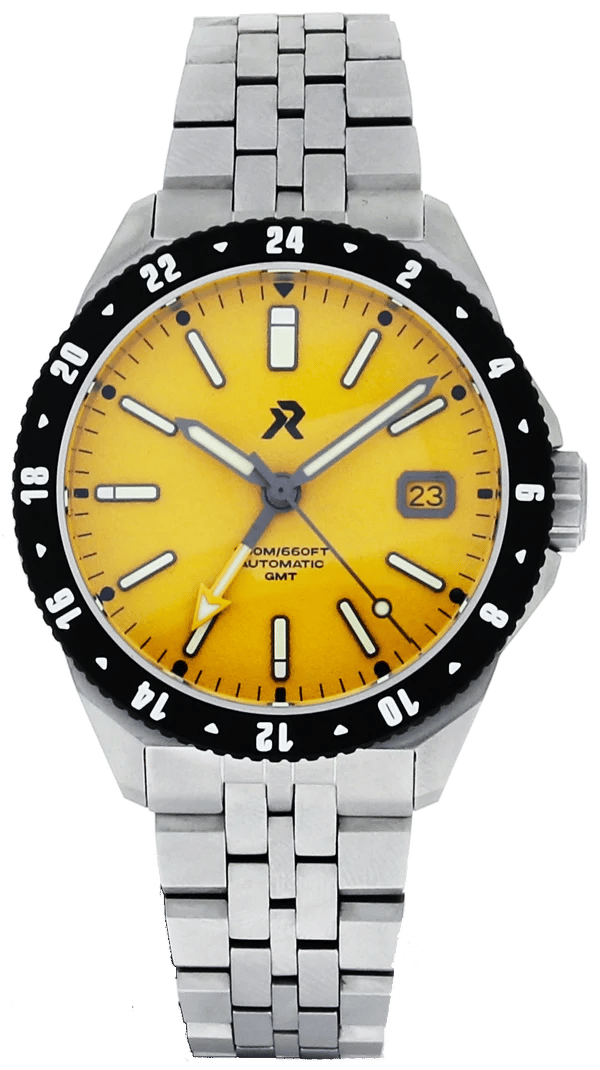
The dial layout is functional rather than decorative: applied indices, a straightforward 24-hour scale, and an arrow-tipped GMT hand that is legible but not so prominent that it overwhelms the hour and minute hands. Colour differentiation between the GMT hand and the local-time hands is handled well, which sounds like a small thing until you have spent a flight squinting at a watch where it is not.
Super-LumiNova BGW9 is applied to the indices and hands. It is a blue-emitting compound with excellent initial brightness and reasonable persistence — good enough to read at 3 a.m. in a hotel room without reaching for a phone, which is the only lume test that matters on a travel watch. The date window is present and unobjectionable; RZE has resisted the temptation to make it a design statement.
The overall effect is restrained. This is not a watch that produces a reaction across a dinner table. It is a watch that tells you the time in two places, in the dark, without any ambiguity. For the intended use case, that is the correct priority ordering.
On the Wrist
The Ascentus wears like what it is: a titanium tool watch that disappears on the wrist. Titanium's density advantage shows up immediately — the case and bracelet read noticeably lighter than a steel GMT of comparable footprint, and the balance point sits close to the head rather than dragging toward the clasp. On a fabric strap it becomes almost weightless, which is the configuration most owners will migrate to after the honeymoon period.
The bracelet is the one place where the price point shows. It articulates cleanly and the finishing is consistent, but it does not have the silky, near-frictionless drape of a five-figure integrated bracelet, and the clasp is functional rather than refined. That is the honest trade: the money went into the movement and the case material, and the bracelet is where the savings were taken. The caseback sits flat against the wrist, and the overall package is comfortable across a full working week rather than merely tolerable for an evening.
Accuracy and Daily Life
The Miyota 9075 is not a chronometer movement and should not be assessed as one. Real-world examples typically settle somewhere in the -10 to +15 seconds per day band once broken in, with positional variation that is noticeable to anyone who tracks their watches but irrelevant to anyone who does not. The jumping-hour mechanism itself is crisp and does not require hacking the movement to set local time — a genuine convenience when you land and want to be out of the airport.
If precision matters to you, an independent watchmaker can regulate a 9-series Miyota for modest money. But chasing chronometer numbers on a travel watch at this price is a category error; the specification that matters here is the complication, and it works.
The Competitive Set
The obvious rival is the Christopher Ward C63 Sealander GMT, which offers comparable true-GMT functionality with considerably more brand recognition and a finishing package that most collectors will find more satisfying under a loupe. It also costs more, and it is not titanium. Buyers who care about resale and about how a watch feels in the hand should go Christopher Ward. Buyers who care about weight on the wrist and about spending the minimum for the complication should go RZE.
Traska's Venturer GMT is the closest philosophical match — another value-led GMT from a small brand with an obsessive approach to case hardening. Baltic's Aquascaphe GMT offers more design character and less technical ambition. And the Seiko SSK remains the volume answer: cheaper, heavier, available in every airport shop on earth, and handicapped by an office-GMT movement that makes it a second time-zone display rather than a travel tool.
Against that field, the Ascentus's differentiation is narrow but real: true GMT, titanium, sapphire, and a price that undercuts anything Swiss. It is not the most characterful watch in the category. It is arguably the most functional one per dollar.
Resale, Demand Cycles and the Hold-or-Sell Call
Here is where the analyst has to be blunt. Microbrand GMTs are consumption goods, not assets. The Ascentus launched at a retail price that sits in the high three figures, and the secondary market for it has followed the standard microbrand curve: strong demand on release, brief premiums on colourways that sold out quickly, then a drift down to the point where a clean pre-owned example typically changes hands meaningfully below what the original buyer paid.
That is not a criticism of the watch. It is a structural feature of a direct-to-consumer brand with no dealer network, no waiting lists, and a steady restock cadence. Rarity in this segment is manufactured by production scheduling, not by genuine scarcity, and the market eventually figures that out. Collectors who bought expecting a Traska-style cult premium on a discontinued colourway have mostly been disappointed; collectors who bought to wear have done fine.
The hold-or-sell judgment therefore depends entirely on why you own it. If the Ascentus is in rotation — actually travelling, actually being worn — there is no case for selling. The replacement cost is low, the utility is high, and the depreciation is already sunk. If it is sitting in a box because you bought it as an investment or because the collection has moved upmarket, sell it. Waiting for appreciation is a losing strategy in this tier, and the best exit window is usually the period just after a restock sells out, when buyers who missed out go looking.
Demand cycles in the microbrand space also run on attention rather than on fundamentals. A favourable YouTube review or a viral Reddit thread can move pre-owned prices for a few weeks; nothing sustains them. Anyone treating a sub-$1,000 Singaporean titanium GMT as a store of value is misunderstanding what they bought. Anyone treating it as a beautifully functional object acquired at a fair price is exactly right.
Servicing and Ownership Costs
Ownership economics are one of the Ascentus's genuine strengths. The Miyota 9-series is ubiquitous, well documented, and serviceable by any competent independent watchmaker. There is no authorised-only service trap, no proprietary parts labyrinth, no six-month wait for a caseback gasket from a European atelier. In many cases a movement replacement is economically preferable to a full overhaul, which is a sentence that would be alarming in a Rolex review and is entirely sensible here.
Practically, budget for a service only when the watch starts misbehaving. These movements run for years without attention, and the cost of putting one right is a fraction of what a Swiss GMT service would set you back. That low running cost is part of the value argument and should be factored into any comparison against the Swiss competition.
Verdict
The RZE Ascentus is the correct answer to a narrow question: what is the least money you can spend on a genuine jumping-hour GMT in a lightweight case that you will not baby? It answers that well, and it does so without the design compromises that usually accompany aggressive pricing in this category.
What it does not do is build equity. This is a consumption purchase, not a collection purchase, and buyers who understand the difference will be extremely happy with it. Buy it, travel with it, scratch it, and treat the depreciation as the rental fee on a very good tool. Collectors looking for the next microbrand that becomes a cult object should look elsewhere — that is not what this watch is for, and RZE has not pretended otherwise.