The Market Context: Why the GMT is King
In the world of high-stakes horology, the GMT complication has undergone a radical transformation. No longer just a tool for Pan Am pilots, the GMT has become the ultimate symbol of the globalist lifestyle. However, for years, the 'True' or 'Flyer' GMT—where the local hour hand jumps independently—was a gatekept feature. You either bought a Rolex, a Tudor, or an Omega, or you settled for an 'Office' GMT where the 24-hour hand moved independently. The RZE Fortitude GMT changes that narrative entirely by leveraging the Miyota 9075, a movement that has democratized the traveler's complication.
Material Science: The UltraHex Advantage
The 'beater' watch is a necessary part of the portfolio. But nobody wants a watch that looks like it’s been through a blender after one weekend of sailing. This is where RZE’s proprietary UltraHex technology comes into play. By applying a clear coating that increases the surface hardness of the Grade 2 titanium to 1200 Vickers (roughly eight times harder than standard 316L stainless steel), RZE has created a watch that is virtually immune to the 'desk diving' scratches that plague luxury pieces. From a resale perspective, this is a massive hedge against depreciation; a watch that stays looking 'New in Box' for years is a watch that maintains its secondary market floor.
Movement Deep Dive: The Miyota 9075
The heart of the Fortitude GMT is the Miyota 9075. Before this caliber hit the market, a mechanical flyer GMT at this price point was a pipe dream. The movement beats at 28,800 vph, providing a smooth sweep that mimics Swiss counterparts. While the rotor can be a bit vocal—a common trait of the Miyota 9000 series—the reliability is unquestionable. In terms of investment, the 9075 is currently the 'it' movement in the microbrand space. As long as supply remains tight and demand for GMTs stays high, watches housing this movement will remain liquid assets in the enthusiast community.
Aesthetic and Ergonomics
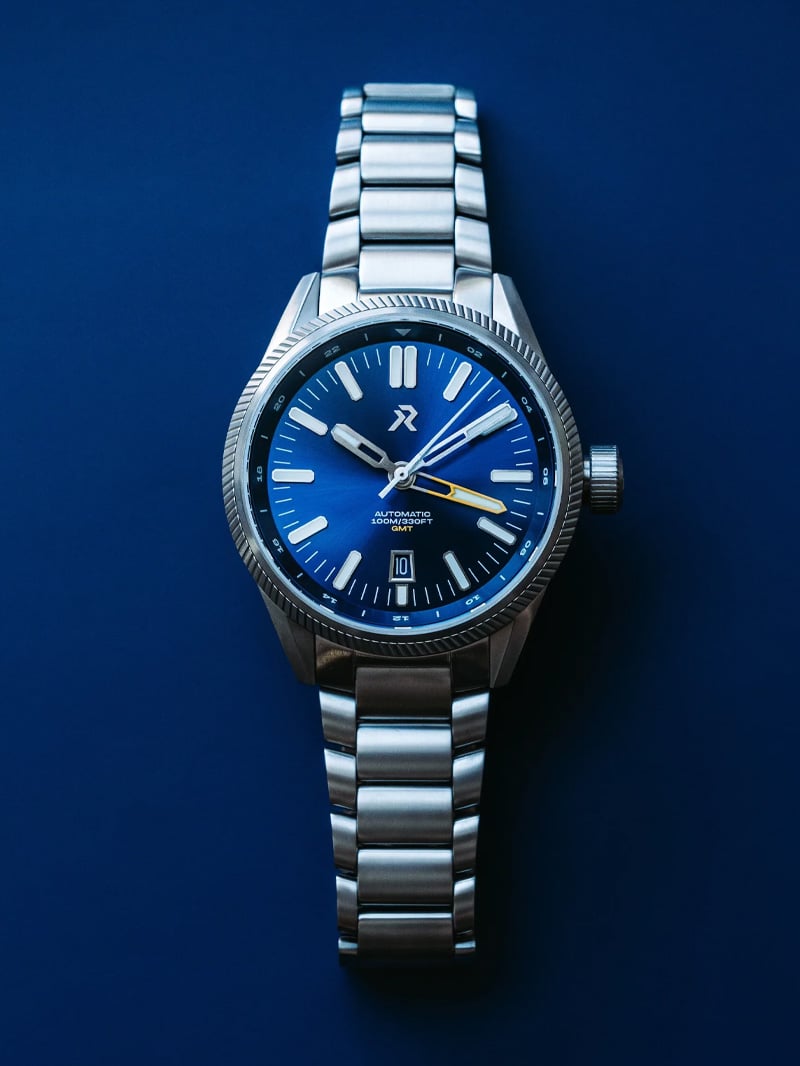
Design-wise, the Fortitude GMT leans into a 'Neo-Pilot' aesthetic. The oversized crown is a nod to heritage aviation watches, but the crosshair dial and sandwich-style indices feel distinctly modern. The 41mm case size is the 'Goldilocks' zone for contemporary collectors—large enough to have presence, yet slim enough at 12mm to slide under the cuff of a Brunello Cucinelli linen shirt. The titanium bracelet is equally impressive, featuring a slight taper and a milled clasp that feels more substantial than many offerings from established Swiss brands at the $2,000 mark.
The Resale Reality
Let’s be frank: you aren’t buying an RZE to fund your retirement. This isn't a Patek Philippe 5270P. However, in the microbrand 'hype cycle,' RZE occupies a very stable position. They don't overproduce, and their technical focus gives them a 'sticky' enthusiast base. On the secondary market, Fortitude GMTs tend to move quickly, often selling for 85-90% of their MSRP. In the world of luxury goods, that kind of retention is impressive. It represents a low-risk entry into a high-utility complication.
Final Verdict for the Sophisticated Collector
The RZE Fortitude GMT is a tactical masterpiece. It’s for the man who understands that true luxury isn't just about the price tag—it's about the engineering. It’s a watch that allows you to navigate time zones with the same ease as a GMT-Master II, but with the added peace of mind that comes from a hardened titanium shell. If you’re looking to diversify your collection with a piece that offers maximum utility and minimum maintenance, the Fortitude GMT is the smartest $649 you’ll spend this year. It’s not just a watch; it’s a high-performance tool for the modern horological portfolio.