The GMT gap in the microbrand market
Every collector eventually reaches the point where a GMT stops being a novelty second hand and starts being a tool. Once you have flown with a travel watch that tracks home time on the wrist, you notice how often you glance at it — across time zones, across calls, across the strange middle-of-the-night hours when you need to know whether it is reasonable to call someone. The complication is genuinely useful in a way that a moonphase is not.
The problem is that the useful GMT has become expensive. Rolex, Omega, Grand Seiko and even Tudor have pushed the category well past the point where a young collector can justify adding one alongside a daily wearer. The microbrand response has been loud and uneven: many brands claim to make a GMT, but relatively few make a GMT worth wearing.
The RZE Fortitude GMT-S is one of the few at the accessible end of the market that I would actually recommend. RZE is a Singapore-based direct-to-consumer brand built on titanium tool watches, and the Fortitude GMT-S is its travel-watch proposition: a lightweight GMT with a Seiko heart, sold direct at a price that asks very little of the buyer. What follows is a working analyst's view — what the watch is, how it wears, what it will cost you to own, and whether it deserves a place in a serious collection.
The RZE origin story
RZE was founded in Singapore in 2020 by Travis Tan, and it was built on a simple observation: collectors want titanium tool watches, but the mainstream brands charge a heavy premium for the metal. By selling direct and using proven third-party movements, RZE has been able to deliver titanium cases and bracelets at prices that steel-focused brands cannot match. The brand's identity is not built on heritage or in-house watchmaking — it is built on materials value and honest tool-watch design.
That context matters for the Fortitude GMT-S, because it explains both what the watch is and what it is not. RZE is not trying to compete with Christopher Ward on finishing or with Seiko on in-house credibility. It is competing on the ratio of capability to price, and it is doing so in a category — titanium GMT — where that ratio is unusually favorable.
Design and construction
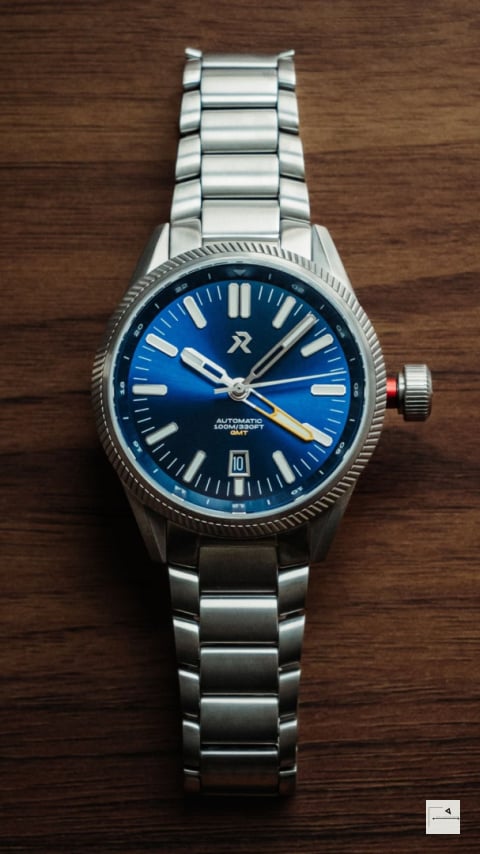
The Fortitude GMT-S reads immediately as a tool watch. The case is titanium, with the slightly muted, warmer tone that titanium always carries compared to polished steel. The finishing is brushed, functional and honest — this is not a watch trying to be a jewellery object. The bezel-less case profile gives the dial maximum real estate, which is exactly what you want on a GMT, and the sapphire crystal protects the whole assembly without the visual distortion that lesser materials introduce.
The dial layout is disciplined. The GMT hand is distinct from the hour and minute hands in both shape and colour, the 24-hour scale is legible without dominating the dial, and the date window — where present — sits discreetly rather than interrupting the symmetry. Legibility has clearly been the brief, and RZE has executed it.
The bracelet deserves specific mention. A titanium bracelet is one of the harder things to get right at this price — cheap titanium bracelets rattle, and cheap clasps feel flimsy in a way that undermines the whole watch. The Fortitude GMT-S bracelet is not a Grand Seiko bracelet, but it articulates cleanly, the folding clasp sits flat on the wrist, and the overall assembly holds together in a way that punches above its price.
Lume is Super-LumiNova, applied generously enough that the dial remains readable overnight and in low-light travel conditions. It is not the torch-bright output of a dedicated dive watch, but for a GMT it is more than adequate.
The movement: Seiko NH34
The Fortitude GMT-S is powered by Seiko's NH34, the GMT variant of the ubiquitous NH35 family. The specification is well known and unexceptional in the best sense: automatic winding, 41 hours of power reserve, 21,600 vibrations per hour, 24 jewels, and a date complication alongside the GMT function. It is not COSC-certified, it is not in-house, and it is not finished for display. What it is, is proven — the NH34 is used by dozens of microbrands because it works, because it is affordable, and because parts and service are available essentially anywhere in the world.
The GMT architecture is worth being precise about. The NH34 is a caller-style GMT: the 24-hour hand can be set independently via the crown, but the local hour hand cannot be jumped without stopping the movement. That means you set the watch by setting the local time normally and then adjusting the GMT hand to track home time. For collectors used to a true traveler's GMT — where the hour hand jumps independently and the watch keeps running — this is a meaningful difference. It is also the correct compromise at this price point, because true traveler's GMT movements are substantially more expensive.
The practical upshot is that the Fortitude GMT-S is best understood as a tracking GMT rather than a flying GMT. If you cross time zones frequently and want to adjust the local hour on landing without disturbing the seconds, this is not the movement you want. If you want to keep an eye on a second time zone while you go about your day — family, a business contact, a market — the NH34 does the job without complaint.
On the wrist
The Fortitude GMT-S is a watch you forget you are wearing, which is the highest compliment a titanium tool watch can receive. The case reads as a proper, slightly broad-shouldered sports watch on the wrist, but the metal itself gives away almost nothing — there is none of the heft that steel GMTs telegraph through a shirt cuff. The bracelet articulates cleanly, the clasp sits flat, and the whole assembly disappears under a cuff or a jacket sleeve in a way that steel alternatives simply do not.
What it does not do is flatter. This is a tool-watch silhouette — pronounced case, highly legible dial, an honest GMT hand — and it wears like one. There is no bracelet taper trickery to make it feel dressier than it is. Collectors who want a GMT that dresses up should look elsewhere; collectors who want a GMT that vanishes into a travel day will find it here.
Wrist presence is confident but understated. The watch reads as serious kit to anyone who knows what they are looking at, and as a well-made sports watch to anyone who does not. It is not a statement piece, and it is not trying to be.
Accuracy and daily performance
The Seiko NH34 is not a chronometer movement and RZE does not position it as one. Expect out-of-the-box performance in the −10 to +25 seconds-per-day window, with many examples settling into a tighter −5 to +15 range after a few weeks of wear. That is acceptable for a tool watch at this price, though it is noticeably looser than what you would get from a Swiss alternative at two or three times the cost.
If sub-10-second accuracy matters to you — and for some collectors it does — budget for a regulation at the first service. The NH34 takes regulation well, and a competent watchmaker can bring a good example comfortably inside ten seconds per day. The movement is one of the most serviceable automatics in the world, and that serviceability is worth more than the specification sheet suggests.
Value and market positioning
The Fortitude GMT-S sits in a genuinely interesting place in the market. At its retail price it competes directly with entry-level Seiko GMTs, entry-level Swiss quartz GMTs, and a small crowd of microbrand competitors. Against the Seikos it wins on materials — titanium versus steel — and on the bracelet. Against the Swiss quartz options it wins on having a mechanical movement and a proper tool-watch identity. Against the microbrand crowd it wins on brand focus: RZE has built a coherent identity around titanium tool watches, and the Fortitude GMT-S benefits from that coherence.
What it does not win on is resale. Microbrands almost universally depreciate, and RZE is no exception. A Fortitude GMT-S bought at retail will typically trade below that figure on the secondary market, and buyers should not expect to exit near what they paid. This is a watch to buy and wear, not a watch to flip. The value proposition is in the ownership experience rather than the exit price.
For collectors building a collection with a genuine travel watch in it, that is a reasonable trade-off. The Fortitude GMT-S delivers the core capabilities — GMT, sapphire crystal, titanium case, bracelet — for a fraction of what those capabilities cost from an established brand. The money you save is money you can put towards a Swiss GMT later, or towards a different complication entirely.
How it compares
The most obvious comparison is Christopher Ward's C63 Sealander GMT, which is Swiss-assembled, better finished, and uses a true traveler's GMT movement — at roughly double the price. Collectors who can stretch should consider it seriously. The Fortitude GMT-S is not trying to beat the C63 on finishing; it is trying to deliver the same functional category at half the cost, and it largely succeeds.
The Nodus Sector GMT is the closest direct microbrand rival. It uses the same NH34 movement and offers a stronger dive-watch accent. The choice between them comes down to aesthetics and strap preference rather than capability. Traska's Seafarer GMT offers a scratch-resistant steel case and a similarly pragmatic philosophy; collectors who prioritise steel durability over titanium weight should look at it. Seiko's own 6R54 Prospex GMTs offer in-house credibility and stronger brand recognition at a higher price of entry.
Against the Seiko 5 Sports SSK — the obvious budget alternative — the Fortitude GMT-S wins on materials and finishing, but at roughly twice the price. Collectors who want the cheapest credible GMT should buy the SSK. Collectors who want a titanium GMT that will last a decade should buy the RZE.
The verdict
The RZE Fortitude GMT-S is the right answer to a specific question: how do I buy a credible GMT tool watch in a lightweight case without spending four figures? It answers that with discipline — titanium, sapphire, a proven Seiko GMT and honest finishing — and refuses to pretend it is a luxury product. It is not the movement you want if you fly constantly and need a jumping local hour, and it is not the watch you want if resale matters to you. But as a working travel watch that earns its keep, it is one of the smartest buys in the accessible end of the category.