A field watch that knows exactly what it is
The modern field watch has a problem: it is almost impossible to make one that feels necessary. The archetype was solved decades ago — a legible dial, a compact case, a movement that survives being dropped on a rock — and everything since has been variation. So when a young Singapore brand announces another titanium field watch, the reasonable response is a shrug.
The RZE Valour, reference RZE-VAL-WW-RB-NP, earns more than a shrug. Not because it reinvents anything, but because almost every decision inside it has been made by someone who has worn a watch hard and thought about what actually matters. The case is titanium with a hardening treatment. The dial carries no date. The movement is a Seiko NH38, which is to say it is the least precious and most repairable automatic available at this price. None of that is glamorous. All of it is correct.
RZE, briefly
RZE was founded in Singapore in 2020 by Travis Tan, and it arrived with an unusually clear proposition: titanium tool watches, hardened against wear, sold direct, priced where a working collector can actually buy one without a justification speech. The brand's UltraHex treatment is the technical signature — a surface hardening process applied over the titanium that raises the case's resistance to the scuffs, strap-change marks and desk-diving scratches that make raw titanium look tired within a year. Whether or not one accepts every claim made for the process, the practical result is a case that keeps its finish longer than untreated alternatives.
The Valour sits at the traditional end of the catalogue. Where RZE's dive and travel models lean on bezels and complications, the Valour is a three-hander with nothing to explain. It is the sort of watch that a brand only makes when it is confident about its own design language, because there is nowhere to hide.
The case and its finishing
Titanium is often described as a weight saving. In practice it is a character change. The Valour's case reads softer and warmer than steel, with a diffuse quality to the light that makes the metal look more like a machined component than a piece of jewellery. The UltraHex finish pushes the surface a shade darker and more matte than untreated titanium, which suits a field watch precisely: it looks like it belongs outdoors rather than in a display case.
The surfaces are brushed with discipline. The case flanks, the tops of the lugs and the upper surface of the case all carry a consistent grain, and the transitions between those planes are crisp without being sharp enough to catch a sleeve. There is no gratuitous polishing anywhere — no mirror chamfers, no bright flanks, none of the showroom tricks that a lesser brand would use to add perceived value. This is a case designed to be looked at once, understood, and then forgotten, which in a tool watch is the higher compliment.
The crystal is sapphire and sits without drama above the dial, clearing the markers comfortably and offering the scratch resistance that a watch in this role genuinely needs. The caseback is closed and simply finished. There is nothing here to service through the back, and RZE has not pretended otherwise.
The lugs deserve a note of their own. They are shaped to pull the strap down rather than out, which is the difference between a watch that sits on the wrist and one that perches above it. It is a small piece of geometry, and it is the sort of thing that separates a designed watch from an assembled one.
The dial
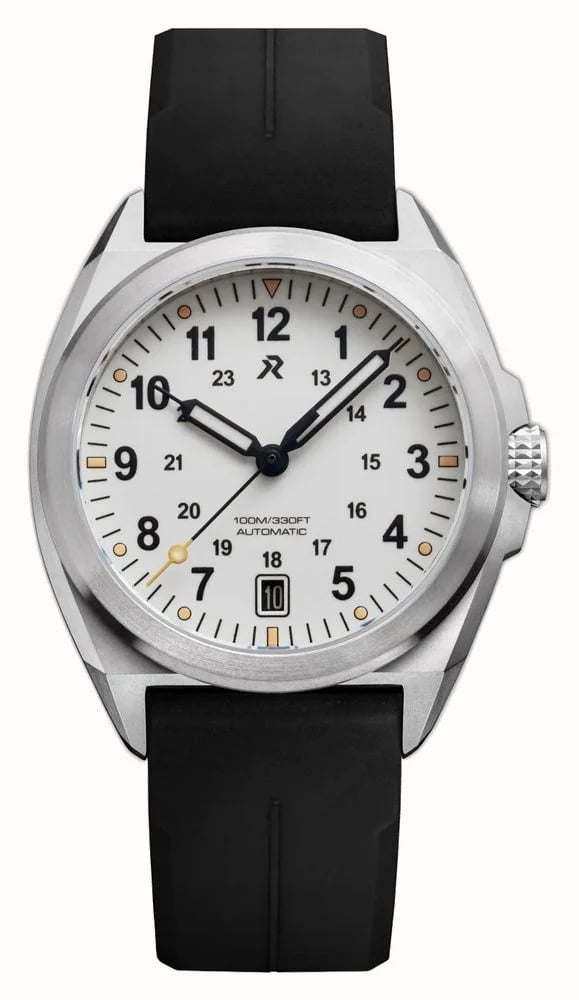
The dial is where the Valour makes its argument most clearly. The reference under review carries a pale, warm-toned surface — the WW in the reference code points to it — and against that ground the printing is heavy and unambiguous. A minute track runs the perimeter. The hour markers are large enough to read at a glance and filled with luminescent material for the dark. The hands are broad and fully lumed, shaped so that the hour and minute indications are distinguishable by silhouette rather than by colour.
There is no date window, and that single omission changes the dial's balance more than any other decision in the watch. The markers can be evenly spaced. The symmetry holds through the centre line. The owner never has to reset anything after a week in a drawer, and never has to look at a misaligned numeral set into a pale dial where it does not belong. The NH38 is a no-date movement, so the omission is honest engineering rather than a styling affectation — RZE chose the movement that matched the dial it wanted to make, which is the correct order of operations.
Contrast is the watch's great strength. Dark printing on a pale ground reads instantly in flat indoor light and in full sun, and the matte surface suppresses the reflections that turn a glossy dial into a mirror at the wrong moment. The luminescence is Swiss Super-LumiNova, applied generously to the markers and hands. It charges quickly under a lamp and remains legible through the night, though it is not the blinding torch that a dedicated dive watch can offer. For a field watch, the balance is right: enough to read the time in a tent, not so much that it becomes the watch's entire personality.
The movement
The Valour runs on Seiko's NH38, the no-date member of the NH3x family and a descendant of the long-serving 7S26 line. It beats at 21,600 vibrations per hour, holds roughly forty-one hours of power reserve, and winds unidirectionally through Seiko's Magic Lever system.
Architecturally it is a compact, robust, uncomplicated automatic: a basic going train, a simple winding mechanism, and a construction that has been proven in millions of inexpensive watches over two decades. The finishing is minimal — brushed bridges, a light surface treatment here and there, no chamfering worth photographing. That is the correct allocation of resources at this price. Money spent decorating an NH38 is money not spent on the case, the crystal, or the strap, and RZE has spent it in the right places.
What the NH38 offers instead of beauty is availability. Any watchmaker with a Seiko parts account can service it, and the movement itself is inexpensive enough that replacement is sometimes the more sensible route than overhaul. That is not a compromise; it is a design decision with real consequences for long-term ownership. A watch you can hand to a local specialist without a six-month wait and a four-figure invoice is a watch you will actually wear.
On the wrist
The first thing you notice is the absence of weight. Titanium does not simply make a watch lighter; it changes how the watch relates to the wrist. There is no pendulum effect when you turn your arm, no case flopping forward over the wrist bone. The Valour sits where you put it and stays there, and after an hour you stop thinking about it entirely.
Balance is the second observation. A light case on a heavy strap feels wrong, and RZE has avoided that trap by supplying this reference on a fitted rubber strap that tapers toward the buckle and meets the case without a gap. The strap follows the contour of the wrist rather than standing away from it, and the pin buckle is simple, secure and easy to replace. Under a cuff the watch disappears, which is exactly what a field watch should do. The crown sits flush enough that it never presses into the back of the hand, and the case edges are rounded enough that a full day of typing produces no hot spots.
It is not a large watch, nor a small one — it is sized to sit in the middle of the wrist and stay there. The proportions are those of a working instrument rather than a statement piece, and the rubber strap reinforces that reading. Fit it to leather and it becomes slightly more formal; fit it to a nylon pass-through and it becomes entirely utilitarian. The case takes both without complaint.
Accuracy and daily behaviour
Seiko publishes the NH38 at approximately -20 to +40 seconds per day, which is a wide window and an honest one: these movements leave the factory unregulated. In practice, examples of the Valour tend to run tighter than the specification allows, typically settling in the +5 to +12 seconds per day range once broken in, with noticeable positional variation between crown-up and dial-up rest.
The Valour is not a chronometer and should not be bought as one. If precision matters, any competent watchmaker can regulate an NH38 in a single sitting, usually bringing it into single digits for a modest fee. That is the honest trade at this price: you get a movement with a generous tolerance and unlimited serviceability, rather than a tightly adjusted one that requires factory attention. Set the watch once a week against a reference and you will never be late for anything important.
Living with it
The UltraHex surface does what it claims over the medium term: the micro-scratches that accumulate on untreated titanium — the hairlines from a seatbelt, the faint marks from a door frame — appear far more slowly, and when they do appear they sit shallow in the grain rather than catching the light. The sapphire crystal means the most visible surface on the watch stays clean. Between the two, the Valour looks newer after a year of hard wear than most steel field watches look after six months.
The strap is the most likely point of replacement. Rubber is comfortable, secure and impervious to sweat, but it does not dress up, and the reference under review is therefore a casual watch by default. That is not a flaw so much as a description: this is a watch for a shirt sleeve, a jacket cuff, or a bare wrist in summer, not for a dinner jacket.
Legibility in low light remains strong thanks to the generous luminescent application, and the no-date dial means there is nothing to correct after the watch has been resting. The forty-one-hour reserve is enough to survive a weekend off the wrist, so a Monday morning reset is usually unnecessary — a small thing that makes a large difference to how a watch feels in ownership.
Value and alternatives
The Valour sits in the busiest segment of the market: the field watch below the price of a decent suit. Hamilton's Khaki Field Automatic owns the mindshare here, and it deserves to — it offers heritage, a Swiss movement and decades of cultural association. The Valour answers with titanium, a hardening treatment, a no-date dial and a case designed with more attention to wrist geometry than its price suggests. Buyers who value history will choose Hamilton. Buyers who value the object in the hand will find the RZE persuasive.
Vertex's M100 revives the British dirty-dozen brief with genuine military lineage, at several times the price. Marathon's General Purpose Mechanical delivers issued-spec utilitarianism with tritium illumination and a contract number behind it. Boldr's Venture is the closest philosophical sibling: another Singapore brand, another titanium case, another direct-to-collector sales model. Timex's Expedition North and Bertucci's titanium field watches sit at the entry point, for buyers who want to test the format before committing.
What the Valour offers against all of them is coherence. The case, the dial, the strap and the movement have been selected to work together rather than to tick specification boxes. There is no feature here that exists to be quoted in a press release, and no compromise that has been disguised rather than accepted.
Verdict
The RZE Valour is not trying to be a luxury object, and that is precisely its strength. It is a field watch with a hardened titanium case, an honest workhorse movement, and a dial that understands legibility as a discipline rather than an accident. The finish is competent rather than exceptional, the movement is accurate enough rather than precise, and the strap restricts it to casual wear — and none of those compromises undermines the whole.
Buy it as a daily wearer and it will justify every dollar. Buy it as an investment and you have misunderstood the brief entirely.