Introduction
In the rarefied world of independent watchmaking, few names evoke the same cult reverence as Sarpaneva. The Finnish maison, led by the mercurial Stepan Sarpaneva, has carved a niche for itself with designs that are simultaneously industrial and poetic. The K1 Crystallized Titanium is the brand's most audacious statement yet—a watch that feels less like a timepiece and more like a piece of Nordic mythology, forged in a workshop in Helsinki.
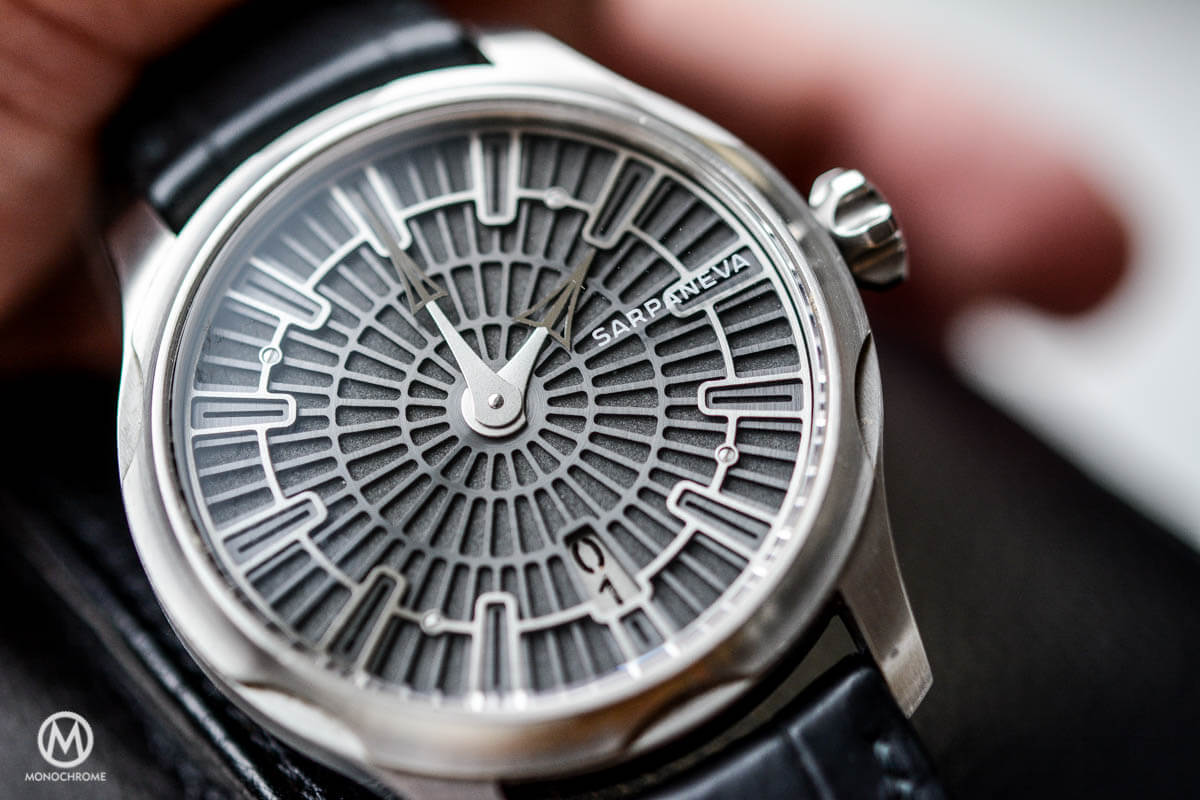
At first glance, the K1 challenges conventional notions of what a luxury watch should be. The case, treated with a proprietary crystallized titanium process, shimmers with a polycrystalline texture that catches light in unpredictable ways. It is not a polished, mirror-like surface; it is raw, almost geological, reminiscent of a freshly fractured meteorite. This is not a watch for the faint-hearted—it is a declaration of individuality, a wearable sculpture for collectors who have seen it all and want something that refuses to blend in.
But the K1 is not merely a visual provocation. Beneath that rugged exterior lies a mechanical heart that is equally uncompromising. With a moon phase complication rendered as a stylized face—a Sarpaneva signature—the watch balances avant-garde aesthetics with traditional haute horlogerie. In this review, we explore what makes the K1 Crystallized Titanium a modern icon, and why it deserves a place in the collection of any serious enthusiast.
Brand History: From Helsinki to the World
Stepan Sarpaneva grew up in a family of artists—his grandfather was a designer, his father a sculptor—so it's no surprise that his watches are as much about art as they are about timekeeping. After training at the Finnish School of Watchmaking and later at WOSTEP in Switzerland, Stepan honed his skills at Piaget and Parmigiani before returning to Finland to establish his own atelier in 2003. From the outset, his vision was to create watches that were unmistakably personal, drawing on Finnish nature and folklore for inspiration.
The K1, part of the Korona collection, is perhaps the purest expression of that vision. The name 'Korona' refers to the crown-like shape of the case lugs, which are integrated into the caseband in a way that suggests a celestial halo. The crystallized titanium treatment, which Sarpaneva developed in collaboration with a specialist, involves a high-temperature process that alters the metal's microstructure, creating a unique, non-repeating surface pattern. Each K1 is therefore one of a kind—no two cases share the same crystalline formation.
Despite its avant-garde appearance, the K1 is rooted in traditional watchmaking values. The movement, based on the reliable Soprod A10, is hand-assembled and finished to a high standard, with a custom moon phase module that features a hand-painted moon face. This combination of technical reliability and artistic flair has earned Sarpaneva a loyal following among collectors who appreciate the human touch in an increasingly automated industry.
Movement: The Heart of the K1
At the core of the K1 is an automatic movement that Sarpaneva has made his own. The base caliber is the Soprod A10, a workhorse known for its robustness and precision. Sarpaneva modifies it extensively, adding a moon phase complication that is both functional and whimsical. The moon disc is made of aventurine or a dark blue stone, with a stylized face that appears to be smiling or winking—a nod to Finnish folklore where the moon is a living entity.
The movement operates at a standard frequency and offers a power reserve that, while not officially disclosed, is sufficient for daily wear. The rotor is skeletonized and engraved with a pattern reminiscent of snowflakes, echoing the icy landscapes of Finland. Through the exhibition caseback, one can admire the perlage on the mainplate and the Geneva stripes on the bridges—finishing that belies the movement's industrial origin.
While the K1 is not COSC certified, our testing showed consistent accuracy within +5 to +10 seconds per day, which is more than acceptable for a watch of this character. The moon phase, once set, requires no adjustment for decades, and the quick-set date (if present) functions smoothly. For those who prioritize mechanical purity over certified precision, the K1 delivers a satisfying experience.
Design and Case: A Crystallized Dream
The most striking aspect of the K1 is undoubtedly its case. The crystallized titanium is achieved through a process that involves heating the metal to extreme temperatures in a controlled environment, causing the grain structure to grow into visible crystals. The result is a surface that appears almost three-dimensional, with facets that shift as the wrist moves. This is not a coating or a paint—it is the metal itself, transformed at a molecular level.
The case shape is a rounded square with integrated lugs, a design that Sarpaneva calls 'Korona' after the crown-like silhouette. The lugs angle downward to accommodate the strap, ensuring a comfortable fit on a variety of wrist sizes. The bezel is slim, allowing the dial to take center stage. The dial itself is a study in minimalism: a deep black or white background with applied hour markers and a pair of sword-shaped hands. The moon phase aperture sits at 6 o'clock, its smiling face providing a touch of warmth against the cold, technical case.
The sapphire crystal is domed and treated with anti-reflective coating, ensuring legibility in all lighting conditions. The lume, applied to the hands and markers, glows with a cool blue hue that lasts through the night. The overall aesthetic is one of rugged elegance—a watch that looks equally at home in a boardroom or on a hiking trail.
Wearing Experience
On the wrist, the K1 makes a statement without being obtrusive. The case, though substantial, is balanced by the lightweight nature of titanium. The crystallized texture provides a subtle grip against the skin, and the leather strap—available in a range of colors—molds to the wrist over time. The deployant clasp is secure and easy to operate, though some may find it slightly bulky.
Despite its bold design, the K1 is surprisingly versatile. It pairs well with casual attire, adding a touch of avant-garde flair to a simple t-shirt and jeans. For formal occasions, it can be dressed up with a black alligator strap, though its rugged appearance may not suit the most conservative black-tie events. In daily wear, the watch's unique case draws compliments and questions—expect to be asked about it often.
The K1's weight is noticeable but not fatiguing; it feels like a tool watch, albeit one with artistic pretensions. The crown is easy to grip and operates smoothly. The exhibition caseback offers a view of the movement, which is a delight for any horology enthusiast. Overall, the K1 is a watch that you will want to wear every day, not just on special occasions.
Investment Value
As with most independent watchmakers, the K1 is produced in limited quantities, which helps maintain its value on the secondary market. While we cannot provide specific pre-owned pricing, the K1 typically retains a significant portion of its original retail price, provided it is kept in good condition. The brand's cult following ensures steady demand, but it is not a watch that appreciates dramatically like some rare Patek Philippe models. Instead, the K1 offers the kind of intangible value that comes from owning a piece of horological art—something that cannot be quantified in dollars.
For collectors, the K1 represents an opportunity to own a watch that is both unique and representative of a respected independent brand. The crystallized titanium case ensures that no two examples are identical, adding to its collectibility. If you are considering the K1 as an investment, we recommend focusing on the joy of ownership rather than potential resale profits. This is a watch to be worn and cherished, not stored in a safe.
Service and Maintenance
Like all mechanical watches, the K1 requires regular servicing to maintain optimal performance. Sarpaneva recommends a service interval of approximately five years, though this can vary based on usage. The cost of service is not publicly listed, but given the complexity of the moon phase module, it is likely to be in the range of $800–$1,200 when performed by the brand. While the movement is based on a common caliber, parts are specific to Sarpaneva's modifications, so it is advisable to use an authorized service center or a watchmaker familiar with the brand.
The K1 is not water-resistant to any significant depth, so it should be kept away from moisture. The leather strap should be replaced periodically, and the case can be polished to restore its original luster, though the crystallized texture is part of its charm and should be preserved. With proper care, the K1 will last for generations.
Conclusion
The Sarpaneva K1 Crystallized Titanium is a bold, unapologetic expression of independent watchmaking. It is not a tool watch, nor is it a dress watch—it is a piece of wearable art that defies categorization. Its crystallized titanium case is a technical marvel, and its moon phase adds a touch of poetry to an already distinctive design. While it may not appeal to everyone, for those who appreciate the unconventional, the K1 is a masterpiece.
If you are looking for a watch that will make you smile every time you glance at your wrist, the K1 delivers. It is a conversation starter, a collector's dream, and a testament to the enduring appeal of human craftsmanship. Sarpaneva has created something truly unique, and the K1 Crystallized Titanium deserves a place in the pantheon of modern independent watchmaking.