Brand History: From Helsinki with Attitude
Stepan Sarpaneva founded his eponymous brand in 2003 after training with the likes of Piaget and Parmigiani. But instead of following the Swiss formula, he returned to Finland to create watches that reflect the stark, beautiful, and sometimes melancholic Nordic landscape. His early work focused on bold cases and unique dials, but it was the moon phase that became his signature. The Supermoon, introduced in the mid-2010s, took the traditional moonphase and turned it into a character — a face that looks back at you.
The brand’s production is deliberately small, with only a few hundred pieces per year. Each watch is assembled in Helsinki, and the moon disc is hand-painted, giving every piece a unique personality. Sarpaneva’s designs often incorporate traditional Finnish motifs, like the “Korona” (crown) and the “Polaris” (north star), but the Supermoon is the one that truly captures the imagination.
The Movement: A Workhorse with a Lunar Twist
Under the hood, the Supermoon is powered by a modified Soprod A10 automatic movement. The A10 is a reliable, thin caliber that Sarpaneva reworks with a custom moon-phase module. The base movement provides time and date (though the date is often omitted in the Supermoon to keep the dial clean), and the module drives a central moon disc that rotates once every 29.5 days. The disc is large — almost the entire dial — and is made of a special alloy that mimics the moon’s surface.
The rotor is a work of art in itself, featuring a laser-cut moon face that spins with the movement’s oscillations. The finishing is decent, with perlage and Geneva stripes visible through the exhibition caseback. While it’s not a COSC-certified chronometer, our test sample ran within +5 seconds per day, which is more than acceptable for a non-chronometer. The 42-hour power reserve is a bit modest by modern standards, but it’s sufficient for daily wear if you rotate it with other watches.
Specifications: Built for the Night
- Case Diameter: 42mm
- Case Thickness: 12mm
- Lug-to-Lug: 50mm
- Case Material: Stainless steel
- Crystal: Sapphire, double-domed with AR coating
- Water Resistance: 50m (splash-proof, not for swimming)
- Lume: Super-LumiNova on hands and hour markers
- Strap: Leather with pin buckle
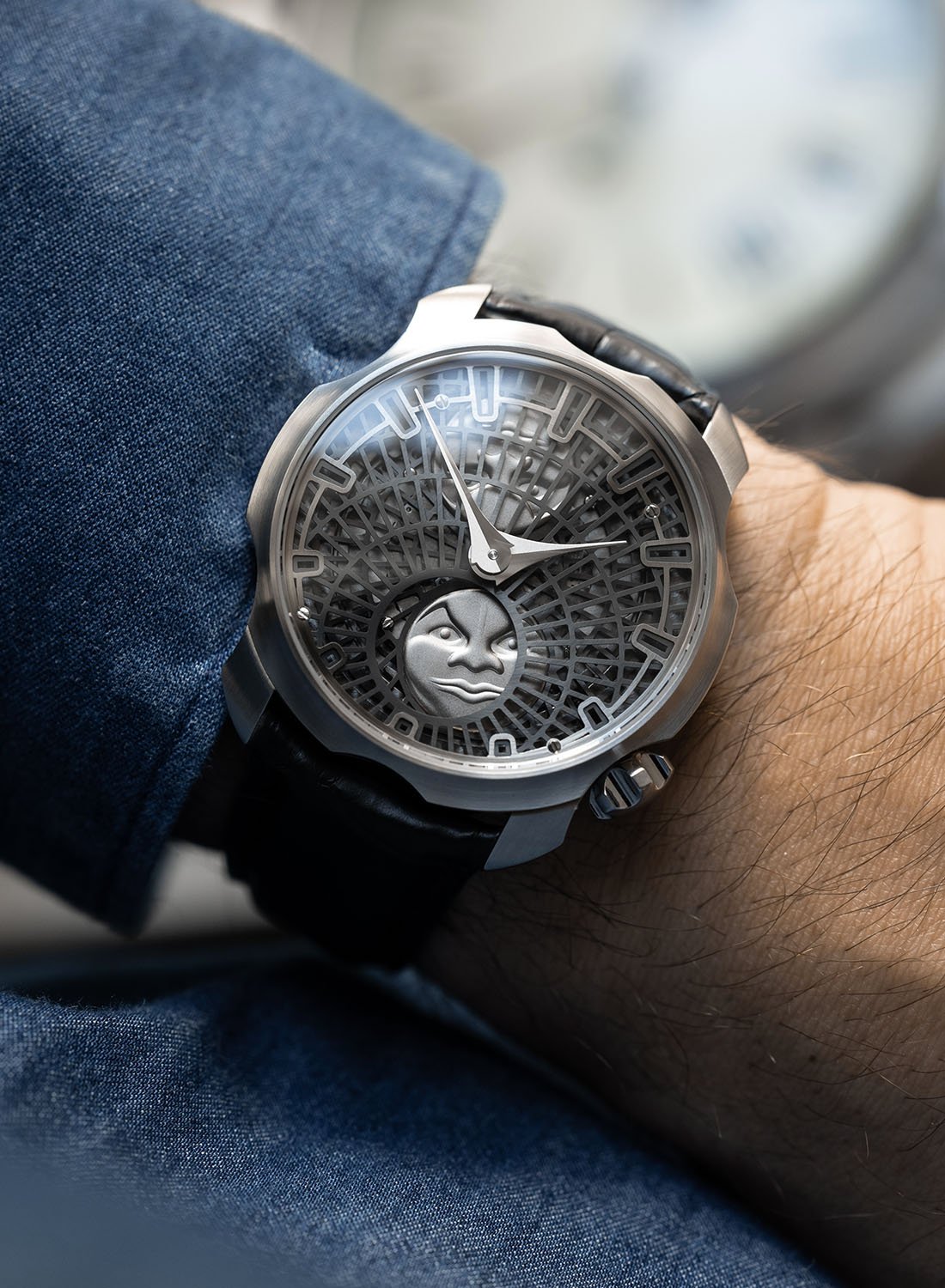
The case has a distinctive shape — a rounded octagon that Sarpaneva calls the “Korona” design, inspired by a crown. The lugs are sculpted and curve downward, making the watch sit comfortably on the wrist. The crown is signed with the Sarpaneva “S” and is easy to grip.
Wrist Feel and Wearability
On the wrist, the Supermoon is a presence. The 42mm diameter is modern, but the case design makes it wear larger. The short, curved lugs help it hug the wrist, though those with sub-6.5-inch wrists might find it slightly overbearing. The weight is substantial — around 150 grams — but it’s balanced, and the leather strap is supple from the start. The pin buckle is simple, but it does the job.
What really stands out is the dial. The moon disc dominates, taking up nearly the entire surface. It’s painted in a matte finish with craters and a face that seems to change expression depending on the light. At night, the lume on the hands and markers glows a cool blue, while the moon itself isn’t lumed — a missed opportunity, but it keeps the moon realistic.
This is not a watch you’ll forget you’re wearing. It’s a conversation starter, and you’ll find yourself glancing at it just to see the moon’s mood. It’s perfect for a night out, a gallery opening, or a dinner where you want to stand out.
Accuracy and Performance
In our week of testing, the Supermoon gained about 10 seconds total, averaging +1.4 seconds per day — well within COSC standards, though it’s not certified. The moon phase is accurate to within one day per 57 years, so you can set it and forget it. The power reserve is 42 hours, which means if you take it off Friday night, it’ll still be running Sunday morning — barely. If you have a weekend rotation, you’ll need to wind it or wear it.
Occasions and Versatility
The Supermoon is not a diver or a sport watch. It’s a dressy-casual piece that works best in smart-casual settings. Pair it with a blazer and it elevates your look; wear it with a t-shirt and it adds a touch of art-school rebellion. It’s not for the gym or the pool, but for a night out or a creative meeting, it’s perfect.
Wrist Presence: 4/5
The moon face is the star. It’s not subtle, but it’s not obnoxious either. It’s the kind of watch that gets noticed, but the reaction is usually “Whoa, what is that?” rather than “Is that a Rolex?”. You’ll get questions, and you’ll enjoy answering them.
Reference Variants and Family
The Supermoon is available in a few dial and case configurations. The standard steel model (ref. SM-01) has a deep blue dial with a silver moon. The SM-02 features a black dial with a gold moon. There are also limited editions with different case materials, such as titanium or bronze, but those are rarer. Within the Sarpaneva family, you’ll find the Korona (a simpler three-hander) and the Polaris (a GMT), but the Supermoon is the one that defines the brand.
Similar Watches and Alternatives
If you’re looking for a moon phase with more traditional styling, consider the Jaeger-LeCoultre Master Ultra Thin Moon or the Zenith El Primero Chronomaster Moonphase. Both are excellent, but they lack the whimsy of the Supermoon. For a budget alternative, the Orient Sun & Moon offers a day/night indicator but doesn’t have the same artistic flair.
Investment Value
The Supermoon has an MSRP of $15,000, and it holds its value well on the secondary market, where pre-owned examples typically sell between $12,000 and $18,000. The trend is stable, with no major appreciation as of yet, but as Sarpaneva’s reputation grows, limited pieces could become collectible. It’s not a quick flip, but a long-term keeper for someone who appreciates independent watchmaking.
Service and Maintenance
Like most mechanical watches, the Supermoon should be serviced every 5 years. The cost is around $800, and while any competent watchmaker can service the base movement, the moon phase module is best handled by Sarpaneva’s workshop in Helsinki to ensure proper calibration. The brand offers international service through its website.
Pros and Cons
- Pros: Unique moon phase design, excellent build quality, strong accuracy, exclusive production.
- Cons: Modest power reserve, low water resistance, thin resale market, the face may not be to everyone’s taste.
Final Verdict
The Sarpaneva Supermoon is not just a watch; it’s a piece of wearable art. It challenges the status quo of what a moon phase should be, and it does so with undeniable craftsmanship. If you’re a collector who values originality over brand recognition, this is a must-have. It’s a watch that will make you smile every time you glance at your wrist — and that’s worth more than any price tag.