Introduction: The Case for Letting a Watch Get Old
Most luxury watches are engineered to resist time. The Schofield Bronze Beater is engineered to record it. Where a stainless-steel dive watch shrugs off scratches and a gold dress watch demands a soft cloth and a quiet room, the Bronze Beater arrives with the explicit expectation that you will wear it hard, sweat on it, swim in it, knock it against doorframes, and let the case do what bronze does: oxidise, darken, streak, and settle into a patina that belongs to nobody else.
That is a design brief, not an accident. Schofield Watch Company, the British outfit founded by Giles Ellis in 2011, has spent more than a decade building watches that sit deliberately outside the Swiss luxury playbook. They are produced in small numbers, sold largely direct, and finished with an emphasis on legibility, honesty of materials, and a kind of industrial poetry that reads more Sussex workshop than Geneva salon.
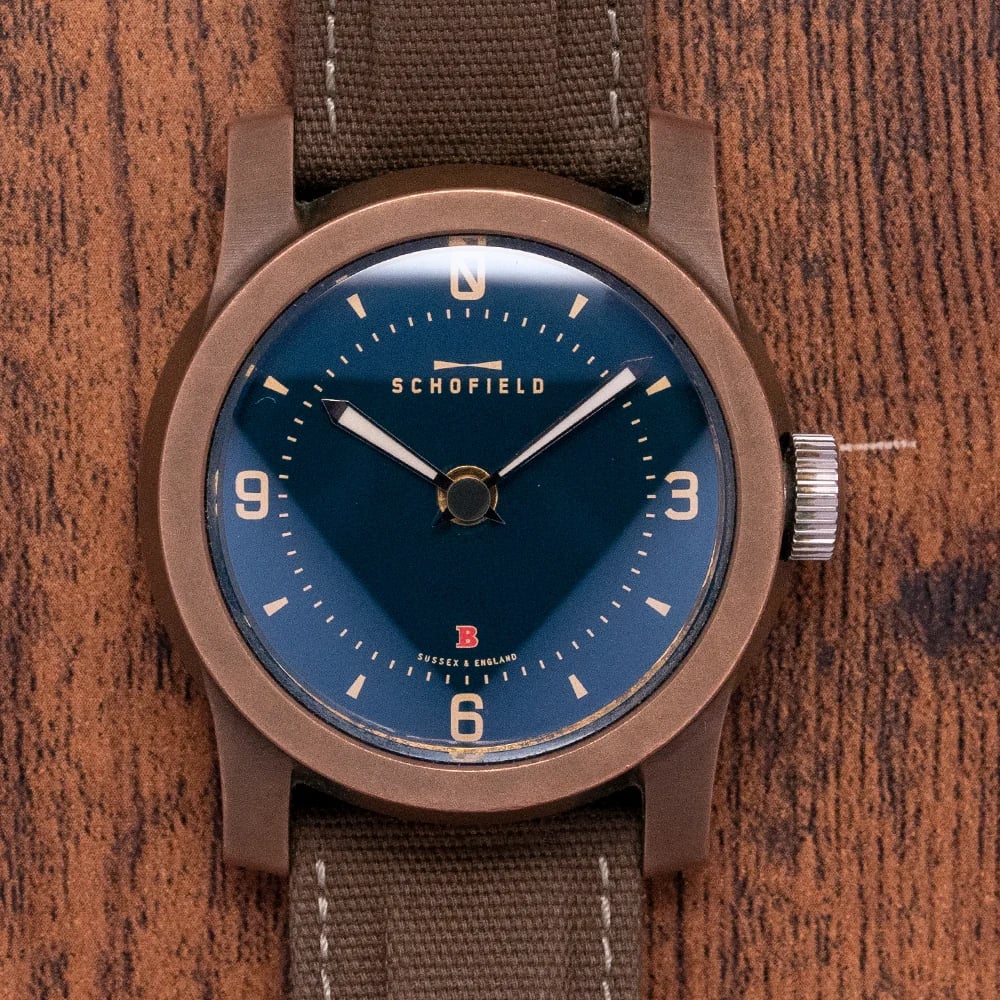
The Bronze Beater, reference BBB3, is the most literal expression of that philosophy. It is a tool watch in bronze — a material softer than steel, warmer in tone, and chemically alive. This review covers what it is, how it wears, what powers it, and whether it deserves a place in a young collector's rotation.
Schofield Watch Company: A Short History
Schofield was founded in 2011 in Sussex, England, by Giles Ellis, a designer who came to watchmaking from outside the industry and brought with him a set of priorities that were distinctly un-Swiss. Where the established houses trade on century-old archives and heritage references, Schofield built its identity on clarity of concept: watches with strong, readable dials, unusual typography, and cases that feel engineered rather than decorated.
The brand's catalogue reads like a series of design studies rather than a product ladder. The Signalman established the house style — a large, legible dial with a distinctive handset and a case built around the wearer's field of view. The Ten Past Ten and the Daymark explored different expressions of the same philosophy, and the Obscura pushed further into experimental territory.
The Beater is Schofield's tool watch, and it is the model that most directly answers the question of what a British field-and-dive instrument should look like in the twenty-first century. It is deliberately unglamorous in concept and quietly confident in execution. The bronze version, the BBB3 under review here, takes that logic one step further: it is a watch whose appearance is not fixed at the factory but is completed by the owner.
Schofield sells largely direct to collectors rather than through a traditional authorised-dealer network, which keeps production volumes low and prices comparatively honest. That direct relationship also means servicing and support run through the brand itself, a detail worth remembering when you consider ownership.
Case and Design
The defining feature of the Bronze Beater is, obviously, the bronze. Bronze is an alloy of copper, and copper is chemically reactive. Exposed to air, moisture, salt, and the oils of human skin, it forms a surface layer of oxides and carbonates that darkens and shifts in tone over time. On a watch case, this produces a finish that is never uniform: the high points of the lugs and bezel stay brighter from contact and abrasion, while the recesses and flanks darken into a deep, warm brown-black.
Schofield does not lacquer the case to freeze this process. That is a deliberate choice. A lacquered bronze watch stays a single colour indefinitely; an unlacquered one becomes a record of where you have been and what you have done with it. Within weeks, the BBB3 stops looking like a new object and starts looking like a used one — and for the intended buyer, that is the entire point.
The trade-off is real. Bronze is softer than stainless steel, so the case picks up small dings and micro-dents more readily. Owners who treat their watches as fragile collectibles will find this distressing; owners who treat them as tools will find it charming. There is no middle ground here, and Schofield is not pretending otherwise.
The crystal is sapphire, which is the correct call for a watch intended to be worn without anxiety. Sapphire's hardness means the window into the dial stays clear even as the case around it accumulates character, and the contrast between a pristine crystal and a patinated case is part of the watch's visual appeal.
Legibility is a Schofield hallmark, and the Bronze Beater follows the house line. The dial is dark, the hands are broad and clearly differentiated, and the markers are treated with Super-LumiNova for low-light visibility. There is no decorative clutter and no attempt at vintage pastiche — the design is contemporary and functional rather than nostalgic.
The Movement
Inside the Bronze Beater sits a Swiss automatic, and Schofield's Beater line has been associated with the Sellita SW200-1 family. This is a sensible, well-understood calibre: a unidirectional-winding automatic with a hacking seconds hand, running at 28,800 vibrations per hour, or four hertz, and offering a power reserve of approximately thirty-eight hours.
The SW200-1 is not a glamorous movement, and Schofield does not pretend that it is. It is a workhorse ébauche that has powered an enormous number of mid-market Swiss watches, and its virtues are exactly the ones that matter in a tool watch: it is reliable, it is accurate enough for daily use, it is easy for a competent watchmaker to service, and spare parts are widely available.
Finishing is functional rather than decorative. You will not find hand-bevelled bridges or Geneva stripes here, and the movement is not chronometer-certified. What you will find is a calibre that does its job without drama, which is precisely what a watch like this should prioritise.
The Bronze Beater does not carry a date or any other complication. That is a design decision worth respecting in an era when dials are routinely cluttered with information the wearer rarely needs. A clean, symmetrical dial is easier to read at a glance, and it suits the watch's tool-watch identity.
On the Wrist
The Bronze Beater wears like a purpose-built object rather than a piece of jewellery. Bronze is denser and warmer against the skin than steel, and the case communicates its presence immediately — there is no pretending this is a discreet watch. Because the material is softer than stainless steel, the case edges and lugs pick up small dings and micro-dents as you live with it, which is exactly the intended behaviour.
The strap pairing matters enormously. A supple leather strap keeps the watch anchored and stops it from rotating on the wrist, and the pin buckle is simple, light, and easy to adjust. Leather also develops its own patina alongside the bronze, which reinforces the sense that the whole object is ageing as a single unit rather than as a collection of separate parts.
Balance is the watch's strongest wearable virtue. Schofield designs its Beater cases around legibility and tool-watch ergonomics rather than slimness, so the head sits confidently on the wrist without feeling top-heavy. The bronze patina develops unevenly at first — darker in the crevices, brighter on the high points — and within a few weeks the watch stops looking new and starts looking like yours.
Collectors who cannot tolerate a case that changes appearance should look elsewhere. Everyone else will find the experience oddly addictive. There is a particular pleasure in glancing down and noticing that the bronze has darkened a shade since last month, or that a new streak has appeared along the flank of the case after a day at the coast.
Accuracy in Daily Use
A Swiss automatic of the Sellita SW200-1 family, when properly regulated, will typically run within roughly minus ten to plus fifteen seconds per day in real-world use, and often considerably better than that if the watch has been adjusted at assembly. Expect the rate to shift slightly as the mainspring winds down and as the watch moves between wrist and drawer.
The Bronze Beater is not a chronometer-certified piece and does not pretend to be one. It is a dependable daily timekeeper, and for most owners that is more than sufficient. If you need reference-grade precision, have it regulated by a watchmaker, and understand that positional variation and temperature will always move the needle a little.
One practical advantage of the automatic movement is that it removes the ritual of daily winding. Wear the watch regularly and it will keep running; leave it in a drawer for a couple of days and it will stop, at which point a few turns of the crown and a reset will have it running again. The hacking seconds hand makes setting the time to a reference signal straightforward.
Occasions: Where It Belongs
The Bronze Beater is not a formal watch and does not want to be. It belongs in the categories where a tool watch makes sense: sport, daily wear, and travel. With a leather strap it reads as a rugged casual piece that works with denim, knitwear, and field jackets. On a weekend away it is the watch you do not have to think about — it takes a knock, it gets wet, and it keeps going.
It is not the watch to wear with a tuxedo, and it is not the watch to wear to a board meeting where a slim gold dress watch would be more appropriate. That is not a limitation so much as a clarification of purpose. A collection works best when each watch has a defined role, and the Bronze Beater's role is the one where character matters more than polish.
Variants and the Beater Family
The BBB3 is the bronze-cased Beater, and its defining characteristic is the unlacquered bronze case that develops a personal patina over time. The rest of the Beater family follows the same design language — the legible dial, the robust case architecture, the Swiss automatic movement — but in stainless steel, which offers a more conventional ownership experience. A steel Beater stays the same colour it was on day one and resists dings and scratches more effectively, at the cost of the patina story.
Schofield's wider catalogue includes the Signalman, the Ten Past Ten, the Daymark, and the Obscura, each of which explores a different facet of the brand's design philosophy. Collectors who respond to the Bronze Beater's combination of legibility and material honesty will find the same instincts at work across the range.
Similar Watches and Homages
If you are shopping for a bronze tool watch, the Bronze Beater sits in a small but growing field. The Oris Divers Sixty-Five Bronze offers a vintage-inflected dive watch in a bronze case with a similar appetite for patina. The Tudor Black Bay Bronze is the benchmark of the category, with a larger presence and a considerably higher entry price. The Christopher Ward C60 Trident Bronze occupies a similar value-for-money position, and the Zodiac Super Sea Wolf Bronze appeals to collectors who want heritage colour and character.
At the other end of the market, homage brands have embraced bronze enthusiastically. The San Martin Bronze Diver captures the bronze-case, dark-dial formula at a fraction of the price, though finishing and movement quality are a different tier. The Steeldive Bronze Diver is an entry-level option for buyers who want to test whether they actually enjoy living with patina before committing real money. Neither will match the Schofield's design conviction or its British small-batch character, but both are reasonable ways to explore the material.
Value, Investment, and Service
Schofield sells largely direct to collectors rather than through a traditional dealer network, and pricing varies by market and configuration, so the Bronze Beater should be understood as an approximately four-figure purchase rather than a fixed number. For that money you get a Swiss automatic movement, a sapphire crystal, a bronze case, and a design language that is genuinely difficult to find elsewhere.
This is not an investment watch, and Schofield would be the first to say so. Small-batch British independents trade on affection rather than on auction momentum, and a patinated bronze case is inherently a personal object rather than a pristine collectible. Secondary-market liquidity is limited compared with mainstream Swiss brands, and there is no meaningful auction history to point to.
Buy this watch to wear it. Treat it as a long-term companion, accept that it will accumulate marks and colour, and the value question largely answers itself. If you are looking for an asset that appreciates in a safe, the Bronze Beater is the wrong instrument.
Servicing runs through Schofield's own UK operation. Because the brand sells direct, owners should contact Schofield directly rather than relying on a general watchmaker. Swiss automatics of this class generally benefit from a service every five to seven years, or sooner if the rate drifts noticeably. The movement's ubiquity means parts and expertise are not a problem, but the case material and the brand's small scale mean the authorised route is the sensible one.
Pros and Cons
Pros:
- The unlacquered bronze case develops a genuinely personal patina that no other owner can replicate.
- A distinctive British industrial design language that avoids heritage pastiche.
- A legible, purpose-built tool-watch layout with strong low-light visibility.
- A reliable Swiss automatic movement that is straightforward to service.
- Small-batch production and direct sales keep it off every other wrist.
Cons:
- Bronze patina is unpredictable and will not appeal to collectors who want a watch to stay pristine.
- The softer-than-steel case is prone to dings and micro-dents with hard wear.
- No chronometer certification and no in-house calibre.
- Limited secondary-market liquidity compared with mainstream Swiss brands.
- Servicing requires going through Schofield rather than a local watchmaker.
Final Verdict
The Schofield Bronze Beater is not trying to be a universal watch, and that is its greatest strength. It is a British tool watch built around a living material, powered by a dependable Swiss automatic, and designed for someone who wants their watch to look different in five years than it did on day one.
Buy it if you want character and are comfortable with a case that records your life in oxide. Skip it if you want a safe, static object. For the young collector building a rotation around personality rather than prestige, the BBB3 makes a persuasive case for itself.