The Microbrand Math
There are roughly four hundred microbrands fighting for wrist space right now, and maybe six of them will still be shipping watches in 2035. Schofield Watch Company is one of the six. Founded in Sussex, England, in 2011 by designer Giles Ellis, the brand has spent more than a decade doing the unglamorous work: building small batches of genuinely idiosyncratic watches for people who care more about how a dial reads at dusk than about what the man next to them at the bar thinks of their wrist.
The Skeptiko Sightings is a special-edition treatment of the brand's Skeptiko line — a watch built around the idea that a tool watch should be legible, honest, and slightly strange. It is not a hype piece. It will never appear in a documentary about waitlists, and no one is going to pay a five-figure premium for one at a Phillips evening sale. What it will do is hold value better than almost anything else at its price point, because Schofield makes very few watches and the people who buy them tend not to sell them.
That is the entire investment thesis in one sentence. Now the watch.
Schofield: A Decade of British Oddness
Giles Ellis did not come to watchmaking through the traditional route. He came from branding and industrial design, which explains almost everything about Schofield: the willingness to make a dial that looks like nothing else on the market, the refusal to chase trends, and the direct-to-consumer model that keeps the price honest and the production numbers low.
The brand's early reputation was built on the Signalman, a watch that announced Schofield's core thesis — that a modern tool watch could be designed in Britain, assembled in small numbers, and still feel like a serious instrument. The Beater, Tenby, Daymark and Obscura followed, each one extending the same visual grammar: wide, bezel-free cases, high-contrast dials, and lume that punches well above the price bracket.
Production runs are measured in the low hundreds. That is the single most important fact for anyone thinking about this brand as an asset. When a manufacturer makes 400 watches and 380 of them are owned by people who bought them to wear, the secondary market is not a market at all — it is a trickle. Prices do not spike, because there is nothing to speculate on. Prices also do not collapse, because there is nothing to dump.
The Skeptiko Sightings: Design and Concept
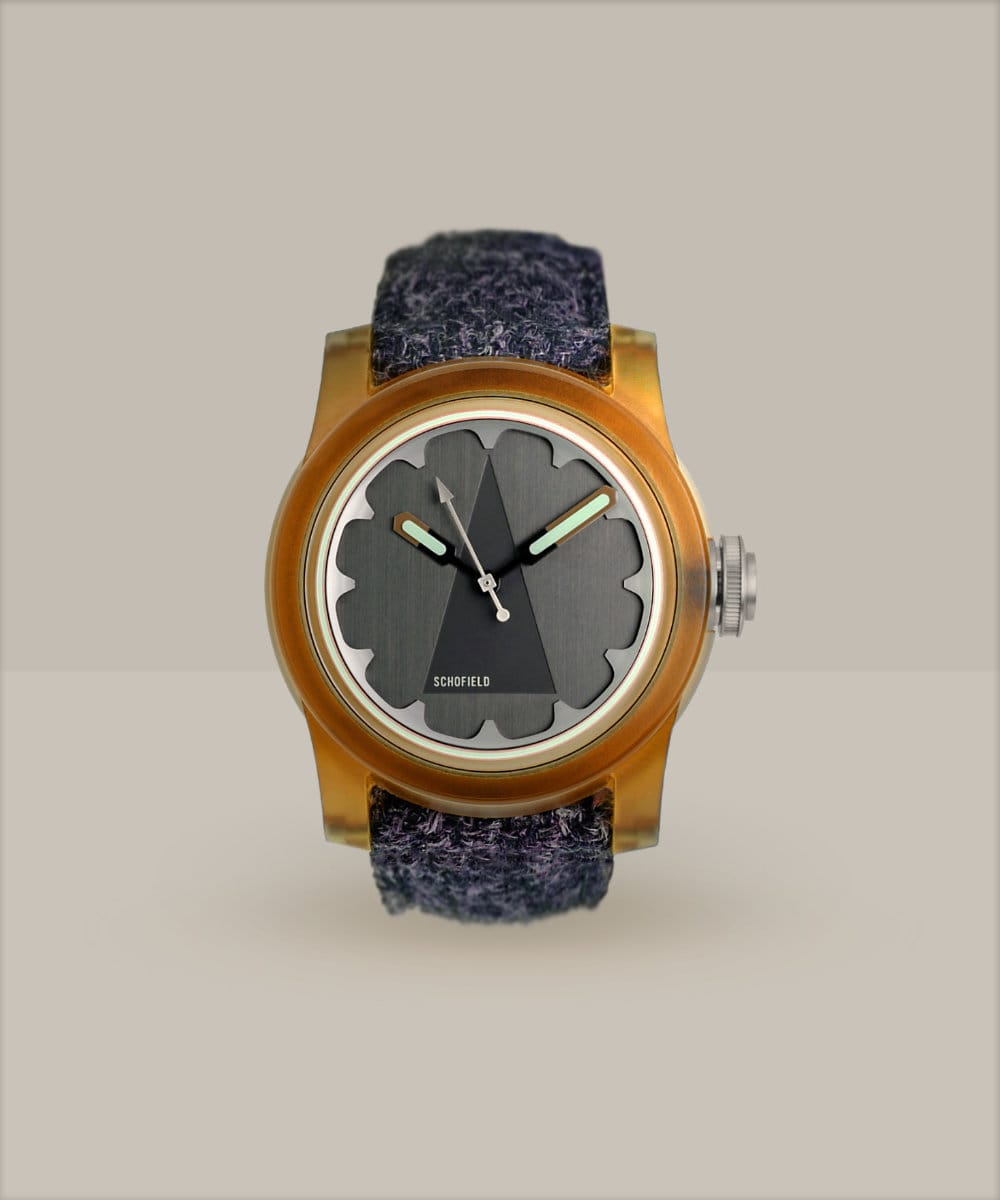
The name is a tell. Schofield has always had a rationalist streak, and the Skeptiko line leans into it — a watch for people who want evidence rather than marketing. The Sightings edition takes that idea and pushes the dial treatment into the brand's signature territory: maximum contrast, maximum legibility, lume applied in layers rather than as an afterthought.
In the metal, the effect is closer to an instrument panel than to a dress watch. The dial fills the aperture edge to edge, with no wasted real estate and no cosmetic clutter. There is no date window to break the symmetry and no subdial to complicate the read. It is a time-only watch, and it is unapologetic about it.
The case is stainless steel, the crystal is sapphire, and the whole thing is mounted on a leather strap with a pin buckle. It is a deliberately simple specification sheet, and that simplicity is the point. Schofield is not selling you complications. It is selling you a design object that happens to tell time.
The Movement: Workhorse, Not Showpiece
Schofield does not publish a specific caliber designation for this reference, and anyone who tells you otherwise is guessing. What is clear is the category: a Swiss automatic on an ETA or Sellita base, running at the standard 28,800 vph, with a power reserve in the high-30s to low-40s hours — the family-typical figure for this class of movement.
This is not a flex, and Schofield has never pretended it is. There is no in-house calibre, no COSC certificate, no METAS master-chronometer bragging rights. What there is, instead, is something arguably more useful to a young collector: a movement that any competent independent watchmaker can service without ordering parts from a Swiss fortress or waiting six months for a factory slot.
That matters more than it sounds. The hidden cost of an in-house movement is not the purchase price — it is the decade of ownership that follows. A watch with an off-the-shelf Swiss automatic is a watch you can actually own, as opposed to a watch you have to manage.
On the Wrist
Schofield does not build shrinking violets. The Skeptiko Sightings sits in the brand's established idiom — a substantial stainless case with a wide, flat, bezel-free top and a dial that fills the aperture edge to edge. That combination reads larger on the wrist than the numbers alone would suggest, and it gives the watch a planted, almost instrument-panel quality. It is not a watch you forget you are wearing; it is a watch you notice, in the good way, every time you glance down.
Balance is the surprise. Despite the visual mass, the case is short enough front-to-back that it does not tip off the wrist, and the strap pairing does most of the comfort work — a supple leather with enough taper to keep the head from sliding. Wear it snug and it disappears into a day; wear it loose and it becomes a paperweight. Sizing matters more here than on a softly proportioned dress watch, so budget five minutes with a spring-bar tool.
Presence is the trade-off. This is a four-out-of-five wrist presence watch: it dominates a casual outfit and looks slightly self-conscious under a tuxedo cuff. If you want a one-watch collection that covers a black-tie wedding, this is not it. If you want a daily driver with personality, it absolutely is.
Accuracy and Daily Life
Real-world accuracy from a Swiss automatic at this level lands where you would expect: roughly -5 to +10 seconds per day out of the box, tightening to around ±5 spd after a proper regulation and a few weeks of settling. There is no chronometer certification here, and Schofield has never claimed otherwise.
If you are the sort of collector who times a watch against an atomic clock app, get it regulated by a competent independent and forget about it. If you are the sort who sets it twice a month, you will never think about it again. The watch is designed for the second kind of owner.
Occasions: Where It Belongs
This is a daily, sport and travel watch. It is at its best with denim, a field jacket, or an airport lounge at 6am. It works with a casual suit if you have the confidence to ignore the rulebook. It does not work with black tie, and it does not pretend to.
The travel case is stronger than you might expect. Maximum legibility, strong lume, and a movement you can set in five seconds make it a genuinely practical companion, even without a GMT function.
Variants and Family
The Skeptiko Sightings is the special-edition dial treatment within the Skeptiko line. The core Skeptiko shares the same case architecture and movement family, which means the Sightings is a dial-and-execution story rather than a mechanical one.
Within the wider Schofield family, the Signalman, Beater, Tenby, Daymark and Obscura all occupy adjacent territory — the same design philosophy applied to slightly different briefs. Collectors who fall for the brand tend to end up owning two or three of them, which is precisely why so few come back to market.
Alternatives Worth Considering
If you want the same brief from Germany, the Sinn 556 I and the Damasko DS30 are the obvious answers — legible, over-built, under-marketed, and quietly appreciating. If you want the British establishment version, Bremont's S300 gives you more marketing and less scarcity. If you want a revived British name with genuine military lineage, Vertex's MPH is the closest cousin in spirit.
If you want an in-house movement at a comparable price, Nomos will sell you a Club 38 with a Glashütte calibre — but you will be buying Bauhaus, not British brutalism, and the two do not trade for each other.
At the bottom of the market, San Martin and Seiko will sell you the same visual grammar for a tenth of the price. They will not sell you the story, the scarcity, or the design authorship, and that is the entire point.
The Investment Case
Let us be precise, because this is where most microbrand coverage goes wrong. The Skeptiko Sightings is not an appreciating asset in the way a steel sports Rolex is an appreciating asset. It is a stable asset with structurally constrained supply and structurally thin demand.
MSRP sits around the $1,950 mark, and the pre-owned range runs roughly $1,400 to $1,900 depending on condition, completeness and how motivated the seller is. That is a modest, orderly discount — not the 40 percent haircut you see on mass-produced microbrands, and not the speculative premium you see on hype releases.
There is no meaningful auction history. That sounds like a negative, and in a pure investment context it is. But it is also the reason the price is stable: there is no speculative froth to deflate when the hype cycle turns.
The hold-versus-flip answer is straightforward. Hold. Flipping requires liquidity, and liquidity is exactly what this watch does not have. If you buy it and sell it within six months, you will lose money to friction. If you buy it and wear it for five years, you will own a watch that has quietly held its value while everything around it depreciated — and you will have actually enjoyed owning it.
Service and Ownership
Schofield services through the brand in the UK, but because the movement is an off-the-shelf Swiss automatic, any competent independent watchmaker can handle a routine service without drama. That is a genuine ownership advantage over in-house exotica, and it is one of the reasons Schofield owners tend to keep their watches rather than churn them.
Budget for a routine service on a standard five-to-seven-year cadence, and treat the watch like what it is: a mechanical instrument that benefits from occasional attention and otherwise asks for nothing.
Pros and Cons
Pros: genuine scarcity from small production runs; a distinctive British design language you will not confuse with anything Swiss; brand-signature lume that outperforms most of its price bracket; an off-the-shelf Swiss automatic that is easy and affordable to service; stable secondary pricing with essentially no speculative froth to deflate.
Cons: thin resale liquidity, meaning a quick sale costs you money; low brand recognition outside enthusiast circles; no COSC certification and no in-house movement to brag about; visual mass that makes it a poor fit for formal dress; and a brand that does not publish a full spec sheet, which will frustrate data-driven buyers.
Final Verdict
The Schofield Skeptiko Sightings is not an investment in the way a steel sports Rolex is an investment. It is an investment in taste, scarcity, and the quiet satisfaction of owning something a hundred other people own.
Buy it because you want to wear it, and the resale math quietly takes care of itself. Flip it, and you will discover that liquidity is the price of admission to obscurity. At this price, it is one of the more honest buys in the microbrand space — and honesty, in this market, is genuinely rare.