The Telemark brief
The Telemark is a field watch in spirit. That means legibility comes before decoration, the dial is meant to be read quickly, and the case is meant to survive ordinary life rather than sit in a safe. Schofield’s design language is not generic. The Telemark looks like a Schofield before you read the name on the dial, which is more than can be said for many independent watches that borrow too heavily from established references.
It is also a small-batch product. That matters for how you buy it, how you service it and how you think about value. You are not buying into a global network of boutiques and standardized references. You are buying a watch from a small British company with a distinct aesthetic and a limited production rhythm. That is part of the appeal, but it is also a practical consideration.
Brand context: small-batch Britain
Schofield Watch Company was founded in 2011 by Giles Ellis and is based in the United Kingdom. The brand made its name with models such as the Signalman, the GMT and the Beater, all of which share a certain robust, design-led approach. Schofield is not trying to be a heritage house with a century of archive material. It is a modern independent with a clear visual identity.
The Telemark fits that story neatly. It is a field-oriented watch from a brand that has always leaned toward utility rather than preciousness. That does not mean it is crude. It means the priorities are different: readability, character and a sense of purpose come before mirror polishing and delicate casework.
Case, dial and legibility
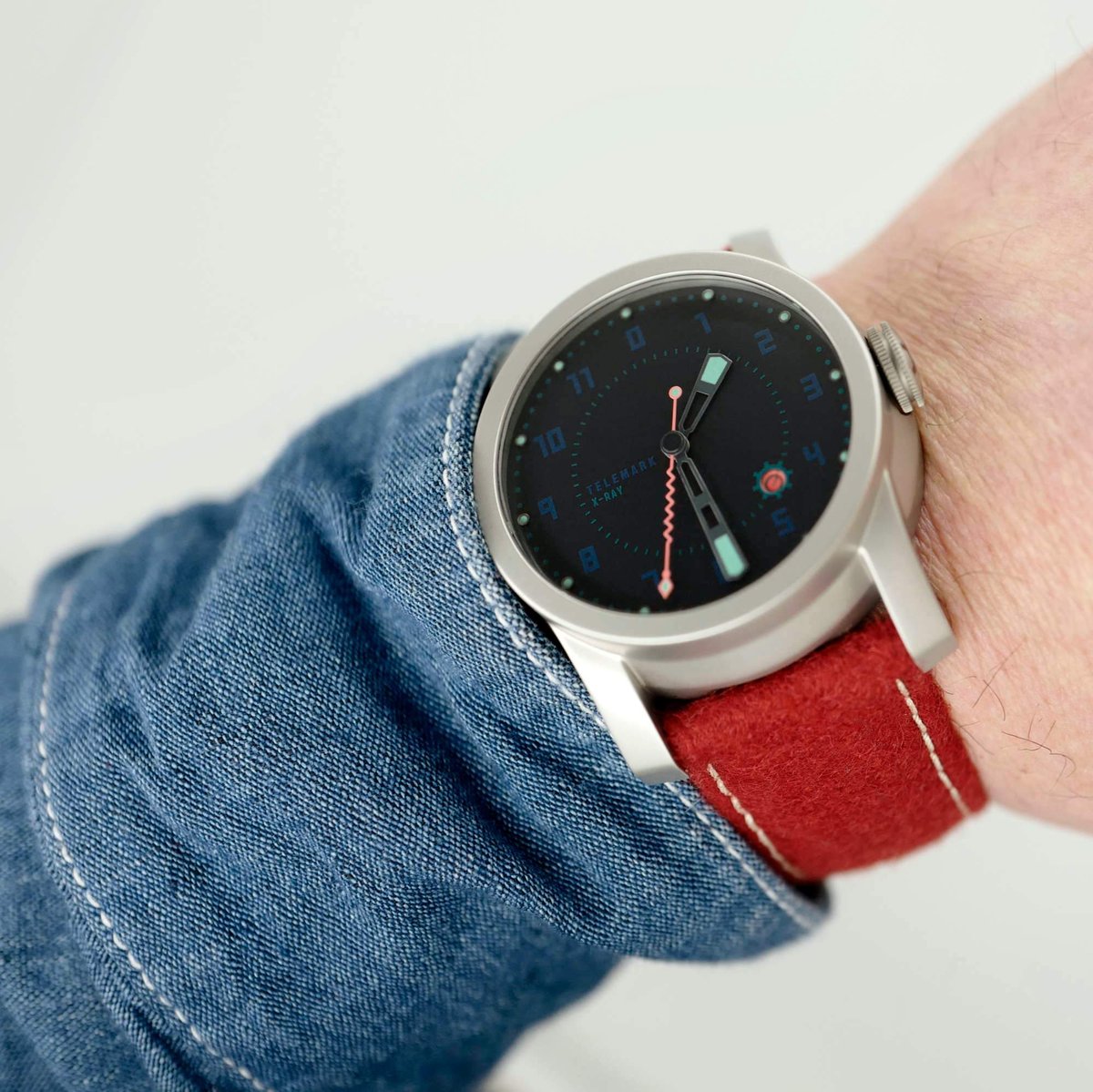
The case is stainless steel and the crystal is sapphire, which is exactly what you want in a watch intended for regular wear. The Telemark feels like a tool watch rather than a piece of jewelry. Its case shape gives it a solid, planted feel on the wrist, and the dial is arranged around quick reading rather than decorative symmetry.
Legibility is the Telemark’s strongest card. The dial is clean, the markers are easy to distinguish, and the hands are clear against the background. In low light, the Super-LumiNova does what it should. This is not a watch that requires you to squint or tilt it toward a window before you can tell the time. It is designed to be read at a glance, and it succeeds.
Water resistance is not the headline claim here, and I would not treat the Telemark as a dive watch. It is a field watch, and that is the right frame of reference. Wear it for daily life, travel, weekends and outdoor use, but do not confuse a purposeful design with a professional diving instrument.
On the wrist
The Telemark has the kind of wrist presence that comes from design confidence rather than from trying to be everything to everyone. It sits like a tool watch should: secure, purposeful and easy to read at a glance. The case is not trying to disappear under a shirt cuff, but the strap integration and balanced case shape keep it from feeling awkward in daily use. I found it most at home on a leather strap, where the watch head stays put and the whole package feels honest rather than precious.
Comfort over a week is good, provided you like a watch with some substance. This is not a delicate dress piece, and it does not pretend to be. The crown is easy to grip, the caseback sits comfortably enough for long days, and the watch does not demand constant fiddling. The real test is whether you forget you are wearing it between glances. The Telemark does not vanish on the wrist, but it settles into a pleasant, reassuring weight.
The pin-buckle leather strap suits the watch’s character. It is easy to adjust, easy to replace and appropriately casual. If you want to dress the Telemark up, a simple leather strap works better than a glossy bracelet. If you want to dress it down, a textile strap will make it feel even more field-oriented. The watch is versatile within its lane, but it is not a chameleon.
Lume and real-world readability
The Super-LumiNova application is one of the reasons the Telemark works so well as a daily watch. It charges quickly enough in normal light and remains useful in the dark. More importantly, the luminous elements are placed where they need to be: on the hands and at the hour markers. There is no confusion about where to look when you wake up in the middle of the night.
Readability in daylight is equally strong. The dial does not rely on high contrast alone; the shapes and proportions of the markers and hands do the heavy lifting. That is a subtle point, but it matters. A watch can have white-on-black contrast and still be hard to read if the design is cluttered. The Telemark avoids that trap.
Movement and accuracy
The Telemark is an automatic watch, and Schofield is an independent brand rather than a movement manufacturer. I have not treated unverified caliber numbers as fact for this review. What matters is that the movement is a conventional mechanical automatic, which means it behaves like one: it winds with wear, it can be hand-wound when needed, and it should be serviceable by a competent watchmaker.
With no COSC certification claimed, the Telemark should be judged as a modern mechanical daily wearer rather than a chronometer-certified instrument. Expect it to keep stable time in normal use, with variation depending on position, temperature and activity. I would not promise quartz-like precision, but the ownership experience is about consistency rather than chasing seconds. Wear it for a week, note the daily deviation, and adjust only if it drifts outside your own tolerance.
The lack of an in-house movement is not a problem at this level. Schofield’s value lies in design, small-batch production and the overall wear experience, not in vertical integration. A well-known automatic movement is also an advantage when service time comes, because it does not require a rare specialist to understand it.
Strap, clasp and daily handling
The leather strap and pin buckle are simple, practical and appropriate. There is no complicated clasp to fiddle with, no micro-adjustment system to learn, and no sharp edges waiting to catch on a sleeve. The pin buckle is the right choice for a field watch because it is easy to replace and easy to live with. If the strap wears out, you can change it yourself without needing a dealer.
Daily handling is pleasant. The crown offers enough grip to set the time without feeling oversized, and the watch does not demand special care beyond the usual common sense. It is the kind of watch you can put on in the morning and forget about until you need to read it. That sounds like a low bar, but it is actually the central requirement of a daily wearer.
Occasions and wrist presence
The Telemark is at its best as a daily watch, a travel companion and a weekend sport watch. It is not a formal dress watch, and it does not need to be. If you wear it with a suit, it will read as a deliberate casual choice rather than a traditional dress watch. That is fine, but it is worth being honest about the watch’s lane.
Wrist presence is strong. I would rate it four out of five: confident and distinctive without being absurdly flashy, but clearly a watch with a point of view. It does not look like a generic field watch from a catalog. That is a significant part of the appeal. If you want a watch that blends in completely, this is not it. If you want a watch that feels like it belongs to you, the Telemark has a better chance.
Variants, family and alternatives
Schofield has produced the Telemark in small batches, and detail changes should be verified with the individual seller. The core formula is a dark dial, a leather strap and a field-watch brief. Limited batches may vary in dial finish, strap choice and small aesthetic details. Because published information is not always consistent across runs, buying from a knowledgeable seller or directly from the brand is preferable.
Within the Schofield family, the Signalman, GMT and Beater are the obvious siblings. The Signalman established much of the brand’s visual language, the GMT adds travel functionality, and the Beater offers a more quartz-oriented utility proposition. The Telemark sits between them as a focused field watch with a strong independent character.
If you are comparing beyond Schofield, the Sinn 556 A and Damasko DS30 are natural alternatives for buyers who want German tool-watch engineering. The CWC GS Sapphire offers a British military-style field watch at a different price point, while the Hamilton Khaki Field Mechanical is the accessible entry point to the same legibility-first idea. The Unimatic U1 is a good comparison for buyers who value independent design and strong wrist presence over conventional restraint.
At the homage end of the market, the Timex Expedition Scout, Seiko 5 SNK809 and MWC G10 all capture pieces of the field-watch formula at much lower prices. They are not substitutes for the Schofield ownership experience, but they are useful reference points for anyone testing whether a field watch suits their daily routine.
Value, investment and service
Schofield’s pricing sits in the independent-luxury bracket, and exact figures vary by batch, currency and availability. I have not treated unverified retail numbers as fact. The more useful question is what the price buys: a small-volume British watch with a distinctive design, a legible dial and a genuine tool-watch character. That is a different proposition from buying a mass-produced luxury watch with a global service network.
The secondary market is thin. Limited production supports interest, but it also means price discovery is imperfect and buyers should not assume liquidity. The Telemark is best bought because you want to wear it, not because you expect it to appreciate. No major auction history is associated with the model, and that is unlikely to change in the near term.
Service should be arranged through Schofield or a competent independent watchmaker familiar with conventional Swiss-pattern automatic movements. Ask about parts availability before work begins. The watch does not require exotic care, but it does require someone who knows what they are doing. A specialist service network is part of the ownership reality of a small independent brand.
Pros and cons
The pros are clear: distinctive Schofield design, excellent legibility, strong lume, a comfortable strap-friendly field-watch format and the character that comes with low-volume independent production. The cons are equally clear: limited availability, a thin secondary market, a specialist service network and a design that is not trying to be a formal dress watch. Published technical data can also be inconsistent by batch, so verify details before buying.
Final verdict
The Schofield Telemark is a field watch with a real personality and a clear reason to exist. It is legible, comfortable in the right strap, and honest about being a small-batch British tool watch rather than a universal luxury compromise. If you want a daily wearer with independent character and can accept limited availability, it is easy to recommend on feel rather than on spec-sheet bragging rights.