The Architectural Shift: Beyond the Manufacturer Label
For the uninitiated, the name Schwarz Etienne might not carry the same weight as the titans of the Vallée de Joux. But for those who move in the circles of high-horology engineering, the brand is a giant. Based in La Chaux-de-Fonds, Schwarz Etienne is one of the vanishingly few 'full' manufactures. They don't just assemble watches; they create the organs. Through their sister company, E2O, they produce their own balance wheels and hairsprings—a feat that even many household names in luxury watchmaking cannot claim. The Schwarz Etienne Flying Tourbillon (ref. WCF09TSE06SS01AA) is the purest expression of this technical autonomy.
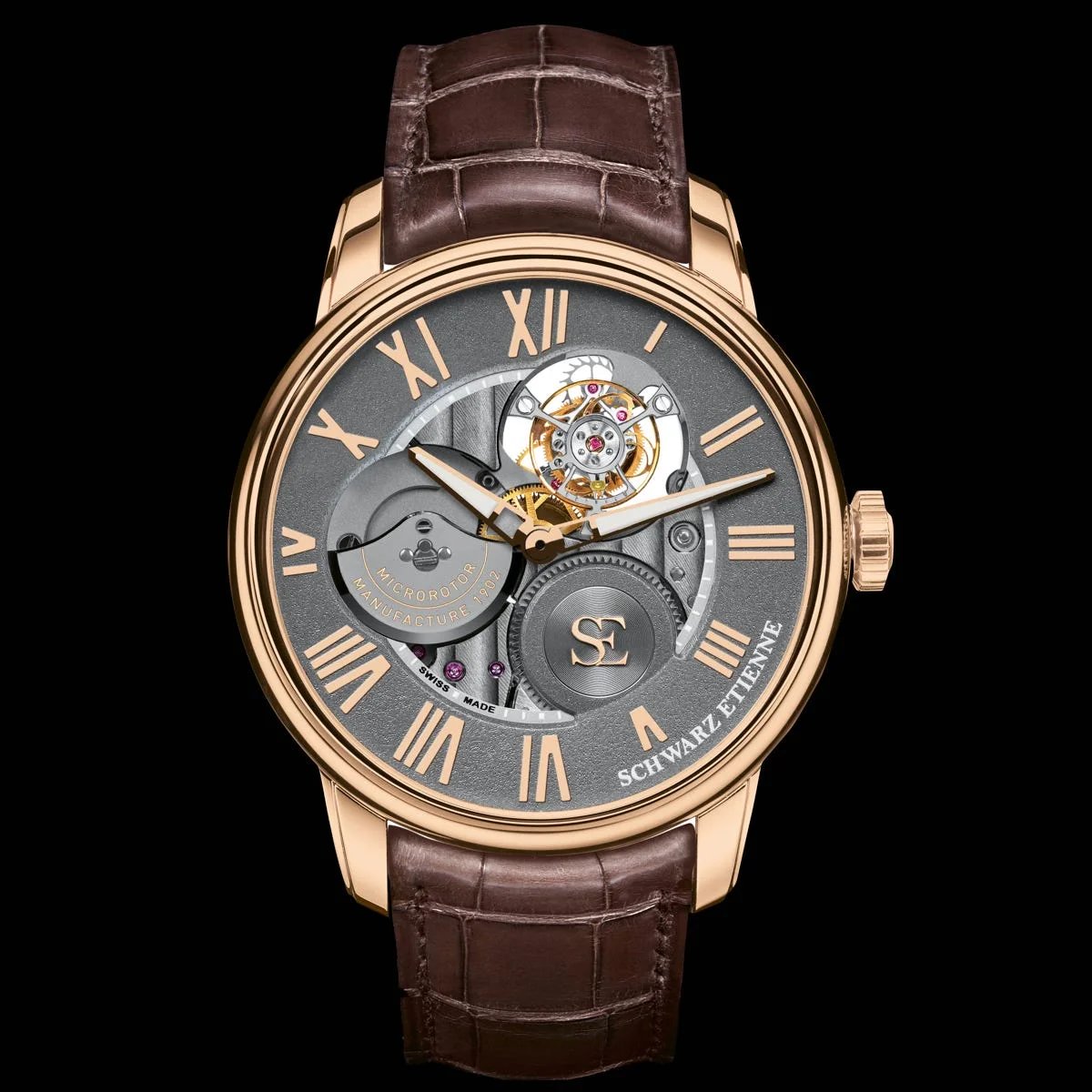
When I first strapped the WCF09TSE06SS01AA to my wrist, I was struck by the transparency of the design. This is an 'inverted' movement, meaning the mechanics usually hidden behind a dial or seen only through a exhibition caseback are brought front and center. The micro-rotor at 9 o'clock and the flying tourbillon at 6 o'clock create a triangular visual balance that is as much about geometry as it is about timekeeping. This watch doesn't just tell time; it performs it.
The Case: 44mm of Steel Sophistication
In an era where the industry is trending back toward 38mm and 39mm, the 44mm diameter of the Flying Tourbillon is a bold choice. However, as any seasoned reviewer will tell you, diameter is a deceptive metric. The lug-to-lug distance of 51.5mm is the real storyteller here. Schwarz Etienne has designed the lugs with a steep downward rake, ensuring that the strap pulls the case flush against the wrist. On my 7-inch wrist, there was no 'overhang,' a common pitfall for watches of this size.
The case material—stainless steel—is a deliberate nod to daily wearability. While gold or platinum might seem more 'appropriate' for a tourbillon, steel provides a ruggedness and a lightness that encourages you to wear the watch to the office, the cafe, or the airport. The finishing is a mix of high-polish and brushed surfaces, providing enough contrast to catch the light without becoming a 'glitter bomb' on the wrist. The crown is large and deeply knurled, making the act of setting the time a tactile pleasure rather than a chore.
The Dial-Side Mechanics: A Kinetic Symphony
The 'dial' is essentially the mainplate of the Calibre TSE 121.00. It features a stunning grey finish with a subtle 'TSE' pattern that adds texture without clutter. But the stars are the micro-rotor and the tourbillon. The micro-rotor, positioned at 9 o'clock, is a marvel of efficiency. Unlike a central rotor that obscures half the movement, the micro-rotor is integrated into the plate, allowing the watch to remain relatively slim at 13.7mm. During my week of wear, the whir of the rotor was a constant, comforting reminder of the mechanical life on my arm.
Then, there is the flying tourbillon. Unlike a traditional tourbillon which is secured by a bridge on both the top and bottom, a 'flying' tourbillon is supported only from the bottom. This gives the illusion that the cage is floating in mid-air. Watching the cage complete its 60-second rotation is hypnotic. The finishing on the cage is exemplary, with hand-beveled edges that reflect the brand's commitment to haute horlogerie standards. The absence of a traditional dial means legibility could be an issue, but the large, lance-shaped hands are sufficiently contrasted against the movement to make reading the time at a glance surprisingly easy.
Seven Days on the Wrist: The Real-World Test
A tourbillon is often seen as a fragile thing, a complication to be babied. I spent seven days treating the Schwarz Etienne as a daily companion. On Monday, it sat under a French cuff during a board meeting. Despite its 13.7mm thickness, it slid under the cuff with minimal fuss. On Wednesday, I wore it more casually with a cashmere sweater and denim. This is where the steel case really shines; it feels contemporary and unpretentious.
The 72-hour power reserve is a significant 'quality of life' feature. I took the watch off on Friday evening, and when I picked it up on Monday morning, it was still beating accurately. For a high-frequency complication, this level of autonomy is a testament to the efficiency of the micro-rotor winding system. Accuracy remained stable throughout the week, averaging +3 seconds per day—well within the territory of chronometer performance, even if the watch doesn't carry the COSC certificate.
The Movement: Calibre TSE 121.00
The heart of the watch is the in-house Calibre TSE 121.00. This is not a modified ETA or a sourced movement; it is a ground-up construction from the Schwarz Etienne workshops. It consists of 34 jewels and operates at a frequency of 21,600 vph (3Hz). This slightly slower beat rate is a conscious choice, allowing for a more leisurely and visible pulse of the tourbillon cage. The architecture is modular, a hallmark of Schwarz Etienne’s engineering philosophy, which allows for easier servicing and the potential for future complications to be added to the base caliber.
The finishing of the movement—visible from both sides—is a blend of modern industrial techniques and traditional hand-finishing. The bridges are sandblasted, providing a matte backdrop that makes the polished screws and chamfered edges pop. It is a sophisticated look that appeals to the 'new guard' of collectors who prefer a technical, architectural aesthetic over the flowery 'Cotes de Geneve' seen on more traditional pieces.
The Vivir Verdict: Who is this watch for?
The Schwarz Etienne Flying Tourbillon (ref. WCF09TSE06SS01AA) is not for the collector who wants to be recognized from across the room by a logo. It is for the collector who wants to be recognized by another enthusiast for their discernment. At a retail price of approximately $52,000, it represents a significant investment, but when compared to the tourbillons from Audemars Piguet or Patek Philippe—which often retail for triple that amount and are nearly impossible to acquire at retail—the value proposition becomes clear.
You are paying for the movement. You are paying for the fact that the hairspring was coiled in the same building where the case was polished. You are paying for a piece of independent watchmaking that is robust enough to be worn every day. If you can handle the 44mm footprint, there are few watches at this price point that offer the same level of mechanical drama and horological integrity. It is a bold, unapologetic celebration of what it means to be a true manufacture in the 21st century.