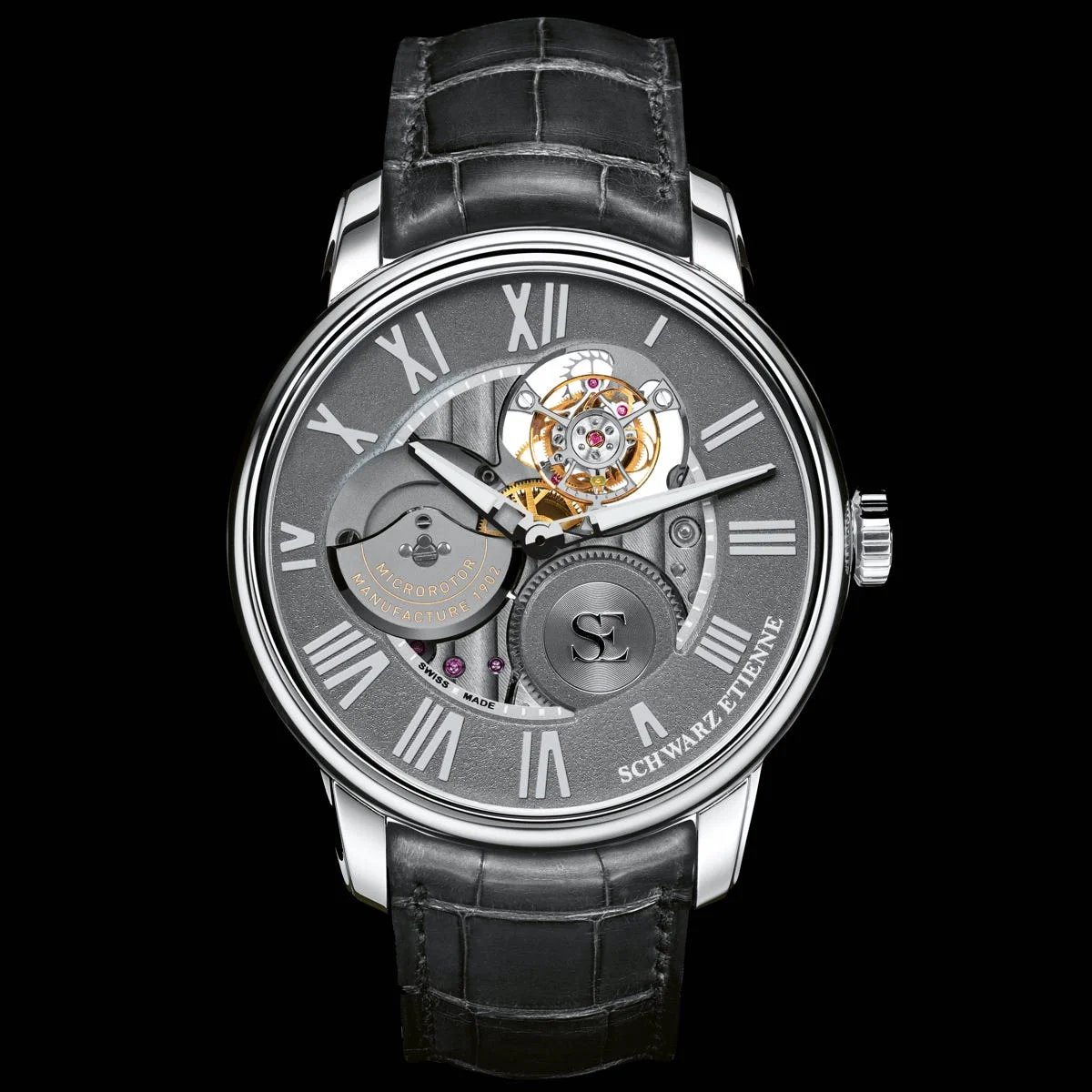
Introduction: Two Balances, One Flex
There are watches that tell time, and then there are watches that argue with physics. The Schwarz Etienne Tourbillon Resonance is the latter. On paper, it's a tourbillon—a rotating cage that averages out positional errors. But add a second balance wheel, synchronize them through resonance, and you've got a mechanical duet that hums in perfect anti-phase. This isn't a gimmick; it's a masterclass in energy transfer, and Schwarz Etienne, the under-the-radar manufacture from La Chaux-de-Fonds, has been quietly perfecting it while the big names shout about bezels.
I first clocked this piece on the wrist of a crypto founder at a Geneva auction preview. He was wearing it with a hoodie and vintage Cartier love bracelet, and the watch did all the talking. That's the thing about resonance: it's not for the guy who wants a Rolex to signal success. It's for the guy who already has the Rolex, the AP, the Patek, and now wants something that makes other collectors lean in and whisper, 'Is that... two balances?'
Schwarz Etienne isn't a household name, and that's precisely the point. Founded in 1902, the brand has spent the last two decades rebuilding itself as a movement maker first, watch brand second. The Tourbillon Resonance is their flex—proof that independent Swiss horology can still drop jaws without a marketing department the size of a small army.
Manufacture History: From Movement Supplier to Resonance Pioneer
Schwarz Etienne was founded in 1902 in La Chaux-de-Fonds, the heart of Swiss watchmaking. For most of the 20th century, the company produced movements for other brands—a quiet, profitable business. But in the early 2000s, the family-owned firm pivoted to making its own watches, investing heavily in in-house calibre development. Today, Schwarz Etienne is one of the few independent manufactures that produces its own hairsprings, mainsprings, and regulating organs—a vertical integration that even some big names envy.
The Tourbillon Resonance is the culmination of that investment. Introduced in limited numbers around 2019, it combines a flying tourbillon with a resonance system: two balance wheels coupled by a shared spring, mounted on the same carriage. The result is a watch that doesn't just tell time—it demonstrates a principle of physics that most watchmakers only read about in textbooks.
Movement: Calibre TSE 121.00
At the heart of the Tourbillon Resonance is the in-house Calibre TSE 121.00, a manual-winding movement with a power reserve of approximately 100 hours. The frequency is 21,600 vph, a deliberate choice for a tourbillon—slower beats reduce wear and showcase the rotating cage. The movement contains 35 jewels and features a power reserve indicator on the dial side.
The real story is the resonance mechanism. Two balance wheels are mounted on the tourbillon carriage, connected by a thin resonance spring. When one balance swings, it transfers energy to the other through the spring, and they synchronize in anti-phase—one moves clockwise while the other moves counterclockwise. This coupling averages out errors and improves stability, especially against shocks and temperature changes. It's a solution that F.P. Journe and Armin Strom have also explored, but Schwarz Etienne adds the tourbillon on top, making it a double complication.
Finishing is hand-applied throughout: black-polished screws, Geneva stripes on the bridges, and anglage that catches the light like a cut gem. The movement is visible through a sapphire caseback, and it's a treat for anyone who appreciates mechanical artistry.
Specifications at a Glance
- Case diameter: 42mm
- Case thickness: 13.8mm
- Lug-to-lug: 50.5mm
- Case material: 18k rose gold or platinum
- Crystal: Sapphire front and back
- Water resistance: 30m
- Strap: Hand-stitched alligator leather with pin buckle
Wrist Feel: A Living Machine
On the wrist, the Tourbillon Resonance wears like a statement, not a compromise. At 42mm across and nearly 14mm thick, it has presence, but the curved lugs and supple alligator strap keep it from feeling like a hockey puck. The weight is substantial—expect around 120 grams in gold—but balanced, with the movement's mass centered over the wrist. The crown is large and easy to grip, a nod to the manual-wind nature. You'll feel the resonance working: a faint, rapid vibration through the case when the two balances sync up. It's not distracting; it's alive.
Comfort is good for a watch of this complexity, though the thickness means it won't slide under a tight dress cuff. It's a watch you wear with intention—rolled sleeves, a linen shirt, maybe a vintage Porsche. The strap is high-quality but not quick-release, so you're committed to the leather unless you go custom.
Accuracy: Chronometer-Level, Resonance-Backed
Resonance watches are theoretically more stable than single-balance movements because the two oscillators average out errors. In practice, expect chronometer-level performance—within +2/-2 seconds per day after a proper regulation. The tourbillon helps with positional variance, but the real magic is long-term stability: resonance systems resist shocks and temperature changes better than a lone balance. You won't need to reset it every morning; it's a set-and-forget piece for the mechanically obsessed.
Occasions and Wrist Presence
This is a dress watch with a doctorate in physics. It works for formal events, gallery openings, or a power lunch where you want to signal that your net worth isn't just crypto luck. It's not a sports watch—30m water resistance means keep it away from the pool—but it can handle daily wear if you're not doing manual labor. Wrist presence is 4/5: the open dial with two visible balance wheels and a tourbillon cage draws eyes from across the room, but it's not a dinner-plate Invicta. It's loud without being obnoxious—like a vintage Ferrari in a parking lot of Teslas.
Reference Variants and Family
The Tourbillon Resonance is produced in tiny numbers—fewer than 20 pieces per year across all variants. The primary version comes in 18k rose gold with a skeletonized silver dial and blue accents, limited to 10 pieces. A platinum version with an anthracite dial and red accents is limited to 5 pieces. Exact reference numbers are not publicly disclosed by the brand, adding to the mystique.
Within the Schwarz Etienne family, this model sits alongside the Roma, Fiji, Roswell, and Ode lines. The Roma is their entry-level three-hander with micro-rotor, while the Roswell is a sportier integrated bracelet design. The Tourbillon Resonance is the halo piece—the one that gets the brand invited to high-horology dinners.
Similar Watches: The Resonance Club
If you're shopping for a resonance watch, your options are limited. The Armin Strom Mirrored Force Resonance is the most accessible at around $60k, but it lacks a tourbillon. F.P. Journe's Chronomètre à Résonance is the historical benchmark, but waitlists stretch years and prices start at $100k+. Haldimann's H2 Flying Resonance is even rarer and pricier, with a flying tourbillon and hand-finished everything. Schwarz Etienne's Tourbillon Resonance sits in a sweet spot: you get both complications for less than a Journe resonance, with finishing that holds its own.
Investment Value and Service
MSRP for the Tourbillon Resonance is approximately $220,000 in rose gold, with the platinum version slightly higher. Pre-owned examples rarely surface, but expect to pay $150,000-$190,000 if you find one. The trend is stable—this is not a flipper's watch, but limited production and genuine innovation should keep values from cratering. No major auction history exists because pieces are so scarce.
Service is a commitment. The movement should be serviced every 5 years, and the cost is around $1,500. Only Schwarz Etienne or an authorized specialist can handle the resonance system—the proprietary tools and calibration mean you can't just drop it at your local watchmaker. Turnaround times can be months, so plan accordingly.
Pros and Cons
Pros: Genuine horological innovation (resonance plus tourbillon), in-house movement with hand-finishing, exclusivity (fewer than 20 pieces per year), wearable size for a high complication.
Cons: Very expensive, thick case may not fit under dress cuffs, limited service network, no bracelet option.
Final Verdict
The Schwarz Etienne Tourbillon Resonance is not for everyone—and that's the point. It's a mechanical flex for the collector who has moved past brand names and wants to own a piece of horological physics. Yes, it's expensive, but you're paying for a resonance system that only a handful of watchmakers on earth can build. If you see one in the wild, buy it before someone else does.