The field GMT idea
Field watches were never meant to be precious. They were made to be read at a glance, carried into weather, and forgotten about until needed. GMT watches were born for pilots and travelers, adding a second time zone to the same practical brief. The Seiko 5 Sports Field GMT sits at the intersection: a tough, compact steel watch with a 24-hour hand and a bezel that tracks a second zone.
That combination is more useful than it sounds. A dive watch bezel counts minutes underwater. A GMT bezel counts hours in another city. For anyone who works across time zones, has family abroad, or simply travels a few times a year, the GMT hand earns its place. The Field GMT makes that function feel casual rather than corporate.
Seiko's long game
Seiko was founded in 1881 in Tokyo by Kintaro Hattori, and the company has been in the business of making watches for almost everyone for well over a century. The Seiko 5 line arrived in 1963 as a compact, affordable automatic with a day-date and a reputation for taking abuse. That democratic brief still defines the family.
The Field GMT extends the Seiko 5 Sports branch of that story. It is not a limited edition or a heritage reissue. It is a volume production watch built around a proven movement, and that is exactly why it matters. Seiko's ability to put an automatic GMT on thousands of wrists at an accessible price is the same ability that made the brand a gateway for generations of collectors.
Movement: Caliber 4R34
The SSK023 runs Seiko's Caliber 4R34, an automatic GMT with a date, 24 jewels, a 41-hour power reserve, and a beat rate of 21,600 vibrations per hour. It is an in-house Seiko movement, which is worth noting at this price. The architecture is familiar from the broader 4R family: robust, simple, and built for serviceability rather than decoration.
You will not find Geneva stripes or a display back here. The 4R34 is a working movement, and the caseback is solid. That is the right call. The GMT function adds a 24-hour hand and a bezel scale, while the date window keeps the dial practical. The power reserve is adequate for a daily wearer, though not generous by modern standards. If you rotate watches often, expect to reset it.
Case, crystal, and specs
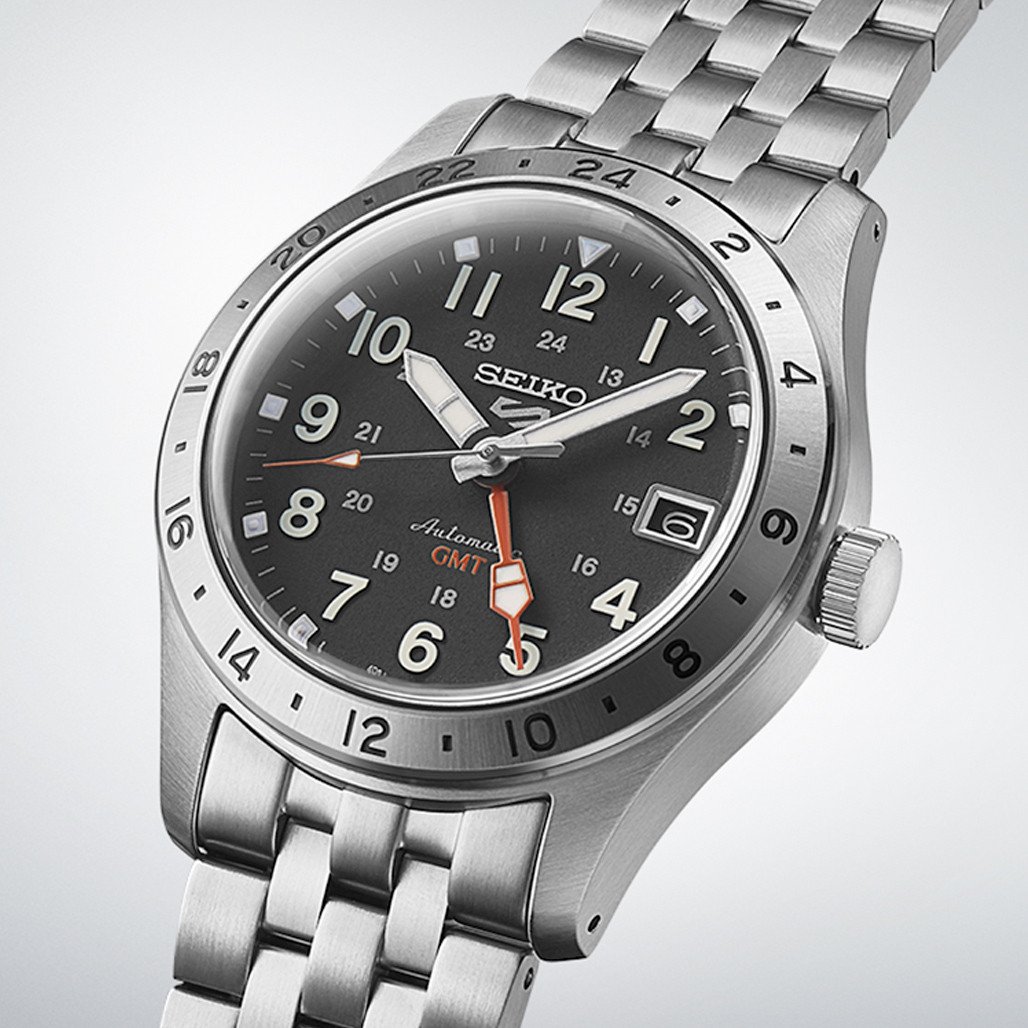
The SSK023 uses a stainless steel case measuring 39.4mm in diameter, 12.6mm thick, with a 47.2mm lug-to-lug. Those numbers matter. The Field GMT is not a chunky sports watch. It wears like a compact field watch, and the short lug-to-lug keeps it comfortable on smaller wrists. Water resistance is rated at 100m, which is enough for swimming, rain, and the accidental plunge.
The crystal is Hardlex, Seiko's mineral glass. It is not sapphire, and that is one of the clearest cost-cutting decisions in the package. Hardlex is more scratch-resistant than basic mineral glass, but it will pick up marks over time. The upside is that replacement is inexpensive. The dial is protected, the case is brushed and polished in the familiar Seiko 5 manner, and the watch feels more substantial than its price suggests.
Lume is Seiko's Lumibrite, applied to the hands and indices. It is not a torch, but it is legible in low light. The bracelet is stainless steel with a folding clasp. The clasp is functional rather than luxurious. There is no micro-adjust on the fly, and the bracelet is the first place you notice the price. A strap change solves most of that.
On the wrist
The first thing you notice is the balance. At 39.4mm wide and 12.6mm thick, the SSK023 sits close to the wrist without disappearing. The 47.2mm lug-to-lug is the quiet hero of the design. It keeps the watch from overhanging on a 6.5-inch wrist, and it makes the Field GMT feel more like a tool than a statement. The case has enough presence to read as a sports watch, but it does not crowd a cuff.
The bracelet is decent for the money. It articulates well, the links are solid enough, and the clasp holds. It is not a Grand Seiko bracelet, and it does not pretend to be. On a NATO or a leather strap, the watch becomes more casual and more comfortable. The field-watch shape makes it a natural on nylon. Weight is moderate. The watch feels planted without being heavy. The bezel is easy to grip, the crown is protected enough, and the dial is legible at a glance. The date window is small but usable. The GMT hand is distinct enough to track without confusing it with the hour hand. That sounds basic, but plenty of affordable GMTs get it wrong.
Accuracy and daily life
Seiko rates the 4R34 at -35 to +45 seconds per day. That is the official spec, and it is wide. In real-world use, many examples run closer, but you should not expect chronometer performance. This is a watch you wear, not a watch you time. If you need precise timekeeping, sync it once a week and move on.
The 41-hour power reserve means the watch will be stopped if you leave it off for a weekend. The date and GMT hand make setting it straightforward, but it is not a grab-and-go quartz. The reward is an automatic movement with a mechanical feel that quartz cannot match. For a first GMT or a travel watch, that trade-off is reasonable.
Dial and bezel
The SSK023's black dial is the most versatile version. The indices are applied and filled with Lumibrite, the hands are broad enough to read in motion, and the 24-hour scale is clear without shouting. The bezel is a 24-hour unit, which lets you track a third time zone if you set it carefully. The overall look is utilitarian, but not brutal. It has the same field-watch clarity that makes the Seiko 5 Sports Field line so easy to live with.
The black dial also hides the date window better than the lighter variants. If you want the GMT function to blend into a daily watch, this is the one. The green and beige versions are more characterful, but the black SSK023 is the easiest to wear with everything from a T-shirt to a chore coat.
Reference variants
The Field GMT family includes the SSK023 in black, the SSK025 in green, and the SSK027 in beige. All three share the same case, movement, and bracelet. The differences are dial and bezel color. The SSK023 is the most neutral. The SSK025 adds a military-green edge. The SSK027 is warmer and more vintage-leaning. If you already own a black-dial daily, the green or beige is the more interesting choice. If this is your only GMT, black is the safest.
Family and alternatives
Within the Seiko 5 Sports GMT family, the SSK001 and SSK003 are the dive-style siblings. They use the same 4R34 movement but sit in a larger, more aggressive case. The Field GMT is the more compact, more casual option. The non-GMT Seiko 5 Sports Field references, such as the SRPG27 and SRPG29, offer the same field-watch silhouette without the 24-hour hand. If you do not travel or track a second zone, those are worth a look.
Beyond the family, the Hamilton Khaki Field Mechanical is the obvious field-watch comparison. It has a more heritage-driven look and a hand-wound movement, but no GMT. The Christopher Ward C63 Sealander GMT is a more refined GMT at a higher price, with a better bracelet and sapphire. The Longines Spirit Zulu Time 39 is a true traveler's GMT with luxury finishing, but it costs several times as much. The Seiko sits below all of them and still delivers the core function.
Homage territory
The affordable GMT space is full of homages. The Pagani Design PD-1662 is a common entry point at around $150, offering a GMT-style look for less. The San Martin SN0116-GMT costs around $300 and generally brings better finishing and specs than the cheapest homages. Neither replaces the Seiko's in-house movement and brand support, but they show how crowded the value segment has become. The SSK023 wins on legitimacy, serviceability, and resale familiarity.
Investment and service
The SSK023 launched with an MSRP of $475 and remains a current retail model around that price. Pre-owned examples typically trade between $300 and $400, depending on condition and whether the bracelet is included. The trend is stable rather than appreciating. This is not a watch to flip. It is a watch to wear, and the depreciation flattens quickly because the entry price is already low.
There is no major auction history for the Seiko 5 Sports Field GMT. That is not a criticism. It is a mass-produced Seiko, and its value is in use, not scarcity. Service is straightforward. The 4R34 can be handled by Seiko or a reputable independent watchmaker, and you do not need to treat it like a fragile heirloom. Many owners run the movement until accuracy or function drifts, then service it. That is the correct attitude for a watch at this level.
Pros and cons
The pros are easy. You get a GMT complication at an entry price, a compact 39.4mm case, a comfortable 47.2mm lug-to-lug, 100m water resistance, and Seiko's proven automatic movement. The dial is legible, the Lumibrite is useful, and the watch looks at home on a trail or in a city. It is also a Seiko 5, which means parts and service are not exotic.
The cons are equally clear. The Hardlex crystal is not sapphire. The 4R34 is not tightly regulated. The bracelet clasp is basic, and the watch does not have the finishing of a $1,000 piece. Those are the trade-offs. At $475, they are acceptable. At $800, they would be harder to defend. The SSK023 knows exactly what it is.
Final verdict
The Seiko 5 Sports Field GMT SSK023 is one of the most sensible watches you can buy under $500. It takes a real complication, puts it in a compact field case, and does not ask you to baby it. It is not luxurious, and it is not an investment. It is a tool watch for people who actually travel, hike, and live in their watches.
If you want a first GMT, a grab-and-go automatic, or a watch that can handle a trip without a safe, the SSK023 is an easy recommendation. If you need sapphire, a tighter movement, or a more refined bracelet, save for the next tier. The Seiko 5 Sports Field GMT is the value play, and it earns its place on the wrist.