The Genesis of a Legend: Seiko's Dive Watch Heritage
Seiko's journey to horological prominence began in 1881, when Kintaro Hattori founded his company in Tokyo, Japan. From its humble beginnings, Seiko (then Seikosha) rapidly evolved into a powerhouse of innovation, consistently pushing the boundaries of watchmaking. By the mid-20th century, the brand had already cemented its reputation for producing robust, reliable, and technically advanced timepieces, challenging the established Swiss dominance with its own brand of precision and accessibility.
The 1960s marked a pivotal era for Seiko, as it ventured into specialized tool watches. The brand had already demonstrated its prowess with chronographs and dress watches, but the burgeoning demand for professional dive equipment presented a new frontier. It was against this backdrop of ambition and technical capability that the 62MAS was conceived, not merely as a fashion accessory, but as a serious instrument for professionals operating in the harsh underwater environment.
The Engineering Heart: Caliber 6217A
At the core of the Seiko 62MAS beats the in-house automatic Caliber 6217A. This movement, while not adorned with the elaborate finishing found in haute horlogerie, is a testament to Seiko's commitment to functional excellence. Operating at a leisurely 18,000 vibrations per hour (vph) and featuring 17 jewels, the 6217A was designed first and foremost for reliability and endurance. Its lower beat rate contributes to the movement's longevity, a critical attribute for a watch intended for professional use where robustness trumps microscopic precision.
The Cal. 6217A offers a power reserve of approximately 45 hours and features a date complication, making it a practical daily wearer even in its vintage form. Importantly, the movement is entirely in-house, a point of pride for Seiko and a factor that adds to the 62MAS's collector appeal. While it doesn't boast COSC certification – a standard Seiko largely eschewed for its tool watches in favor of its own rigorous internal testing – its performance was more than adequate for the demands of the mid-century diver. For collectors today, the serviceability of this movement by competent independent watchmakers is a significant advantage, ensuring the longevity and continued operation of these historical pieces.
Aesthetic & Ergonomic Brilliance: Specs and Wrist Feel
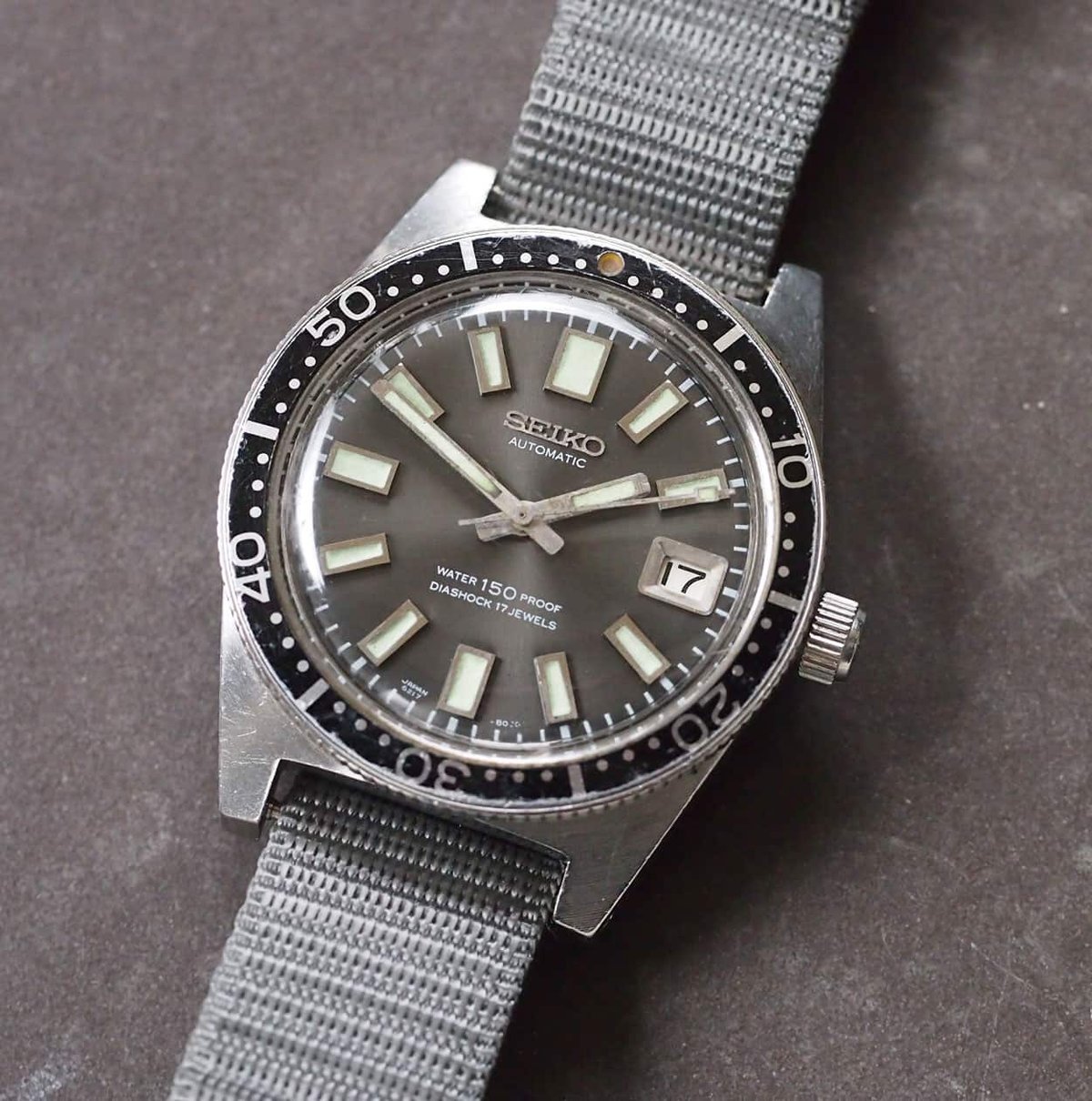
The Seiko 62MAS is instantly recognizable, and its design has been endlessly emulated for good reason. Crafted from stainless steel, its case measures a compact 37mm in diameter, with a lug-to-lug distance of 47mm and a thickness of 13.5mm. These dimensions, while modest by today's standards, were considered substantial for a diver of its era and contribute to its exceptional wearability. The case profile, with its sharp lines and distinctive crown at 3 o'clock, exudes a purposeful, no-nonsense aesthetic.
The watch was originally fitted with a Hardlex crystal, Seiko's proprietary hardened mineral glass, which offered superior scratch resistance compared to standard acrylic. However, over decades, even Hardlex can show signs of wear, and many vintage examples will exhibit character-adding scratches or have had replacement crystals. The unidirectional rotating bezel, a crucial safety feature for divers, features a black insert with a 60-minute scale, providing excellent legibility. Water resistance was rated at 150 meters, a significant achievement for 1965, positioning it firmly in the professional diver category.
Luminescence on the original 62MAS was provided by a radioactive material, likely tritium-based. For collectors, this means the luminous plots and hands will have aged, developing a unique patina that ranges from cream to deep orange, and will no longer glow in the dark. This degradation is a hallmark of authenticity and a cherished characteristic of true vintage pieces. The original strap was a distinctive 'waffle' pattern rubber strap, designed for secure wear over a wetsuit and adding to its tool-watch credentials. Many vintage examples will now be found on aftermarket straps, though finding an original in good condition significantly boosts desirability.
Despite its status as a professional dive instrument, the Seiko 62MAS wears with a surprising elegance and comfort. The 37mm case diameter, while modest by today's oversized standards, is perfectly proportioned, making it an exceptionally wearable vintage piece. Its relatively slim profile for a diver, combined with the gentle curvature of its lugs, allows it to sit snugly on the wrist without feeling cumbersome or top-heavy.
The original 'waffle' rubber strap, when present and in good condition, contributes significantly to its authentic vintage feel and comfortable wear. Even on modern NATO or tropic straps, the 62MAS maintains its balanced presence, proving that true ergonomic design transcends eras. For collectors accustomed to bulkier contemporary divers, the 62MAS offers a refreshing return to understated functionality and an almost forgotten sense of proportionate design. Its wrist presence, a solid 3 out of 5, is not about overt flash, but a quiet, confident assertion of its historical and horological significance – a subtle flex for the discerning.
Performance & Practicalities: Accuracy and Service
As a vintage timepiece, particularly one designed as a rugged tool watch from the 1960s, the real-world accuracy of a Seiko 62MAS can vary significantly depending on its service history and overall condition. When properly serviced, the Cal. 6217A movement is capable of running within acceptable vintage parameters, typically around +/- 20-30 seconds per day. However, it's crucial to understand that these watches were not engineered to meet modern COSC standards, nor should they be expected to. Day-to-day, a well-maintained example will offer reliable timekeeping, but collectors should anticipate periodic adjustments and factor in the inherent variability of a 50-year-old mechanical movement.
For optimal performance and longevity, a service interval of approximately 5 years is recommended for vintage mechanical watches like the 62MAS. The approximate cost for a full service on a 6217A movement typically runs around $400, depending on the watchmaker and any parts required. Fortunately, the 6217A is a relatively common and robust movement, meaning that competent independent watchmakers specializing in vintage Seiko timepieces can service it. This alleviates the need for potentially expensive and time-consuming authorized service, though finding original replacement parts for the case, bezel, or crystal can be a challenge.
The Investment Thesis: Value, Trend, and Hold Recommendation
For the sophisticated collector, the Seiko 62MAS represents a compelling investment opportunity within the vintage watch market. With an original MSRP that was undoubtedly modest in 1965 (and thus not comparable to today's market), its current pre-owned range of $4,000-$12,000+ demonstrates a significant and consistent appreciation trend. This is not a speculative bubble; it's a reflection of its foundational status in dive watch history and increasing global demand for authentic, historically significant vintage Seiko.
The trend for the 62MAS is unequivocally appreciating. Factors driving this include its status as the 'first' professional Seiko diver, its relatively short production run (1965-1968), and the subsequent success and popularity of Seiko's modern reissues (like the SLA017 and SPB14x series), which continually draw attention back to the original. Each new reissue, while offering contemporary functionality, inadvertently validates and elevates the historical importance and market value of the 62MAS.
For existing owners, our recommendation is a strong 'hold'. Well-preserved examples with original components and minimal restoration are becoming increasingly rare and will continue to command premium prices. Expect continued appreciation, particularly as the pool of pristine examples shrinks and interest in vintage Japanese horology expands beyond niche circles. While the 62MAS doesn't typically feature in major, record-breaking auction headlines like certain Swiss counterparts, it consistently achieves strong results in private sales and specialized vintage watch auctions, solidifying its position as a blue-chip vintage diver.
Reference Variants & Family Connections
The primary reference for the original Seiko 62MAS is the 6217-8000/1. While often grouped, collectors note subtle differences across its short production span. Early examples, sometimes referred to as 'small crown' variants, are particularly sought after, though these distinctions are often minor and relate to crown size or dial text nuances. Regardless of these subtle variations, the core design and historical significance remain consistent.
The legacy of the 62MAS is far-reaching, inspiring a direct lineage of iconic Seiko divers. Its most notable modern family references include the high-end SLA017 (and its JDM counterpart, SBDX019), a faithful and highly regarded reissue that pushed prices into the luxury segment, and the more accessible SPB14x series, which offers a contemporary interpretation of the original's aesthetics. These reissues, while distinct, serve to reinforce the original's legend and market value.
Beyond its direct descendants, the 62MAS stands alongside other notable Seiko models that exemplify the brand's diverse horological achievements. Watches like the Grand Seiko "First" (demonstrating Seiko's precision ambitions), the Seiko Pogue (a vibrant automatic chronograph), and the robust Seiko Tuna (a professional saturation diver) showcase the breadth of Seiko's innovation and its ability to compete across various segments of the watch market.
Competitive Landscape: Similar Watches and Homages
In the broader historical context, the Seiko 62MAS stands shoulder-to-shoulder with other pioneering dive watches of its era, though often at vastly different price points. The Rolex Submariner 6538, for instance, represents a contemporary but decidedly more luxurious take on the professional diver, showcasing similar early design principles but targeting a different clientele. Similarly, the Blancpain Fifty Fathoms, another foundational dive watch, shares the 62MAS's military provenance and historical impact, albeit with its own distinct aesthetic and market valuation.
The influence of the 62MAS is also evident in the vibrant market for homages. Brands like San Martin with their SN007-G (priced around $250) and Steinhart with the Ocean One Vintage Military (around $500) offer aesthetically similar watches that capture the spirit of the 62MAS without the vintage price tag. These homages, while not original, underscore the enduring appeal and iconic status of Seiko's design, making the original even more desirable for purists and investors.
Pros & Cons: A Balanced View for the discerning Collector
Pros:
- Unparalleled historical significance as Seiko's first professional diver.
- Strong and consistent investment potential with a clear appreciation trend.
- Understated, timeless vintage aesthetics that remain highly relevant.
- Robust, in-house Cal. 6217A movement designed for durability and serviceability.
- Compact and comfortable wearability, fitting most wrists elegantly.
- Influential design that spawned countless modern iterations and homages.
Cons:
- Finding pristine, all-original examples is exceedingly challenging and commands top dollar.
- Water resistance on vintage models is almost certainly compromised and not reliable for actual diving.
- Service parts, particularly for the case, bezel, and original Hardlex crystal, can be scarce and expensive.
- The original Hardlex crystal is prone to scratches, though often polishable.
- Lume plots, being tritium-based, will have degraded and are no longer luminous, which some may find a detractor.
Final Verdict
The Seiko 62MAS is more than just a vintage watch; it's a strategic asset for the sophisticated collector. Its unparalleled historical significance, coupled with a consistent trend of appreciation, positions it as a 'must-have' for anyone serious about diversifying their horological portfolio. While the journey to acquire a pristine example requires patience and discernment, the reward is a piece of watchmaking history that offers both profound aesthetic satisfaction and robust investment returns. For the discerning individual, the 62MAS represents a smart, enduring play in the ever-evolving market of luxury timepieces.