A deep dive into the Seiko King Turtle's market position, investment potential, and why it remains a formidable contender for serious collectors.
In the dynamic landscape of luxury horology, discerning collectors often seek models that marry robust engineering with undeniable value. The Seiko King Turtle, a robust diver from the brand's Prospex line, has carved out a unique niche, appealing to both seasoned enthusiasts and new entrants into the mechanical watch world. It represents a significant upgrade over its predecessor, the 'Turtle,' incorporating premium materials and refined aesthetics while retaining the core attributes that define Seiko's diving legacy.
This review delves beyond the surface-level appeal, examining the King Turtle through a market-driven lens. We will assess its technical prowess, evaluate its position within current demand cycles, and provide a clear 'hold-versus-sell' judgment for those considering its place in a diversified collection. For sophisticated young collectors prioritizing tangible value and performance, understanding the King Turtle's investment trajectory is paramount.
Manufacture History: Seiko's Legacy in Diving Horology
Seiko's journey began in 1881, founded by Kintaro Hattori, initially as a watch and jewelry shop in Tokyo. The brand quickly established itself as a pioneer, producing Japan's first wristwatch in 1913. Throughout the 20th century, Seiko consistently pushed the boundaries of watchmaking, from developing the first quartz watch in 1969 to creating some of the most enduring and innovative mechanical movements. The Prospex line, an abbreviation for 'Professional Specifications,' encapsulates this spirit, dedicated to crafting timepieces that meet the stringent demands of professionals in air, land, and sea. It is within this esteemed lineage that the 'Turtle' series, and subsequently the King Turtle, finds its roots, building on a foundation of reliability and purpose-built design that has earned Seiko an unparalleled reputation among divers and collectors alike.
Movement Analysis: The Workhorse 4R36 Caliber
At the heart of the Seiko King Turtle beats the in-house automatic Caliber 4R36. This movement is a testament to Seiko's philosophy of producing robust, reliable, and serviceable mechanical engines. With a power reserve of 41 hours and operating at a frequency of 21,600 vibrations per hour (3 Hz), the 4R36 is designed for endurance rather than high-beat precision. It incorporates 24 jewels, facilitating smooth operation and reducing friction within the gear train. Crucially for modern collectors, it features both hacking (the second hand stops when the crown is pulled out, allowing for precise time setting) and hand-winding capabilities, a significant upgrade over older entry-level Seiko movements.
While the 4R36 is not chronometer-certified by COSC, its performance is generally well within acceptable parameters for a tool watch of this caliber. Its architecture prioritizes durability and ease of maintenance, making it a favorite among watchmakers. The finishing is utilitarian, as expected for a movement designed for work rather than exhibition. However, its reliability is undisputed, cementing its status as a true workhorse. For a watch positioned as a serious diver, the 4R36 provides a dependable and easily serviced engine, ensuring longevity and practical utility for its owner. This focus on enduring performance over superfluous decoration aligns perfectly with the King Turtle's identity as a no-nonsense, high-performance instrument.
Technical Specifications: Built for Purpose
The King Turtle's specifications underscore its commitment to professional diving standards and enhanced durability:
- Case Diameter: 45mm – A substantial presence, yet intelligently designed for wearability.
- Case Thickness: 13.2mm – Maintains a relatively sleek profile for a diver of its capability.
- Lug-to-Lug: 47.7mm – The critical dimension that ensures its ergonomic fit on the wrist.
- Case Material: Stainless Steel – Provides robust protection and corrosion resistance essential for a dive watch.
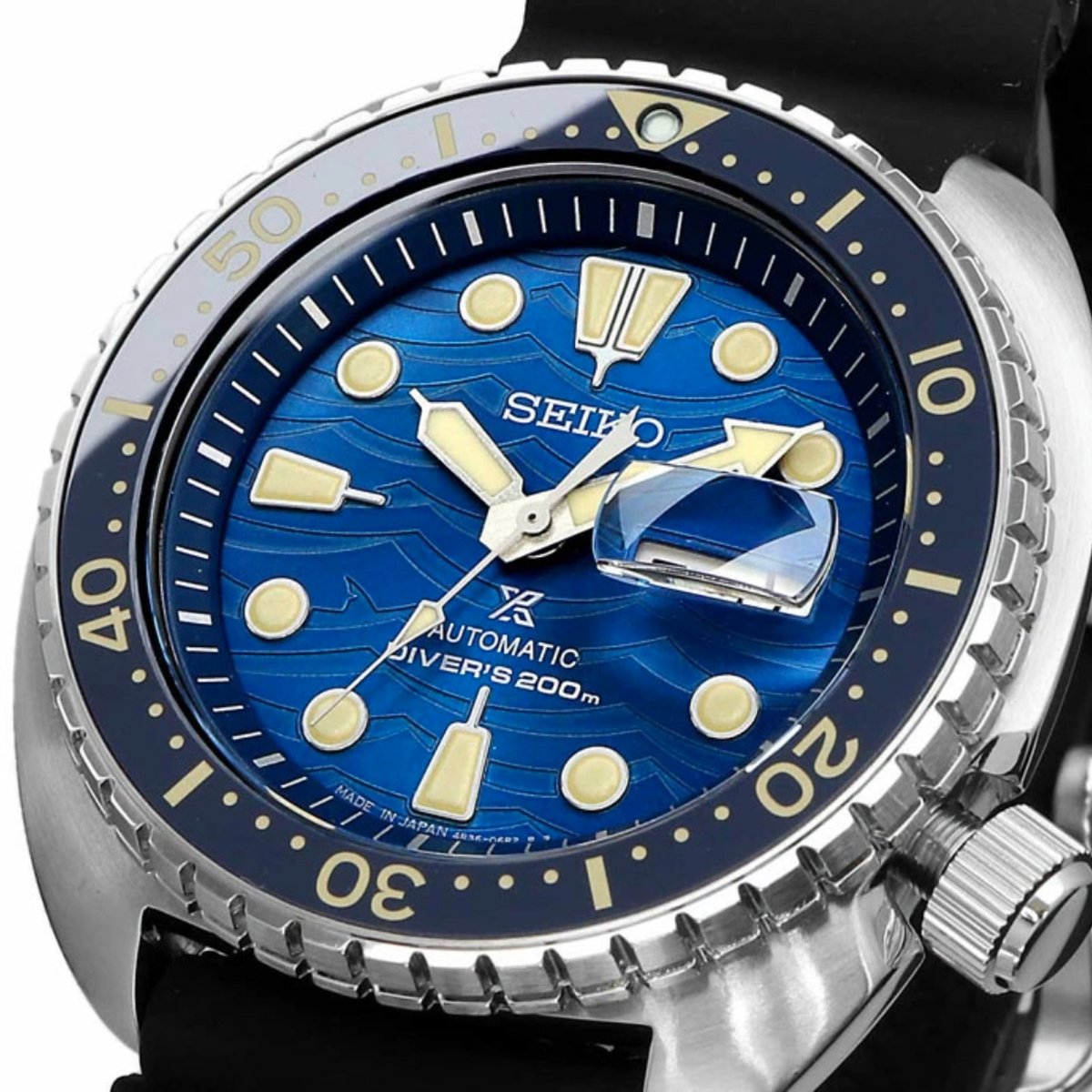
- Crystal: Sapphire – A significant upgrade over the Hardlex mineral crystal found on its predecessor, offering superior scratch resistance and clarity. Many King Turtle variants also feature a cyclops magnifier over the date window, enhancing legibility.
- Water Resistance: 200 meters (660 feet) – ISO 6425 certified, confirming its suitability for professional diving.
- Lume: LumiBrite – Seiko's proprietary luminescent material, renowned for its exceptional brightness and longevity in low-light conditions.
- Bezel: Unidirectional rotating bezel with a ceramic insert – Another key upgrade, offering superior scratch resistance compared to aluminum inserts and a premium tactile feel.
- Bracelet/Strap: Typically offered on a robust stainless steel bracelet with a diver's extension or a comfortable silicone/rubber strap.
- Clasp Type: Deployant clasp with push-button release and security flap on the bracelet, or a sturdy pin buckle on rubber straps.
These specifications collectively paint a picture of a watch engineered for demanding environments, where reliability and material quality are paramount. The inclusion of a sapphire crystal and ceramic bezel insert elevates the King Turtle beyond many competitors in its price bracket, offering features often reserved for higher-tier luxury divers.
On the Wrist: Wearability, Presence, and Real-World Accuracy
Wrist Feel
Despite its substantial 45mm case diameter, the Seiko King Turtle wears remarkably well on a variety of wrist sizes, largely due to its relatively short lug-to-lug measurement of 47.7mm and the ergonomic 'turtle' case shape. The case's curves allow it to hug the wrist comfortably, distributing its weight effectively. On the steel bracelet, it feels solid and substantial, conveying a sense of purpose-built durability without being overly cumbersome. When paired with the factory rubber strap, the watch becomes noticeably lighter and more pliable, enhancing comfort for prolonged wear, especially during water-based activities. The balance is excellent, preventing the watch head from feeling top-heavy, a common issue with larger dive watches. This thoughtful design ensures that the King Turtle, despite its visual bulk, remains a practical and comfortable companion for extended periods.
Accuracy
The Seiko 4R36 movement, while not chronometer-grade, is generally expected to perform within Seiko's stated accuracy range of +45/-35 seconds per day. In real-world scenarios, many owners report better performance, often achieving accuracy within +/- 15-20 seconds per day out of the box. For a tool watch in this price segment, this level of accuracy is entirely acceptable. Consistent wear and proper winding can help maintain optimal performance, and for those seeking higher precision, regulation by a skilled watchmaker is a straightforward process given the movement's widespread availability and design. It's important for collectors to set expectations; this is a reliable workhorse, not a precision observatory chronometer, and its accuracy is more than adequate for its intended purpose.
Occasions and Wrist Presence
The King Turtle is primarily a sport watch, excelling in casual and active settings. Its robust nature makes it an ideal daily wearer, capable of shrugging off the bumps and scrapes of everyday life. It’s a perfect companion for travel, especially to destinations involving water sports or outdoor activities. While its size and tool-watch aesthetic might make it less suitable for formal dress occasions, it can certainly pull off a smart-casual look with confidence. Its wrist presence is undeniable, scoring a 4 out of 5. The substantial case, bold bezel, and highly legible dial with prominent LumiBrite indices ensure it commands attention. It’s a statement of robust utility and purposeful design, signaling a collector who values capability and durability.
Reference Variants & Market Comparisons
Key Reference Variants
The King Turtle series offers a compelling array of aesthetic options, each retaining the core upgrades of sapphire and ceramic. Understanding these variants is crucial for collectors:
- SRPE03K1: The quintessential black dial variant, often considered the benchmark. It features a classic black dial with a black ceramic bezel insert, paired with a robust stainless steel bracelet. This reference offers universal appeal and strong resale liquidity.
- SRPE05K1: A more adventurous green dial variant, often with a textured pattern reminiscent of a turtle's shell. This model typically comes on a matching green rubber strap, offering a sportier aesthetic and excellent comfort.
- SRPF77K1 ('Great White'): A special edition featuring a captivating textured blue dial, designed to evoke ocean waves, often with a subtle shark fin motif. This variant has garnered significant collector interest due to its unique dial and narrative, potentially seeing slightly stronger secondary market performance.
- SBDY079: The Japanese Domestic Market (JDM) equivalent of the SRPE03K1, often distinguished by 'Made in Japan' on the dial, which some collectors prefer.
Family References & Other Notable Models
The King Turtle builds directly upon the legacy of the original 'Turtle' series (e.g., SRP77x), which it largely supersedes in terms of material upgrades. Within the broader Seiko Prospex line, collectors might also consider the more premium 'Sumo' (SBDC1xx) or the increasingly popular 'Captain Willard' reissues (SPB15x), which offer higher-grade movements (6R35) and a more vintage aesthetic at a higher price point. Beyond Prospex, Seiko's vast catalog includes the more accessible Seiko 5 Sports SRPD series, while at the pinnacle, Grand Seiko offers a completely different tier of finishing and precision.
Similar Watches & Homages
When considering alternatives, the market for robust, value-driven dive watches is competitive:
- Orient Kamasu: Offers a sapphire crystal and in-house automatic movement, often at a slightly lower price point, making it a strong contender for sheer value.
- Citizen Promaster Diver NY0040: A classic ISO-certified diver known for its distinctive left-hand crown and robust build, offering a different aesthetic and proven reliability.
- Certina DS Action Diver: A Swiss-made alternative that offers COSC-certified movement options and a higher perceived luxury finish for a modest premium, appealing to those seeking Swiss heritage.
In the realm of homages, brands like Steeldive (e.g., SD1970) produce direct aesthetic copies of the original Seiko Turtle design, offering similar looks at an ultra-affordable price point, typically around $150 USD. While these can satisfy a craving for the aesthetic, they lack the genuine heritage, movement quality, and material integrity of a true Seiko.
Investment Value: A Stable Asset, Not a Speculative Play
For the sophisticated young collector, understanding the investment profile of any watch is crucial. The Seiko King Turtle, while an exceptional tool watch, operates in a segment where significant appreciation is rare. Its MSRP typically hovers around $650 USD, though current retail prices often see discounts, settling around $550 USD. On the pre-owned market, a well-maintained King Turtle can be acquired in the range of $350-$480 USD, depending on the specific reference, condition, and whether it includes the original box and papers.
The trend for the King Turtle is best described as stable. It experiences typical Seiko depreciation from its initial retail price, but once it settles into the secondary market, its value tends to hold relatively steady. This makes it a 'hold' for its intrinsic utility, robust build, and the enjoyment it brings to the wearer, rather than as a vehicle for capital gains. Unlike limited edition Grand Seikos or certain vintage references, the King Turtle is not a speculative investment. Its value lies in its exceptional build quality per dollar, offering a reliable, ISO-certified diver with premium materials at an accessible price point.
There is no major auction history for the King Turtle, as it is a modern, mass-produced model. Its market is driven by retail and secondary sales platforms rather than high-end auctions. Collectors should view the King Turtle as a foundational piece, an entry point into serious mechanical dive watches, or a reliable daily beater that provides immense satisfaction without the pressure of market fluctuations.
Service & Maintenance: Practicality and Longevity
Maintaining the Seiko King Turtle is remarkably straightforward and cost-effective, a significant advantage for budget-conscious collectors. Seiko generally recommends a service interval of approximately 5 years for its automatic movements. The approximate cost for a standard service on a 4R36 movement is around $150-$250 USD, making it one of the most affordable mechanical movements to maintain. Crucially, servicing is not restricted to authorized Seiko service centers. The 4R36 is a widely used and robust movement, meaning most competent independent watchmakers are familiar with its architecture and can perform routine maintenance, including lubrication, regulation, and gasket replacement. This accessibility ensures that your King Turtle can remain a reliable companion for decades, further enhancing its long-term value proposition as a functional tool.
Summary & Final Verdict
The Seiko King Turtle, exemplified by references like the SRPE03K1, offers an incredible blend of heritage, robust engineering, and tangible value. Priced typically in the $450-$700 range, it secures an ISO-certified dive watch equipped with a sapphire crystal and ceramic bezel insert – features that elevate it significantly above many of its direct competitors. This price point represents a judicious investment in a highly capable and durable timepiece that will serve its owner faithfully.
Pros and Cons:
Pros:
- Robust, reliable in-house automatic movement (4R36)
- Sapphire crystal with cyclops for enhanced scratch resistance
- Ceramic bezel insert for durability and premium feel
- Excellent LumiBrite luminescence for low-light visibility
- ISO 6425 compliant 200m water resistance
- Comfortable and ergonomic 'turtle' case design
- Strong value proposition for a feature-rich dive watch
Cons:
- Accuracy of 4R36 movement is not chronometer-grade
- Stock bracelet can feel basic to some collectors
- Larger case diameter may deter those with smaller wrists
- Typical Seiko depreciation means it's not an appreciating asset
- Date magnifier (cyclops) is polarizing aesthetically
Final Verdict:
The Seiko King Turtle is a formidable offering for collectors seeking a genuinely capable and aesthetically refined dive watch without venturing into four-figure territory. Its blend of practical upgrades, robust construction, and undeniable Seiko heritage makes it a compelling choice for daily wear or as a reliable tool. While it won't yield significant returns, its enduring functionality and solid build quality ensure it remains a highly respected and stable asset in any collection. For the sophisticated young collector prioritizing intrinsic value and performance, the King Turtle stands as an intelligent acquisition, a testament to Seiko's enduring commitment to accessible excellence.